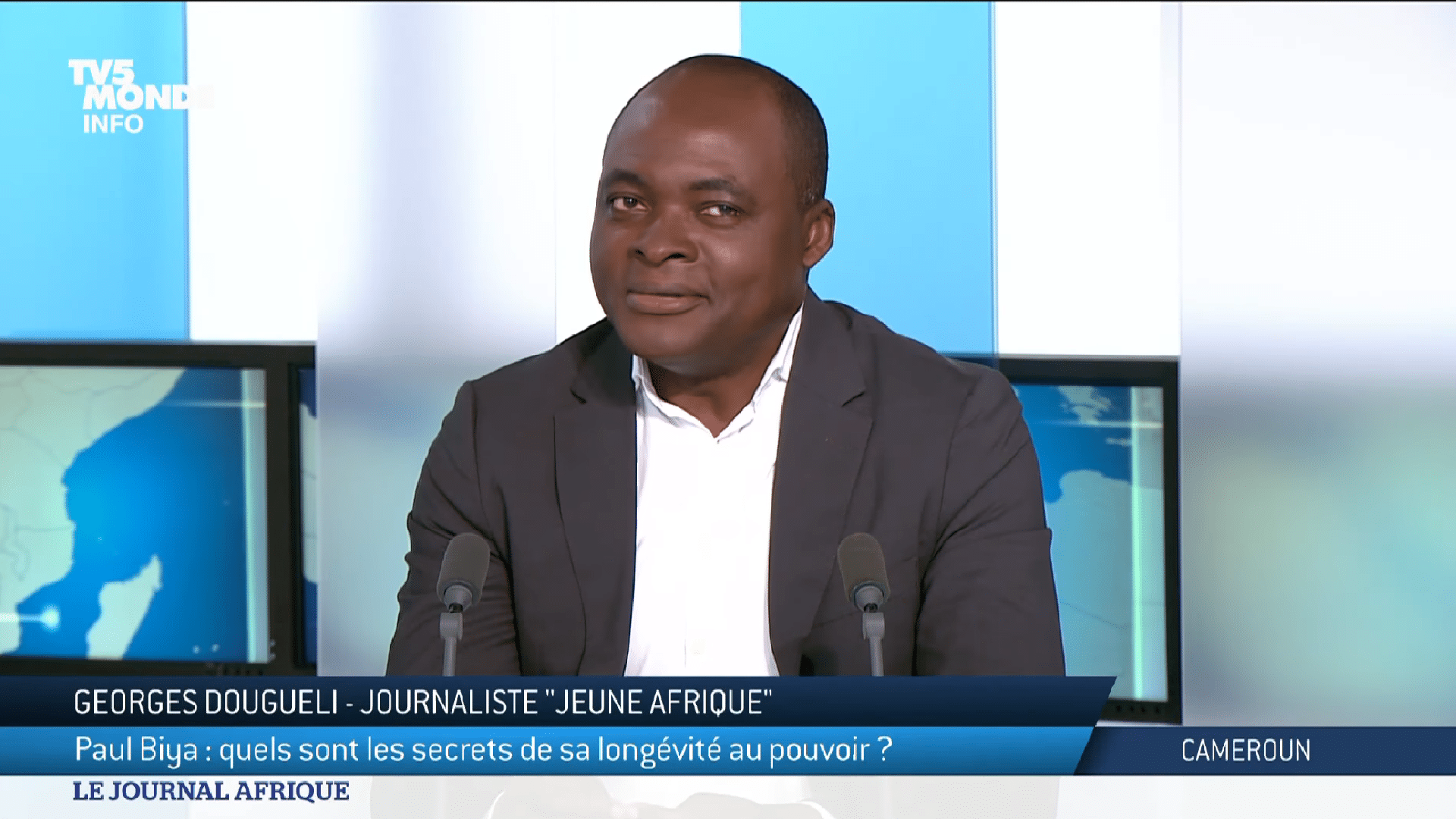
a cameroonian journalist defends the right to probe presidential health, challenges owona nguini’s rhetoric
In a recently published commentary, a prominent journalist addressed the vice-rector of the University of Yaoundé II, emphasizing that a journalist’s role inherently involves informed analysis and, at times, speculation.
Journalist Georges Dougueli underscores that a journalist’s duty includes insightful analysis, particularly concerning the health of national leaders.
Georges Dougueli, a journalist, has issued a sharp retort to Monsieur Owona Nguini, following Nguini’s public statements on June 26th. Nguini’s assertion that “Dougueli speculates on the death of President Biya” prompted a flood of messages to Dougueli, who firmly defended his professional practice.
Dougueli clarified that for genuine journalists, examining the potential mortality of heads of state is an inherent aspect of their work. He emphasized that no subject is off-limits for journalistic inquiry, even revealing that newsrooms occasionally prepare obituaries for prominent figures before their passing. He recalled former French President Mitterrand’s characterization of journalists as “dogs,” a sentiment, Dougueli noted, that seasoned politicians like President Biya would understand. Dougueli’s critique extended to the security sphere zealots Nguini seemingly aims to appease, stating that one cannot adequately chronicle the state’s affairs without scrutinizing the well-being of its leaders. Dougueli then questioned the true audience and intent behind Nguini’s impassioned critique.
1- Targeting “Ekang” Supremacists?
Dougueli suggested that Nguini operates within a political landscape where he recklessly manipulates volatile concepts. Nguini’s repeated declaration, “I am a lord,” might appear as mere megalomania to some, but Dougueli argued it reflects a deeper influence from Laburthe Tolra’s work. Dougueli highlighted Nguini’s role in popularizing and distorting the “Ekang” concept, derived from Mvett mythology. Anthropologist Laburthe Tolra theorized that the Ekangs, or “Lords of the Forest,” migrated from the Nile’s banks to colonize the equatorial forest.
According to Dougueli, Monsieur Owona Nguini’s literal interpretation of this research leads him to believe that this population, which also settled in Gabon, Equatorial Guinea, and Congo, is destined to govern these regions. Dougueli pointed to Gabon, where the Fang people (40% of the population), deeply rooted in Mvett culture through figures like Tsira Ndong Ntoutoume, recognized the peril of such a supremacist “Ekang” narrative. This manifested in the 2009 presidential election with the “TSF” (Tout sauf les Fangs – Anything but the Fangs) sentiment, reflecting a rejection from non-Fang communities. Dougueli asserted that the “Ekang” concept has not successfully crossed Cameroon’s southern border. Drawing a parallel to Karl Schmitt, Dougueli stated that Nguini’s political approach involves identifying an enemy. Previously, it was the “Ntaalibams” of “Tonton Maurika”; now, it is the “Eglisiens,” characterized as “fanatics who will create problems.” Dougueli challenged Nguini to explain the specifics of this alleged threat, concluding that Nguini, with his intellectual-academic agitation and lack of subtlety, is the one poised to create genuine instability.
2- Mobilizing the Ruling Elite Against the “Rabble”
Dougueli questioned the notion that all supporters of Samuel Eto’o, amidst the intense scrutiny he has faced since 2021, are simply “brainless” or paid operatives. He argued that by launching an attack against the “illiterate” head of Fecafoot, his “flock,” his “uncultured fanatics,” and his “cybernetic pack,” Nguini attempts to rally intellectuals against what he portrays as a threat from the lower classes.
Nguini constructs a narrative of “brains” versus “brawn.” Dougueli asserted that Monsieur Owona Nguini and his associated faction aim to label Eto’o as a “cancer” that must be insulted and debased until his “symbolic death.” This symbolic assassination, Dougueli suggested, would perhaps serve to rehabilitate a clan whose public image has been damaged by poor governance, rampant corruption, political crimes, and decadent behavior. Dougueli concluded that this strategy seeks to put the “illiterate” populace back in its place, even if it means stripping them of their sovereignty in the face of monarchical will, through the misuse of “high instructions” falsely elevated to the highest legal authority. He left further detailed analysis of Nguini’s statements to constitutionalists, political scientists, psycho-sociologists, or even psychoanalysts.
Related posts

Real Madrid vs RB Leipzig: Champions League clash triggers fierce reactions and reshapes group dynamics
Aftermath of sharp defeats and rising tensions The upcoming Real Madrid vs RB Leipzig showdown in...
Lille’s Ligue 1 upset against Brest sparks intense post-match reactions and reshapes title race
The shock 0-1 defeat suffered by Lille against Brest in the 7th matchday of Ligue 1...
Moussa Kaka’s disappearance in Niger: one month on, outrage grows and questions mount
More than a month has passed since Moussa Kaka, a towering figure in Niger’s journalism and...