Over the past two decades, the landscape of major public contracts in Senegal has undergone a dramatic transformation. While French conglomerates once held sway over the country’s infrastructure, energy, and banking sectors, their dominance has waned significantly. Today, Chinese firms lead the pack, securing over 30% of public tenders, while French companies account for a mere 5%. This shift reflects a broader global realignment in African economic partnerships.
a new era of infrastructure development
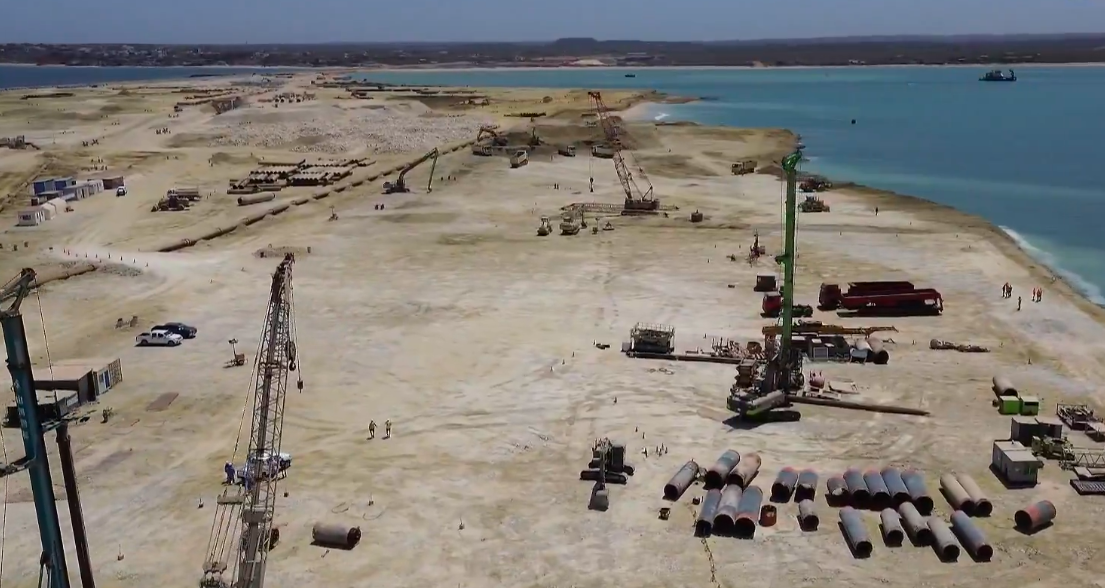
The most striking example of this change is the construction of the Ndayane deep-water port, a $2 billion project designed to accommodate the largest container ships in the Atlantic. Spearheaded by the Emirati firm DP World, the construction consortium is primarily composed of Chinese companies. Despite fierce competition from global players, including several French firms, the Chinese-led bid emerged victorious. As David Gruar, DP World’s project director, noted, “We had companies from around the world competing, including many from France, but ultimately, they did not win.”
The financial edge was decisive. The Chinese consortium’s offer was approximately 20% lower than the bid submitted by Eiffage, a major French construction group. This underscored a critical challenge faced by Western firms: balancing quality with affordability in a market increasingly dominated by cost-competitive Asian competitors.
Just a short distance from Ndayane, the Diamniadio new city project near Dakar tells a similar story. Here, Turkish companies have secured the majority of contracts for the stadium, railway station, hotels, and residential buildings. The industrial zone, designed to attract foreign investors, is another case in point. “Over there, we have a Tunisian company. To the right, a Chinese one,” explained Bohoum Sow, Secretary-General of the APROSI association, who admitted he was unaware of any French companies operating in the area.
why chinese firms are winning the race
According to Sow, Chinese companies have demonstrated a deeper understanding of Senegal’s economic and social needs. One notable example is a Chinese-built cardboard packaging factory where technicians are training local workers. “This is an industry that did not exist before,” Sow remarked. “They identified a specific need and delivered a solution that is both flexible and efficient.”
China’s strategic investment in Africa over the past 20 years has positioned it as a key economic partner on the continent. As Sow put it, “The times have changed, and so have the partners.” He emphasized that this shift is a win-win scenario: “Senegal needs infrastructure, and China understands that. It’s real collaboration.”
While French firms like Ragni have managed to secure contracts by adapting to local demands—such as deploying a Senegalese-led team to implement 36,000 solar streetlights—their market share remains limited. Proparco’s representative in Senegal, Caroline Richard, acknowledged that French companies can still compete, but only if they embrace flexibility, local partnerships, and competitive pricing. “French firms are highly competitive when standards are high,” she said. “There are significant opportunities here for job creation and growth.”
the future of french-senegalese partnerships
The changing dynamics in Senegal’s infrastructure sector highlight a broader trend across Africa. While Chinese, Turkish, Emirati, and Tunisian firms increasingly dominate large-scale projects, French companies are adapting by focusing on niche markets, sustainability, and high-value services. However, to regain their foothold, they must align their strategies with the evolving needs of the market—balancing cost, innovation, and local integration.
As one project manager put it, “The new model requires flexibility, local engagement, and a willingness to compete on price. Those who can deliver will find opportunities, but the landscape is no longer what it once was.”