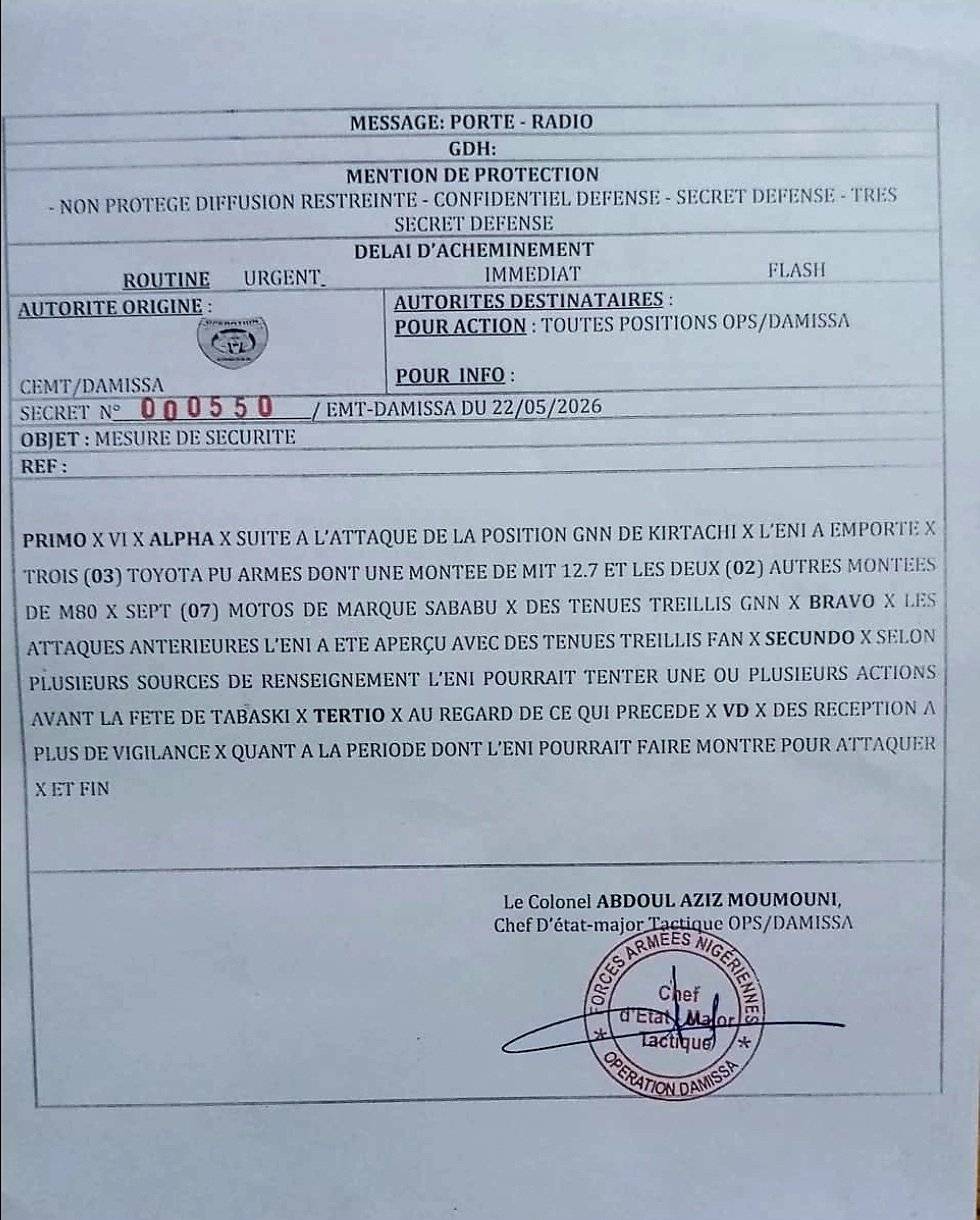
Following the brutal assault on Niger’s National Guard (GNN) in Kirtachi, located within the Tillabéri region, an internal radio message dated May 22, 2026, has lifted the veil on the true extent of losses suffered by the Defense and Security Forces (FDS). This official military document, marked as «secret défense», confirms the significant arsenal and strategic equipment that fell into the hands of terrorists from the Group for the Support of Islam and Muslims (JNIM). Amidst a particularly heavy human toll and the looming specter of infiltrations as Tabaski approaches, Nigerien forces are confronting a major Niger security challenge.
the implications of a critical leak
In the ongoing asymmetric conflict gripping Niger, official assessments often present an incomplete picture. However, an internal radio message, intercepted and reviewed on Friday, May 22, 2026, has broken through the standard regulatory silence. Originating from the highest echelons of the military hierarchy, this classified document meticulously details the operational setbacks experienced by the National Guard of Niger detachment in Kirtachi, a strategic locality situated in the volatile “three borders” zone.
The disclosure of this technical note provides a precise measure of the logistical impact resulting from the assault. Moving beyond typical social media speculation, this high-level staff document presents a rigorous inventory that has caused profound concern among the command overseeing national operations.
an alarming inventory of seized arsenal and logistics
The true shockwave generated by this document stems from the detailed list of military equipment seized by JNIM. The assailants executed a thorough logistical raid, stripping the detachment of its crucial mobility and firepower capabilities.
According to the internal radio communication, the enemy successfully captured three armed Toyota pick-up vehicles, all combat-ready. Among these vehicles, one was notably mounted with a formidable 12.7 mm heavy machine gun, known for its high rate of fire and devastating effect against ground troops, while the other two were equipped with M80 type machine guns. The attackers also gained possession of seven Sababu brand motorcycles, lightweight and robust vehicles perfectly suited for swift, hit-and-run operations across the Sahelian terrain.
Even more concerning for the integrity of future operations, the document highlights the theft of several GNN camouflage uniforms. This appropriation of official military attire immediately raises the risk of infiltration attacks, where terrorists could impersonate Nigerien soldiers to bypass checkpoints and deceive security forces.
a growing human tragedy
This material disaster compounds a human tragedy whose official count remains profoundly painful. The intense clashes in Kirtachi claimed the lives of 12 FDS personnel, who valiantly fell in the line of duty while attempting to repel the invasion.
Beyond the loss of life, the secret document also mentions the disappearance of four additional Nigerien soldiers, who are now officially listed as abducted. The fate of these military hostages remains uncertain, as JNIM frequently utilizes prisoners of war as bargaining chips or as tools for propaganda disseminated through its media channels. This dual crisis starkly illustrates the severe pressure exerted by non-state armed groups across the Tillabéri region.
maximum alert as tabaski draws near
In response to the gravity of the situation and the recovery of such strategic equipment, the military command reacted immediately. The confidential dispatch dated May 22, 2026, issued an urgent call for heightened vigilance across all operational positions throughout Niger.
Military analysts fear that JNIM will swiftly exploit this newly acquired cache to launch further large-scale operations. The timing is particularly critical as the Tabaski festival approaches. This period of intense religious observance and significant population movements historically presents a window of vulnerability that terrorist groups have often sought to exploit to make a profound impact.
The Kirtachi attack and the revelations from this «secret défense» document unequivocally underscore the intricate and severe nature of Niger’s ongoing security crisis. By seizing armed pick-up trucks, heavy machine guns, and official uniforms, JNIM has temporarily bolstered its operational capacity for harm and its mobility within the vital “three borders” zone. For the Nigerien army, the challenge is now twofold: to ensure the safety of its citizens in the run-up to the Tabaski celebrations and to urgently adapt its ground tactics to counter an adversary now equipped with its own captured weapons.