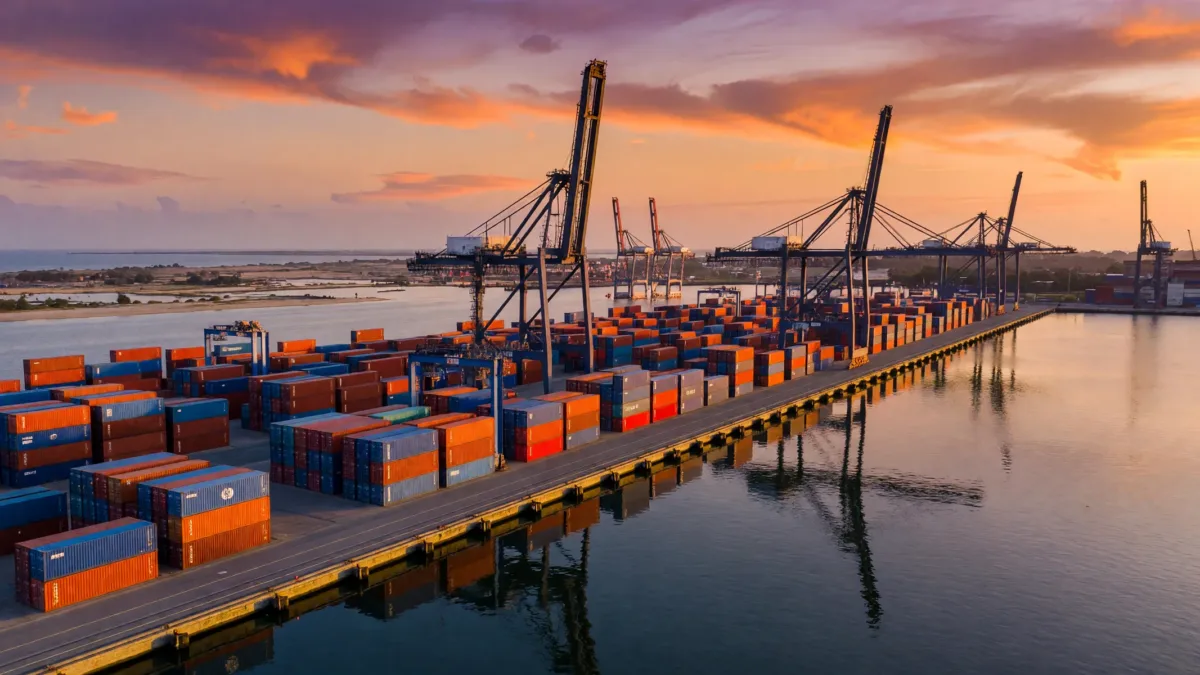
The Port of Abidjan has deepened its economic ties with Ouagadougou, Bamako and Niamey, reinforcing its position as a key logistics hub in West Africa. This strategic move comes as the port continues to serve as a vital gateway for landlocked Sahel nations despite recent geopolitical realignments.
Record throughput drives port expansion
In 2025, the Port of Abidjan achieved a 16% surge in total cargo volume, underscoring its enduring role in facilitating trade for Burkina Faso, Mali and Niger—three countries with no direct maritime access. This milestone has cemented its status as West Africa’s leading Francophone port, surpassing Lomé and Cotonou.
The port’s leadership has prioritized infrastructure upgrades to handle rising demand, slashing vessel turnaround times through expanded capacity and streamlined operations.
New multimodal corridor boosts Bamako trade
Earlier this year, Africa Global Logistics launched a multimodal trade corridor linking Abidjan to Bamako via the inland port of Bobo-Dioulasso in Burkina Faso. This route combines road and rail transport to accelerate goods movement to Mali.
The Burkinabè government has allocated nearly 200 billion CFA francs in its 2026 budget to upgrade the critical Ouagadougou–Bobo-Dioulasso highway, aiming to cut transit delays and reduce logistics costs for Mali and Burkina Faso traders.
Digital customs reform speeds up Sahel trade flows
On 31 March, Côte d’Ivoire eliminated physical customs visas for goods transiting to Burkina Faso and Mali. The change coincides with the rollout of the SIGMAT digital system, now integrated with Burkina Faso’s customs authorities to enhance clearance efficiency and transparency.
This digital shift allows businesses to submit declarations online, minimizing border bottlenecks and accelerating trade flows. It forms part of a broader modernization drive to position Abidjan as a competitive alternative to Bénin and Togo’s port networks serving the Sahel.
Côte d’Ivoire’s economic lever: Ports as growth engines
Côte d’Ivoire, the largest economy in the West African Economic and Monetary Union, is banking on its port infrastructure to sustain its regional trade dominance. The country operates two major ports: Abidjan, the primary hub for containerized cargo and Sahel-bound transit, and San Pedro, focused on cocoa and timber exports.
In April, the Dutch government pledged 196 billion CFA francs to upgrade San Pedro and Abidjan’s port facilities. Meanwhile, the Belgian group Sea Invest has announced fresh investments targeting a combined throughput capacity of 11 million tonnes annually by 2026.
Sahel nations rely on Atlantic access despite political shifts
The landlocked trio of Burkina Faso, Mali and Niger remains critically dependent on West African coastal ports for essential imports, including fuel, foodstuffs and machinery. Although these countries withdrew from ECOWAS in early 2024, the Port of Abidjan is actively countering trade disruption risks by enhancing efficiency, tariff competitiveness and procedural agility.
The port’s leadership is confident that these measures will preserve Abidjan’s attractiveness, even as regional dynamics evolve and neighboring ports in Bénin and Togo vie for Sahel trade dominance.