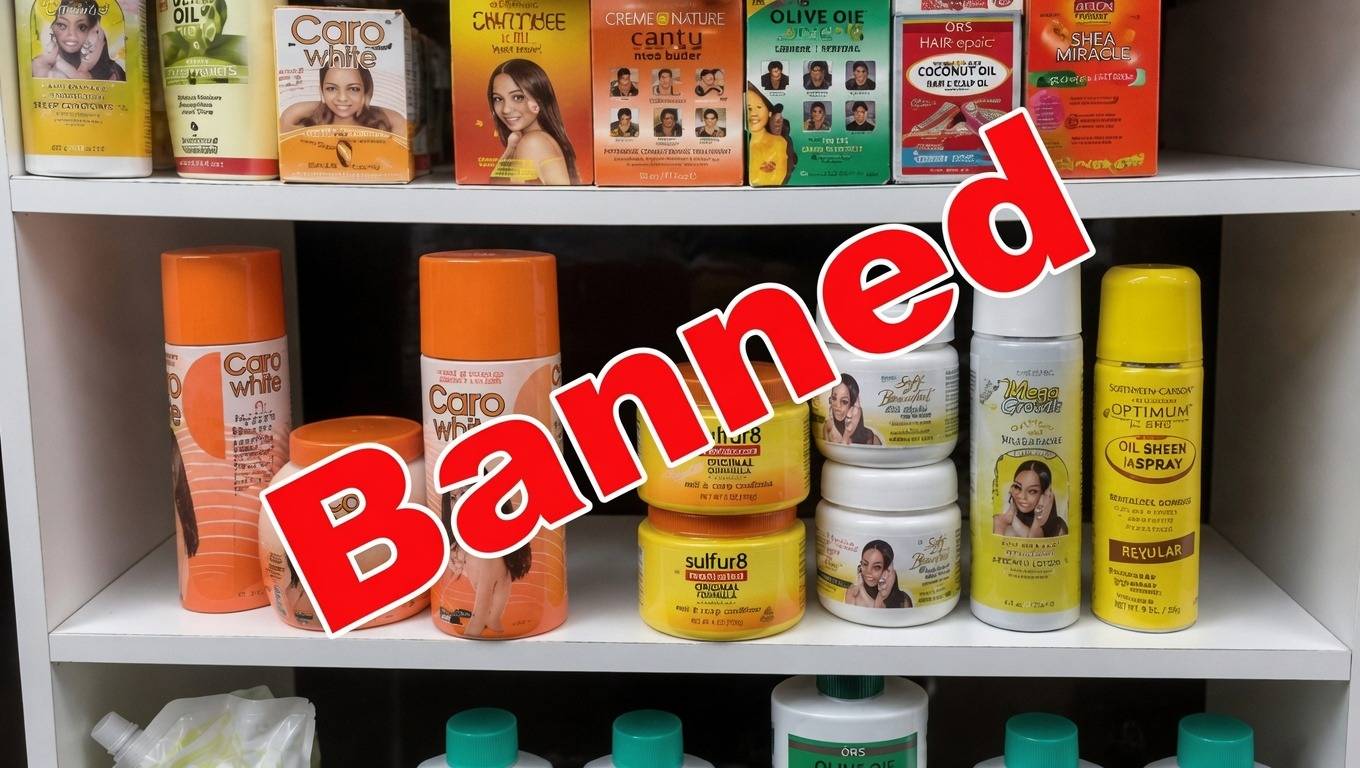
The government of Bénin has initiated a direct offensive against the market for skin-lightening products. Effective May 5th, numerous creams, lotions, and other substances designed to lighten skin tone are officially prohibited from sale across the entire national territory. This robust measure targets a pervasive practice whose health consequences are increasingly alarming authorities.
Halting the ‘tchatcho’ phenomenon
In Bénin, the use of skin-lightening products, locally known as ‘tchatcho’, affects a significant portion of the population, irrespective of social standing. These items were previously readily available, from the bustling stalls of Dantokpa market to online boutiques on social media platforms.
Through this new regulatory framework, authorities aim to curtail this widespread proliferation. The Ministry of Health, in conjunction with pharmaceutical regulatory bodies, has compiled a definitive list of products deemed hazardous. Enhanced inspections are now mandated, encompassing both wholesalers and smaller retailers.
The objective is unequivocal: to dismantle the supply networks of a particularly lucrative trade, which is frequently sustained by contraband and unregulated artisanal preparations whose composition remains entirely unchecked.
Escalating health concerns
The state’s decision to adopt a stricter stance stems from numerous warnings issued over several years by health professionals. Dermatologists, in particular, have consistently cautioned against the devastating effects of artificial depigmentation.
The prohibited products commonly contain potentially dangerous substances such as hydroquinone, potent corticosteroids, or mercury. When used repeatedly, these components can lead to significant skin fragility and sometimes irreversible complications.
In the short term, users face risks including burns, deep stretch marks, extreme skin thinning, impaired wound healing, and recurrent cutaneous infections.
However, the repercussions extend beyond the epidermis. Upon absorption into the body, these substances can contribute to the onset of severe conditions such as chronic kidney failure, arterial hypertension, certain metabolic disorders, and an elevated risk of skin cancers.
A challenge beyond mere enforcement
While the medical community commends this prohibition, its implementation promises to be intricate. Authorities must contend with permeable borders, the circulation of illicit goods, and the resourcefulness of vendors who frequently alter packaging to evade controls.
Beyond punitive measures, the true challenge is also cultural. The allure of lighter skin, fueled by specific beauty standards and persistent social pressures, continues to drive demand.
For this policy to yield lasting effects, it must therefore be complemented by extensive public awareness campaigns aimed at promoting natural complexions and deconstructing stereotypes associated with skin color.
By embarking on this struggle, Bénin marks a significant advancement in public health protection. The question now remains whether the authorities’ resolve and evolving societal attitudes will succeed in permanently curbing the ‘tchatcho’ phenomenon.