In the face of intensifying terrorist assaults across the Sahel region, Abidjan has unequivocally reaffirmed the critical need for a unified front. Given the pressing security imperative, Captain Ibrahim Traoré is urged to prioritize pragmatism and foster collaboration with the Ivorian state to effectively contain a menace that transcends national borders.
Across West Africa, the moment has passed for diplomatic disagreements and ideological posturing; the paramount concern is now collective survival. As armed terrorist groups continue their relentless advance, inflicting profound sorrow upon the Sahel and imperiling coastal nations, Ivory Coast has issued a clear appeal to its neighboring states, Mali and Burkina Faso.
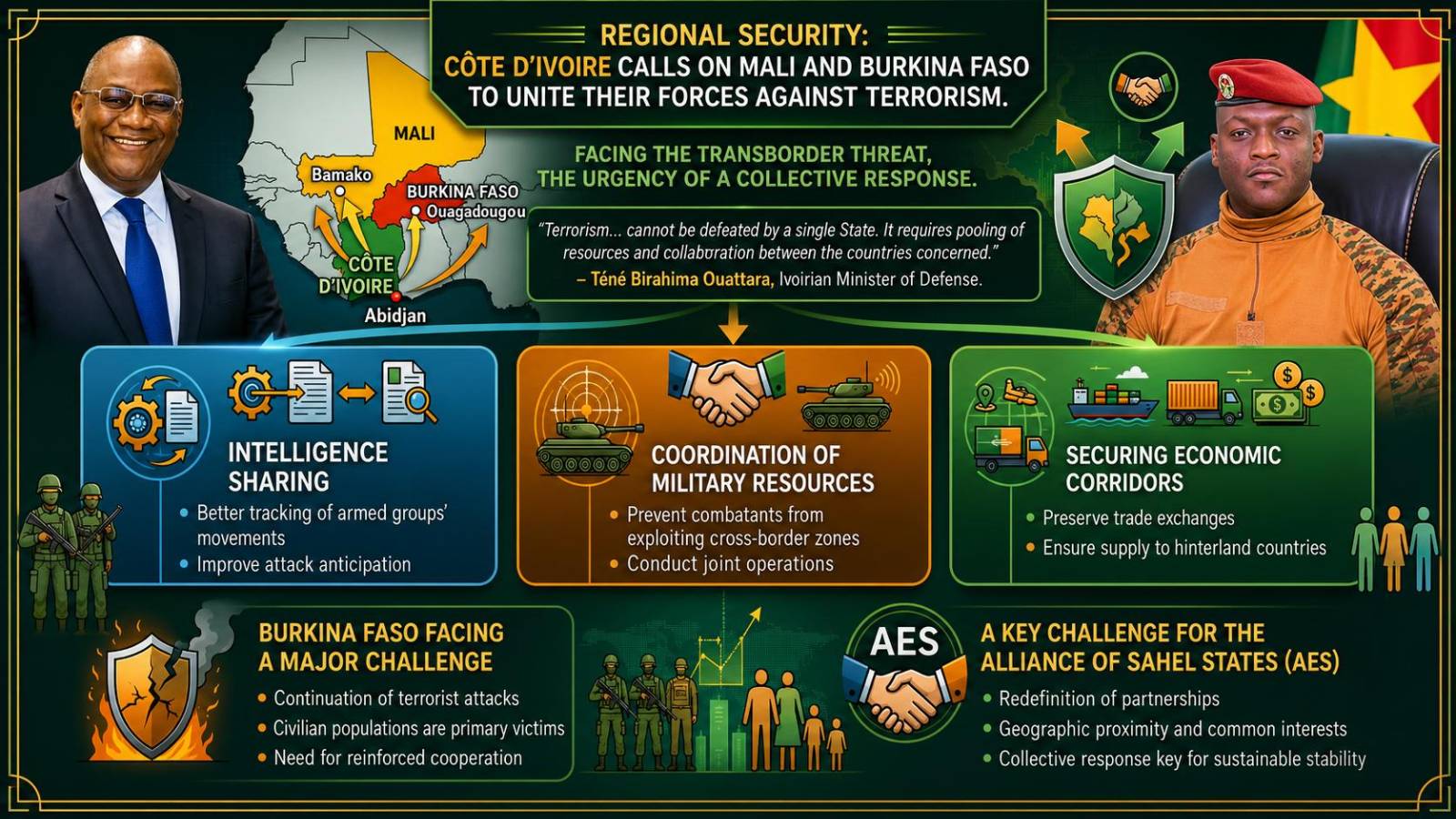
The Ivorian Minister of Defense, Téné Birahima Ouattara, articulated the situation with stark realism:
« Terrorism, in its current manifestation, cannot be vanquished by a single state. It necessitates the mutualization of resources and robust collaboration among all affected countries. »
This overture serves as a poignant reminder of the prevailing realities for Ouagadougou.
Burkina Faso at a critical juncture
Despite persistent rhetoric emphasizing national sovereignty and extensive domestic mobilization efforts, it is evident that Burkina Faso continues to struggle in its containment of the multifaceted terrorist threat. Attacks are proliferating, control over territory remains tenuous, and civilian populations are bearing a disproportionately heavy cost. For Captain Ibrahim Traoré, the transitional president of Burkina Faso, the current circumstances demand a pivotal decision.
According to various regional analysts, the enduring nature of the threat should compel the young leader to set aside political tensions and personal considerations, committing fully to this communal dynamic. The safety and security of his populace now hinge upon a decisive break from strategic isolation.
Pillars of Abidjan’s proposed cooperation
Ivory Coast, benefiting from relative stability and substantial logistical capabilities, has put forth a framework for collaboration founded on three principal tenets:
- Intelligence Sharing: To meticulously track the movements of jihadist groups along porous border regions.
- Resource Mutualization: To coordinate cross-border military operations, thereby preventing terrorists from seeking sanctuary on either side of the frontier.
- Securing Economic Corridors: To ensure the uninterrupted flow of essential goods vital to the economies of landlocked nations.
A test of political maturity for the AES
This gesture of cooperation from Ivory Coast represents a significant test for the Alliance of Sahel States (AES). While Mali and Burkina Faso have opted to recalibrate their international partnerships, geographical realities remain immutable. Ivory Coast persists as an inherent and indispensable regional ally.
For Captain Ibrahim Traoré, embracing collaboration with the Ivorian state would not signify a concession of weakness, but rather an act of profound political maturity and a demonstration of responsibility towards his constituents. Against an asymmetric and highly mobile adversary, division portends dire consequences; only a concerted and unified response will facilitate the restoration of peace within the sub-region.