From rhetoric to reality: the paradox of sovereignty in Burkina Faso
In Ouagadougou, the official discourse champions a narrative of “reclaimed sovereignty,” yet the actions of the transitional authorities tell a different story. While the government restricts local initiatives and non-governmental organizations from aiding the most vulnerable citizens under the guise of regulating humanitarian assistance, it simultaneously extends an open hand to Moscow for emergency food supplies. The recent visit by Russia’s Foreign Minister laid bare the stark contradictions of this so-called “cooperation.”
A transaction of unequal partners
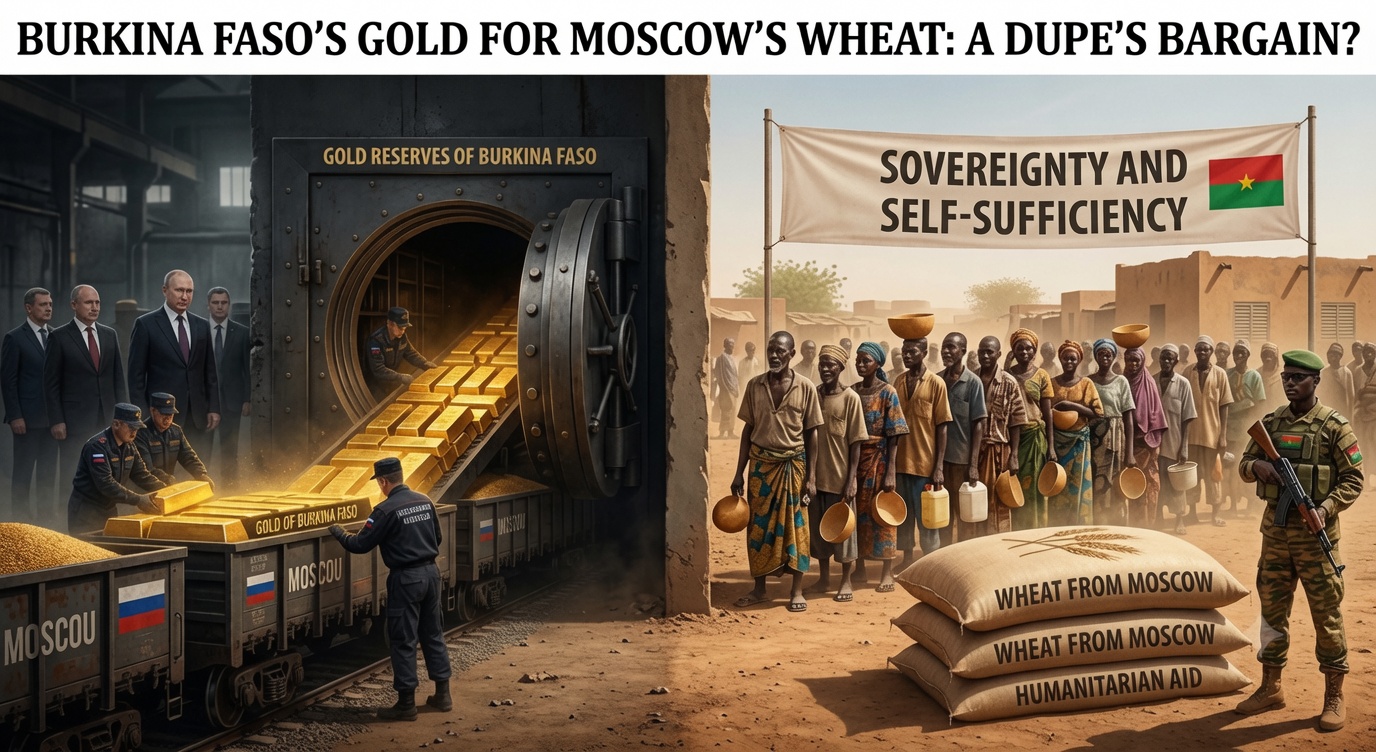
During closed-door discussions, the Kremlin’s envoy endorsed Burkina Faso’s decision to transfer and store its national gold reserves in Moscow. The move is being framed as a strategic partnership, yet it reveals a troubling pattern of dependency. For a government that has built its legitimacy on rejecting neocolonial influences and proclaiming total economic independence, entrusting its gold reserves to Russia resembles less a bold assertion of sovereignty than a Faustian bargain.
Food aid vs. self-sufficiency: the hollow promise of sovereignty
Despite repeated pledges to achieve food self-sufficiency, Burkina Faso continues to rely on external wheat shipments to avert hunger. This dependence not only undermines the credibility of its economic sovereignty claims but also exposes a fundamental flaw: a nation cannot claim true autonomy when its ability to feed its people hinges on the benevolence of a foreign power. The irony deepens when one considers that Burkina Faso is one of West Africa’s top gold producers—a resource that could, in theory, finance irrigation systems, agricultural subsidies, and food storage infrastructure.
Humanitarian aid: a tool of control or compassion?
The government’s insistence on monopolizing aid distribution raises serious concerns. By obstructing grassroots initiatives and local organizations from delivering assistance, authorities risk not only slowing relief efforts in insecure areas but also transforming food aid into a political instrument. In regions where state presence is weak or absent, independent humanitarian actors often fill critical gaps. Restricting their role could leave vulnerable populations more exposed—and more dependent on centralized, state-controlled aid networks.
The human cost of a misplaced priority
Ordinary Burkinabè are repeatedly called upon to make sacrifices in the name of national resilience, security, and state reconstruction. Yet the daily reality for many remains unchanged: persistent food insecurity, continued displacement due to conflict, and an economy still propped up by foreign assistance. Can a sovereignty that depends on shipments of Russian wheat truly be considered sovereign? How can a nation claim dignity when its survival is contingent on the goodwill of a foreign patron to whom it has handed the keys to its treasure?
What sovereignty really means
The true measure of a nation’s independence lies not in its diplomatic alliances, but in its capacity to protect, nourish, and empower its people. Burkina Faso’s gold may now rest in Moscow, but the real question is whether this exchange will translate into lasting food security, stronger institutions, or improved living conditions for its citizens. If the goal is to break free from external domination, then trading one dependency for another—especially one rooted in survival rather than development—falls far short of the ideal. The captain of the transition may have changed the guardian, but the people remain hungry, and the promise of genuine sovereignty remains unfulfilled.
Until Burkina Faso’s wealth is used to build resilient food systems, support local farmers, and ensure that no citizen goes to bed hungry, its declarations of independence will ring hollow. Sovereignty is not achieved by swapping one foreign patron for another; it is earned by ensuring that the nation’s resources serve the needs of its people—not the ambitions of its rulers.