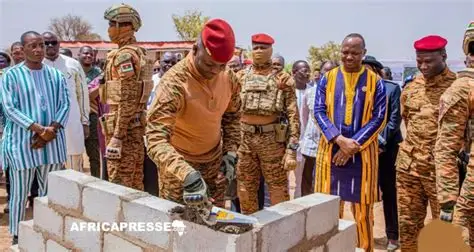
The captain ibrahim traoré’s administration has recently intensified its public relations efforts, showcasing newly inaugurated industrial projects across burkina faso. From tomato processing plants to gold refining units, these developments are presented as milestones on the nation’s path to economic emergence. Yet, beneath the polished media coverage, the country grapples with escalating security and economic challenges that propaganda alone cannot conceal.
the illusion of progress through grand projects
In a predictable tactic employed by governments seeking legitimacy, burkina faso’s transitional leadership has adopted a strategy of “major works” to project an image of resilience. By highlighting local job creation and economic sovereignty, the administration aims to counter the narrative of dependency on western partners and regional instability.
Proponents of the regime frame each groundbreaking ceremony as a triumph against neocolonialism. However, economic analysts view these high-profile announcements not as part of a structured development plan, but as a desperate attempt to maintain public confidence amid crumbling foundations.
unverified industrial projects and financial opacity
Investigations into the touted industrial ventures often reveal glaring inconsistencies. While ribbon-cutting ceremonies draw attention, critical details—such as actual funding sources, operational viability, and long-term production capabilities—remain shrouded in secrecy.
Allegations of financial impropriety surrounding patriotically mobilized funds further erode trust. Questions persist about the allocation of resources designated for both national security and industrial development. As traditional private enterprises struggle under heavy taxation and persistent insecurity, the emergence of politically connected entities raises serious concerns about the fairness and transparency of procurement processes.
the harsh reality behind the propaganda
The stark contrast between state-sanctioned narratives and the lived experiences of burkinabè citizens is undeniable. As the government celebrates industrial milestones, ordinary citizens face an increasingly dire economic situation.
- Rising cost of living: Essential goods like rice, cooking oil, and millet have become prohibitively expensive, pushing vulnerable populations to the brink of survival.
- Humanitarian crisis: With over two million internally displaced persons, burkina faso is experiencing one of the most severe humanitarian emergencies in its history. Entire villages remain under terrorist blockades, reliant on unreliable humanitarian aid convoys.
- Stagnant informal economy: The backbone of burkina faso’s economy—its informal sector—is in freefall. Frequent power outages and the perilous state of major roads have crippled trade, leaving local markets in disarray.
perception vs. reality: the limits of state propaganda
The carefully curated image of a burkina faso on the rise serves primarily to stifle dissent and foster a fragile sense of optimism. Yet, no amount of polished media content can substitute for tangible improvements in people’s lives.
Food security cannot be achieved if farmlands are inaccessible due to insurgent activity. Economic sovereignty cannot be claimed if newly inaugurated factories exist only as visual props for television broadcasts. The captain ibrahim traoré administration is gambling heavily on shaping public perception, risking a dangerous disconnect from the harsh realities endured by its people.
While industrialization remains a commendable long-term goal, its success hinges on two critical prerequisites: uncompromising financial transparency and effective territorial security. Without these, the much-celebrated industrial projects risk becoming mere illusions—shimmering mirages in the sahelian landscape, offering no real substance to a nation in need.