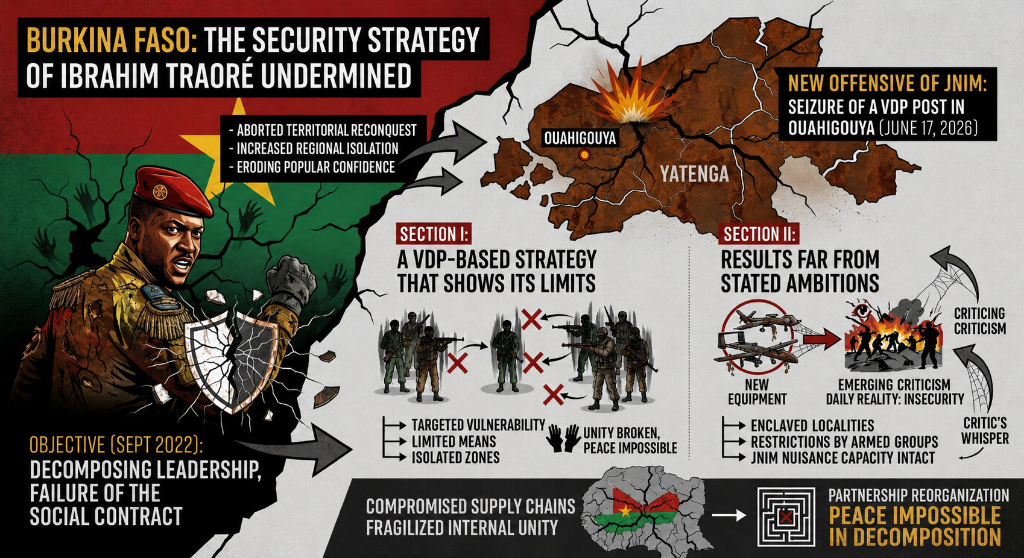
The security landscape across Burkina Faso continues its concerning trajectory of deterioration. The Jama’at Nusrat al-Islam wal Muslimeen (JNIM), an entity aligned with Al-Qaeda in the Sahelian region, has asserted responsibility for an assault on June 17, 2026, which resulted in the capture of a position held by the Volunteers for the Defense of the Homeland (VDP) within the Ouahigouya area, the principal urban center of Yatenga province in the country’s northern reaches.
This latest offensive represents an additional setback for the transitional government’s stated strategy of territorial reclamation. Captain Ibrahim Traoré, who assumed leadership in September 2022 with a commitment to re-establishing national integrity, now confronts escalating scrutiny regarding the efficacy of his chosen security paradigm.
A VDP-centric strategy revealing its inherent limitations
In an effort to address the personnel deficiencies within the conventional armed forces, the authorities have placed considerable reliance on the Volunteers for the Defense of the Homeland. However, these civilian formations, frequently deployed in remote locales and operating with constrained resources, have increasingly become prime targets for hostile armed factions.
The incident in Ouahigouya contributes to a succession of reversals observed over recent months. Notwithstanding ongoing military operations, the sustained security of numerous positions continues to pose significant challenges. Numerous experts specializing in the Sahel region contend that JNIM maintains substantial disruptive capabilities and considerable operational latitude across the Northern and Eastern territories.
Outcomes diverging significantly from declared aspirations
The transitional government frequently highlights advancements and the procurement of advanced equipment, including surveillance and combat drones. Nevertheless, for a segment of the populace, pervasive insecurity remains a daily lived experience. Numerous communities endure isolation, and specific areas continue to be subjected to constraints imposed by armed entities.
Within this environment, critical assessments of the current security policy are surfacing. The fundamental justification initially cited for the 2022 overthrow of civilian rule – namely, the failure to guarantee civilian protection – has now re-emerged as a central focus of public discourse.
As Ouagadougou proceeds with realigning its alliances within the Confederation of Sahel States (AES) and plans to escalate its operational tempo throughout 2026, the Yatenga assault serves as a stark reminder of the inherent complexities in definitively resolving an asymmetric conflict through military means alone.