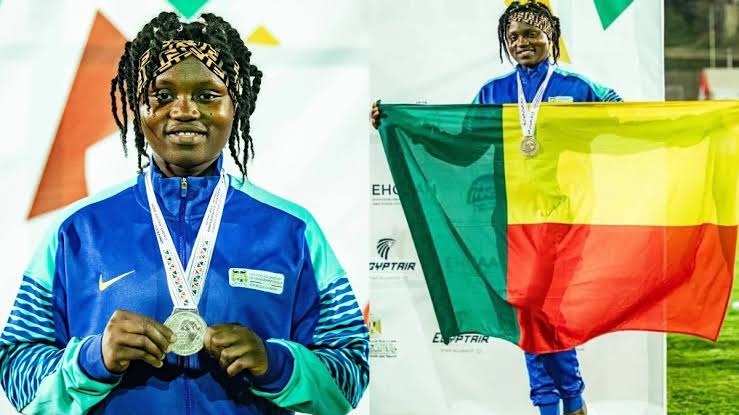
As the 12th African University Games unfolded in Cairo this September, one name dominated discussions beyond Benin’s borders: Brigitte Tchede. The Porto-Novo native not only secured the West African nation’s first medals of the 2026 edition but also delivered performances that transcended mere podium finishes, signaling a potential inflection point for university-level athletics across the continent.
Why Tchede’s double medal haul at Cairo 2026 matters for Benin
Benin arrived at the African University Games with modest expectations but left with two silver medals—both claimed by Brigitte Tchede. Her achievements in two distinct disciplines underscored her versatility while spotlighting the untapped potential within Benin’s university sports ecosystem. More than a personal triumph, her results offer a blueprint for how targeted development could reshape competitive athletics in the country.
The significance of her performance becomes clearer when examined against the backdrop of recent competitions. Her personal best in the women’s discus throw—47.08 meters—represented a dramatic leap of 2.71 meters from her previous mark (44.37 meters), set at the African Athletics Championships in Accra earlier this year. Such incremental yet decisive improvements in elite sports are often the difference between obscurity and recognition in regional and continental circuits.
From Accra’s track to Cairo’s podium: Tchede’s rising trajectory
Brigitte Tchede’s journey from Accra’s continental stage to Cairo’s university Games was not one of overnight success but of methodical progress. Her performance in Ghana already hinted at a talent on the rise; in Egypt, she translated that potential into tangible results. The 2.71-meter improvement in her discus throw wasn’t just a statistical gain—it reflected months of targeted training, technical refinement, and mental preparation under pressure.
This upward curve is particularly critical in sports like discus, where marginal gains often determine podium placements. Tchede’s ability to elevate her performance in high-stakes environments suggests she is not only meeting the demands of elite competition but is also positioning herself to challenge Africa’s best in the near future.
A second medal underscores her all-around excellence
While the discus throw captured headlines, Brigitte Tchede’s silver medal in a second discipline reinforced her reputation as Benin’s most consistent athletic prospect at Cairo 2026. This dual success carries implications beyond individual accolades: it demonstrates that Benin’s athletes can compete—and triumph—in multiple disciplines when given the right support structures and competitive exposure.
The dual podium finish also sent a powerful message to Benin’s sporting authorities: investing in university-level athletes can yield rapid and measurable dividends. Such results could catalyze efforts to expand grassroots programs, enhance coaching infrastructure, and create pathways for student-athletes to transition smoothly from collegiate to elite competition.
Cairo 2026 as a springboard for Benin’s athletic future
The African University Games are often seen as stepping stones for emerging talents, but Brigitte Tchede’s breakthrough shows they can also serve as launchpads. Her performances in Cairo have not only elevated her personal standing but have also provided concrete proof that Benin’s athletes are capable of competing at the highest levels of university sports in Africa.
More importantly, her results could inspire a new generation of young Beninese athletes to pursue athletics with renewed ambition. The visibility she gained—both domestically and across the continent—highlights the role of university sports in talent identification and development. For a country like Benin, where Olympic-level success remains rare, such stories are invaluable in shifting the narrative and fostering a culture of sporting excellence.
The road ahead: can Cairo 2026 be a turning point for Benin’s athletics?
With two silver medals already secured, Benin’s focus now shifts to building on this momentum. Brigitte Tchede’s record-breaking performance sets a new benchmark, one that future athletes will strive to surpass. For the Béninoise federation and local sports bodies, the challenge lies in leveraging this success to attract investment, improve training facilities, and create a sustainable pipeline for emerging talents.
The question now facing Benin is whether Cairo 2026 can mark the beginning of a sustained rise in university and elite athletics. If Brigitte Tchede’s trajectory is any indication, the answer may lie in continued support, strategic planning, and a commitment to nurturing the next generation of Beninese champions.