The distance between official statements and what is actually happening on the ground can be hard to reconcile. That gap became evident after the Group for the Support of Islam and Muslims (JNIM) announced on the morning of Wednesday, September 16, 2026, that it had captured two positions held by Volunteers for the Defense of the Homeland (VDP) in Mahrou and Winten, both situated in Bam Province. Multiple sources reported the claim, but no independent confirmation has verified that JNIM truly controls those areas.
That lack of verification is precisely where the real scrutiny begins.
For months, the government of Ibrahim Traoré has made the expansion of Burkina Faso’s defense manufacturing a centerpiece of its public messaging. Officials have repeatedly emphasized domestic production and assembly of equipment for the armed forces, framing it as a matter of national sovereignty and reduced dependence on foreign suppliers. Industrial progress is routinely presented as a flagship policy achievement.
But on the battlefield, an armored vehicle does not win conflicts simply because it is celebrated as an industrial success.
It must absorb impacts, protect its crew, keep moving under fire, and—most importantly—help hold ground.
That is the live-fire test.
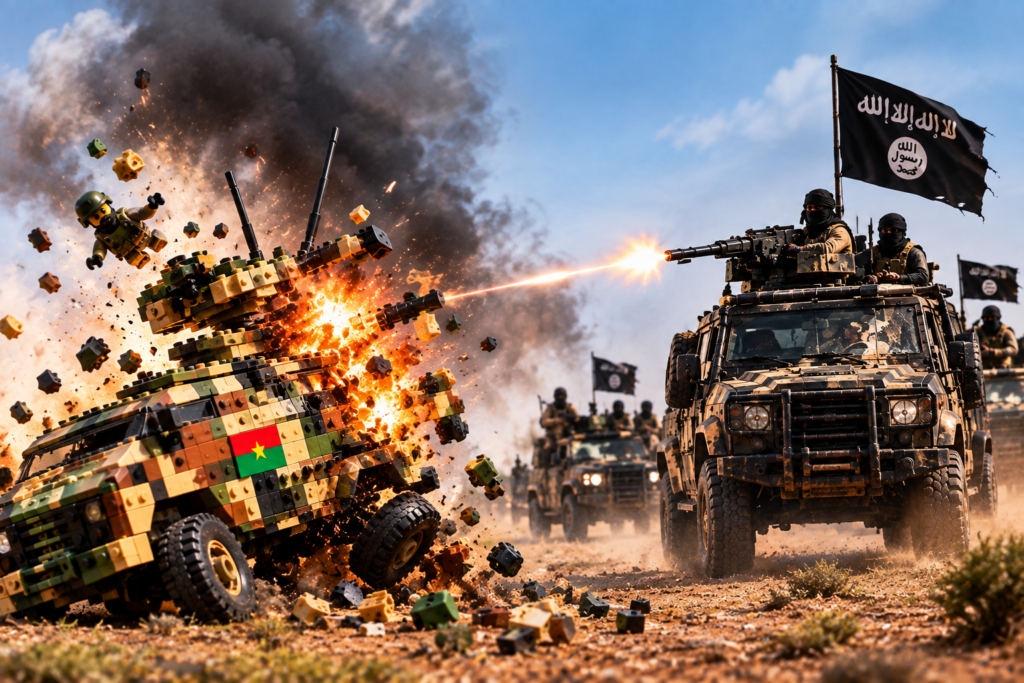
After the official rollouts and carefully staged photographs, the moment has come for these much-touted armored vehicles to move from the display stand to the front lines. And here, with a touch of irony, some observers might ask whether these are not armored vehicles assembled like Lego bricks: put together, exhibited, applauded… and then the field determines whether they truly last.
The comparison is mocking, certainly. But beneath the sarcasm lies a wholly serious question: what is the actual performance of this equipment when confronted with the operational realities of northern Burkina Faso?
The growing number of attacked positions serves as a reminder of a far less flattering reality than industrial slogans suggest: having equipment, even locally made, does not guarantee lasting territorial control.
On August 19, JNIM had already claimed responsibility for seizing several VDP positions, including in Séguénéga and Bourzanga. Recent assessments have also highlighted the difficulties Burkina Faso’s forces face in maintaining control over certain zones that had previously been retaken or secured.
The true benchmark, then, will not be the number of vehicles paraded before cameras, nor the rhetoric about industrial sovereignty.
It will be how they perform when actually under fire.
In Mahrou and Winten, if JNIM’s claim is confirmed, the battlefield will have delivered a particularly uncomfortable signal: between building an armored vehicle, showcasing it, and proving its operational effectiveness, there lies a vast gulf.
And that gulf cannot be measured in speeches.
It is measured in kilometers of territory actually held, positions defended, and soldiers brought home alive.