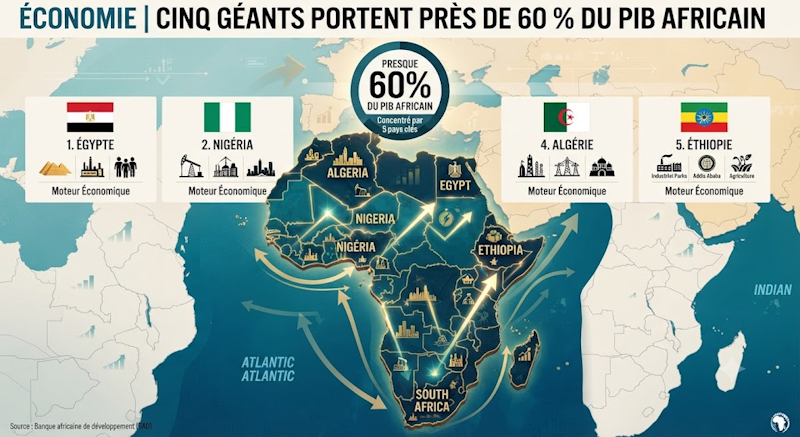
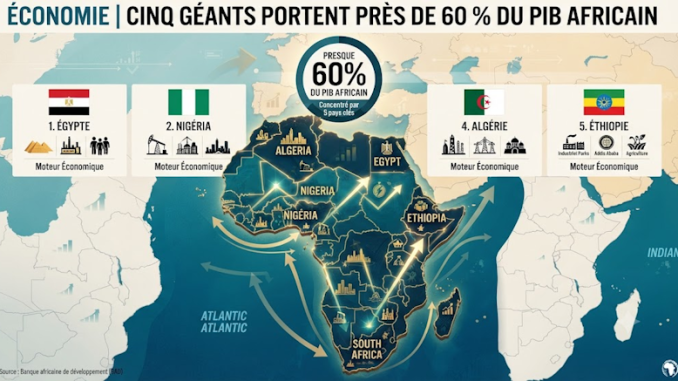
Across the African continent, a recent economic assessment highlights a striking concentration of wealth, with just five nations collectively generating nearly 60% of the total Gross Domestic Product (GDP). These key players, namely Egypt, Nigeria, South Africa, Algeria, and Ethiopia, stand out as the primary drivers of Africa’s economic landscape.
This significant concentration underscores the pivotal influence these economies wield over continental growth. Their strategic importance in Africa’s economic development is attributed to abundant natural resources, expansive domestic markets, robust industrial capabilities, and substantial investments in critical infrastructure.
Egypt and Nigeria lead with their vast populations and increasingly diversified economic structures. South Africa maintains its position as the continent’s foremost industrial and financial hub. Algeria leverages its rich energy reserves and a strategic public investment policy to fuel its expansion. Meanwhile, Ethiopia continues its impressive ascent, propelled by rapid industrialization and ambitious infrastructure projects.
However, this concentration of GDP also brings into sharp focus the existing economic disparities among African nations. While these five countries act as the continent’s economic locomotives, many other states grapple with significant hurdles in areas such as industrialization, economic diversification, securing adequate financing, and creating sufficient employment opportunities.
Economic analysts emphasize that a crucial objective for the coming years will be to cultivate more equitable growth across the continent, ensuring that all African economies can benefit from the momentum generated by these regional powerhouses.