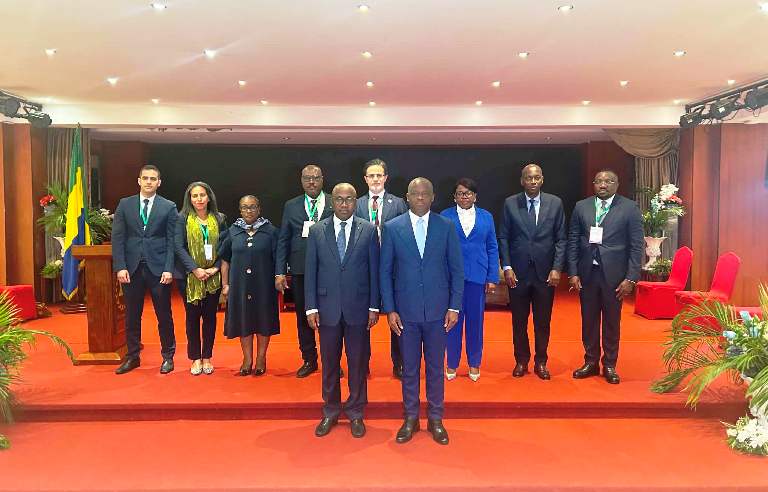
In Libreville, Government Vice-President Hermann Immongault officially commenced the nation’s assessment mission on Monday, June 29, 2026. This marked the start of the direct dialogue for the second review cycle of the United Nations Convention against Corruption (UNCAC) implementation mechanism. For four days, this significant gathering will bring together technical experts from various government administrations, specialists from the United Nations Office on Drugs and Crime (UNODC), and international partners. Their collective aim is to assess Gabon’s advancements in preventing and combating corruption effectively.
Gabon, having adhered to the United Nations Convention against Corruption since October 1, 2007, is committed to solidifying its ongoing reforms. These initiatives are designed to enhance transparency, foster accountability in public administration, and improve the governance of its institutions.
During the official opening of the proceedings, Vice-President Immongault underscored that the fight against corruption serves as a vital catalyst for economic and social development.
“Public integrity boosts the performance of government actions, secures investments, strengthens economic competitiveness, and establishes the conditions for sustainable, inclusive, and equitable development,” he stated emphatically.
This conviction resonates deeply with all stakeholders actively involved in this evaluation process. Séraphin Ondoumba, who serves as the UNODC focal point and a commissioner for the National Commission for the Fight Against Corruption and Illicit Enrichment (CNLCEI), emphasized that this dialogue transcends mere technical discussions.
“I remain confident that this direct dialogue will not only allow for a better appreciation of our country’s efforts but also further strengthen cooperation among State Parties and promote best practices in corruption prevention and combat,” Mr. Ondoumba affirmed.
This mission represents a pivotal phase in the Convention’s second review cycle, which focuses primarily on preventive measures and the recovery of assets derived from corruption.
Mohamed Cherbal, the UNODC Mission Head, explained, “Throughout this week, the review team will deepen its analysis of Gabon’s anti-corruption frameworks, with particular emphasis on implementing the Convention’s provisions related to preventive measures and asset recovery.”
Scheduled from June 29 to July 1, 2026, this new evaluation builds upon the foundation of the first review cycle, which commenced in 2010. During that initial phase, Gabon’s adherence to Chapters III and IV of the Convention—pertaining to criminalization, law enforcement, and international cooperation—was assessed. That process notably included an evaluation visit conducted by experts from Sierra Leone and the Lao People’s Democratic Republic between April 21 and 23, 2015.
Today, the expectations for this current dialogue are equally substantial. Nestor Mbou, President of the CNLCEI, views this engagement as a prime opportunity for continuous enhancement of public policies.
“The direct dialogue commencing today signifies an essential step in the review process. It’s not merely about evaluating a legal or institutional framework; it’s also about identifying effective practices, acknowledging progress, assessing remaining challenges, and exploring avenues for improvement that can lead to concrete recommendations to accelerate the implementation of our strategy,” he declared.
The findings of this mission, it is anticipated, will guide future reforms and further reinforce national mechanisms for preventing, controlling, and recovering illicit assets, ultimately aiming to build a more transparent, efficient, and accountable administration for the citizens.