- Home
- Debates and analysis
- Mali jihadist coalition offensive threatens Bamako’s grip on power
Mali jihadist coalition offensive threatens Bamako’s grip on power


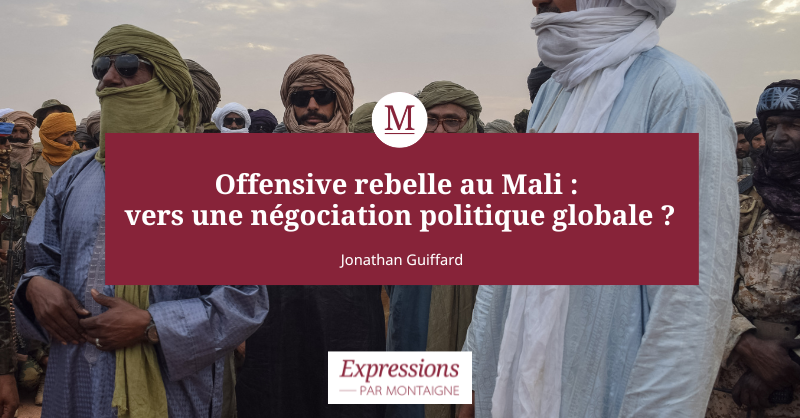
The Malian junta led by Assimi Goïta, allied with Russian forces, faces unprecedented pressure following a coordinated offensive on April 25 by jihadists from the JNIM (Al-Qaeda affiliate) and separatists from the Azawad Liberation Front (FLA). Northern Mali now risks falling into rebel hands, echoing the 2012 crisis—though key differences remain. Western military intervention appears unlikely, but what are the rebels’ true objectives? How will Russia react? And how should European nations prepare for the rise of a new jihadist proto-state?
The April 25 offensive marked a turning point in Mali’s security crisis, as the JNIM and FLA launched a rare joint operation targeting Bamako, Kidal, Gao, Sévaré, and Mopti. This unprecedented collaboration signals a shift from sporadic coordination to a full-fledged military partnership, with rebels striking deep into government-held territory. Unlike past offensives, this one directly threatens the Malian capital while targeting Russian-backed forces in the north.
What sets this offensive apart from the 2012 takeover? And what short-term outcomes can be expected?
Current context: the boldest offensive in years
On April 25, 2026, the JNIM and FLA launched a sweeping assault on five strategic Malian cities, including Bamako and key northern hubs like Kidal and Gao. This marks the first time since 2012 that the two groups have coordinated a large-scale offensive, abandoning their previous ad-hoc cooperation in favor of sustained military partnership. Their strategy focused on crippling government and Russian positions, with Bamako’s Kati military district and airport among the targets.
A preliminary assessment reveals the following developments:
- Northern cities have fallen under rebel control. Kidal, along with Tessalit, Anéfis, Ber, Bourem, Gourma-Rharous, Léré, Intahaka, and Tessit, now lie in rebel hands, encircling Gao and Tombouctou. While some Russian-backed Malian bases remain, the rebels’ advance has reshaped the security map.
- Junta leaders have been directly hit. Defense Minister General Sadio Camara was killed, and Security Agency chief General Modibo Koné was wounded. President Assimi Goïta reportedly fled to the Turkish embassy before resurfacing publicly with Russian officials on April 28.
- Rumors of a coup attempt by General Malick Diaw have circulated, though unverified. One certainty remains: the junta’s command structure has been severely disrupted by the assault.
Key differences from 2012 include:
- A unified rebel-jihadist messaging strategy. Unlike past operations, the JNIM has allowed FLA leaders to take public credit. While Iyad Ag Ghali and Hamadoun Kouffa remain in the shadows, JNIM’s Sidan Ag Hitta appeared in Tessalit.
- Negotiated withdrawals over violent confrontation. The JNIM and FLA have opted for negotiated surrenders with Malian troops, offering safe passage in exchange for disarmament—a tactic absent in 2012’s brutal takeover.
- Russian mercenaries negotiated out of northern bases. Reports suggest Algeria may have mediated talks, enabling Russian forces to withdraw peacefully from Kidal and other northern strongholds—mirroring tactics used in Syria.
- A two-pronged strategy targeting Bamako and central Mali. The offensive stretched Malian forces thin, stretching the junta’s resources across multiple fronts.
Russian mercenaries negotiated withdrawals from northern bases, avoiding direct conflict—a strategy reminiscent of Syrian operations.
This offensive underscores a calculated shift by the rebels. Rather than seeking visible territorial control, the JNIM and FLA are strangling Bamako and the junta through blockades and psychological pressure. By April 28, the JNIM had imposed a total blockade on the capital, burning supply trucks to signal resolve while the junta scrambled to secure dwindling convoys.
Unlike 2012-2013, the Malian regime and its Russian allies have not collapsed. Instead, they’ve launched counteroffensives, conducting sweep operations in central regions. Civil society voices, including politician Oumar Mariko and former minister Mamadou Ismaïla Konaté, have renewed calls for negotiations, criticizing the junta’s reliance on military force alone. The Islamic State’s Sahel Province (EIWS) also attempted to exploit the chaos by attacking Ménaka, but was repelled by Russian-backed Malian forces.
An anticipated crisis
As early as September 2022, analysts warned that Russian military support in Mali was ill-suited to counter jihadist threats, predicting its counterproductive effects. The Wagner Group’s presence, ostensibly to bolster security, has instead alienated civilians and failed to stem the JNIM’s expansion. Our January 2023 foresight exercise outlined three likely scenarios:
- Escalating tensions between the CMA and FAMa/Wagner forces would reignite northern clashes, with the CMA aligning with the JNIM to seize control of the Niger River loop and northern Mali.
- Central Mali’s fragmentation would fuel inter-communal conflicts, with the Macina Katibat (JNIM affiliate) clashing with self-defense militias.
- The capital would face encirclement, though full occupation remains unlikely unless the army collapses entirely.
- Loss of northern Mali would trigger political upheaval, forcing the junta to negotiate with the JNIM—potentially ceding territory or accepting constitutional changes.
By November 2023, after Malian and Russian forces briefly retook Kidal, we cautioned that the victory was fleeting. The CMA had strategically withdrawn, preparing for a future counteroffensive—a prediction confirmed by the recent rebel advances. These developments confirm that Mali’s crisis was foreseeable, raising critical questions about its likely evolution.
Short-term prospects: a slow-motion collapse?
Militarily, the JNIM-FLA coalition is poised to negotiate the withdrawal of Russian forces from the north before targeting Gao and Tombouctou, effectively partitioning Mali as in 2012. Desertions among Malian troops, already rampant, may accelerate under the dual pressure of military defeat and negotiated surrenders. If Russian forces withdraw from northern strongholds, the rebels’ control over the Niger River loop and Gao-Tombouctou corridor could become irreversible.
The rebels’ progress may hinge on their ability to neutralize Malian and Burkinabé drones, including the TB2 models. While the JNIM could target Malian airfields with kamikaze drones, Burkinabé and Nigerien drones pose a harder challenge. Northern Mali’s fall appears imminent, but the rebels’ long-term governance plans remain ambiguous.
The FLA seeks de facto autonomy for Azawad without outright independence, while the JNIM appears willing to temper its harshest Islamic law provisions. This pragmatic shift reduces the risk of a 2012-style jihadist takeover, where AQMI and allies imposed violent rule. After AQMI’s defeat in 2013, its leaders advocated for a softer expansion model focused on preaching and limited sharia enforcement.
Controlling northern Mali would position the rebels strategically but also expose them to two new fronts: the Islamic State’s Sahel Province in Ménaka and potential air incursions by Malian, Burkinabé, and Nigerien forces. The JNIM’s growing presence in central Mali suggests further attacks on Malian garrisons in Gossi, Boni, Hombori, and other key cities. Unlike 2012, the rebels may avoid direct city control, instead focusing on breaking Malian military formations.
Civilian reprisals, such as the recent attacks on Kori-Kori and Gomossogou, risk undermining the rebels’ narrative as protectors of the people. The JNIM’s fragmented command structure remains a critical vulnerability.
The fate of central and southern Mali is harder to predict. The JNIM has long controlled rural areas, negotiating Islamic law enforcement with local communities—a tactic reminiscent of Viet Cong or Taliban strategies. However, unlike the Taliban, the JNIM lacks the troop numbers to sustain large-scale territorial control. If northern Mali’s fall triggers a recruitment surge, as it did in 2012-2013, the JNIM could rapidly expand its influence.
The siege of Bamako is a deliberate strategy to asphyxiate the junta, forcing either regime change or forced negotiations.
The capital’s blockade exemplifies the rebels’ long-game strategy. By choking off supply routes and isolating the junta, they aim to either topple Assimi Goïta’s regime or compel negotiations. The recent deaths of key junta figures—Sadio Camara and Modibo Koné—have already weakened the regime’s cohesion. Tensions between Goïta and his Russian backers, exacerbated by recent defeats, could further destabilize the alliance.
Despite propaganda claims, the junta’s inability to repel the offensive exposes its fragility. Goïta’s evacuation to Turkey and reappearance with Russian officials underscore the regime’s desperation. The Russian partnership, once a cornerstone of the junta’s survival, now faces scrutiny. Without Russian support, Bamako’s security could unravel, leaving the junta reliant on Burkina Faso and Niger—both of which are stretched thin by their own insurgencies. Senegal may secure its borders but is unlikely to deploy troops amid its own jihadist threats. Algeria, Mauritania, Guinea, and Côte d’Ivoire are likely to observe from the sidelines, privately welcoming the junta’s humiliation while pushing for negotiations.
Looking ahead, three critical dynamics emerge:
- Northern Mali’s fall is inevitable. The rebels’ momentum, combined with Malian troop desertions and Russian withdrawals, makes this outcome highly likely.
- The Russian partnership is unsustainable. Recent events confirm that Wagner’s presence has failed to curb jihadist expansion and may even have worsened it.
- Negotiations or external intervention are the only viable paths. A negotiated settlement could involve autonomy for northern regions and limited Islamic law enforcement, but the JNIM’s ties to Al-Qaeda complicate its legitimacy. External intervention, whether regional or international, remains unlikely due to logistical and political barriers.
What lies ahead for Mali and the international community?
Two primary scenarios could unfold:
Scenario 1: External military intervention
What happens when jihadists hoist their black flags over a major Malian city? In the past, such a provocation would have triggered Western military intervention.
The rebels’ advance forces a reckoning: what should the international community do when the JNIM establishes control over a Malian city? Historically, such events prompted Western interventions in Afghanistan, Iraq, and Syria. But post-2022, the withdrawal from the Sahel and Afghanistan has reshaped the calculus. Is another Barkhane-style operation feasible or desirable?
Regionally, only Algeria possesses the capacity to reverse the rebels’ gains—but its non-intervention doctrine and pragmatic ties to jihadist groups make such action unlikely. Mauritania’s 2010 non-aggression pact with AQMI and the JNIM further complicates regional responses. Other West African armies have struggled against jihadists, leaving them focused on defensive postures.
An international intervention remains the only theoretical option, but it faces insurmountable hurdles. France and the UN are unlikely to return, while European nations lack the political will to act alone. The U.S. is preoccupied with other conflicts. Thus, negotiations emerge as the most plausible path forward.
Scenario 2: A comprehensive political negotiation
The JNIM has signaled since 2025 its desire to replicate the Hay’at Tahrir al-Sham (HTS) model in Syria: nationalizing its struggle, moderating its governance, and engaging with the international community. Algeria or Mauritania could serve as patrons, leveraging their ties to the FLA and JNIM while opposing the Bamako junta. The rebels may seek a governance model inspired by Mauritania’s Islamic legal framework, blending pragmatism with sharia enforcement.
However, critical obstacles remain. Unlike HTS, the JNIM has not severed its allegiance to Al-Qaeda, and it has not engaged in formal negotiations with Western powers. Its goal of exporting jihadist rule beyond Mali’s borders further complicates its legitimacy as a negotiating partner. Without pressure from Russia, Turkey, or African states (e.g., Togo, Ghana), the junta is unlikely to concede. Civil society calls for dialogue, including from figures like Oumar Mariko and Mahmoud Dicko, may grow louder, but the junta’s repression since 2020 has silenced most dissent.
Negotiations would require discussions with both the FLA (building on the Algiers Accords) and the JNIM (drawing from local agreements with the High Islamic Council of Mali). The rebels’ blockade of Bamako could force the junta’s hand, but without external pressure, the stalemate is likely to persist. Until then, the strangulation strategy will continue, with captured cities serving as launching pads for further attacks.
The rise of a jihadist proto-state in Mali will demand vigilance akin to Syria and Afghanistan.
For European nations, the long-term implications of a Malian jihadist proto-state cannot be ignored. While the JNIM and FLA may moderate their tactics, the specter of external jihadist threats—akin to Syria or Afghanistan—looms large. Containing this risk will require coordinated efforts with regional and Arab partners to monitor and normalize these actors within the international framework.
Related posts

Real Madrid vs RB Leipzig: Champions League clash triggers fierce reactions and reshapes group dynamics
Aftermath of sharp defeats and rising tensions The upcoming Real Madrid vs RB Leipzig showdown in...
Lille’s Ligue 1 upset against Brest sparks intense post-match reactions and reshapes title race
The shock 0-1 defeat suffered by Lille against Brest in the 7th matchday of Ligue 1...
Moussa Kaka’s disappearance in Niger: one month on, outrage grows and questions mount
More than a month has passed since Moussa Kaka, a towering figure in Niger’s journalism and...