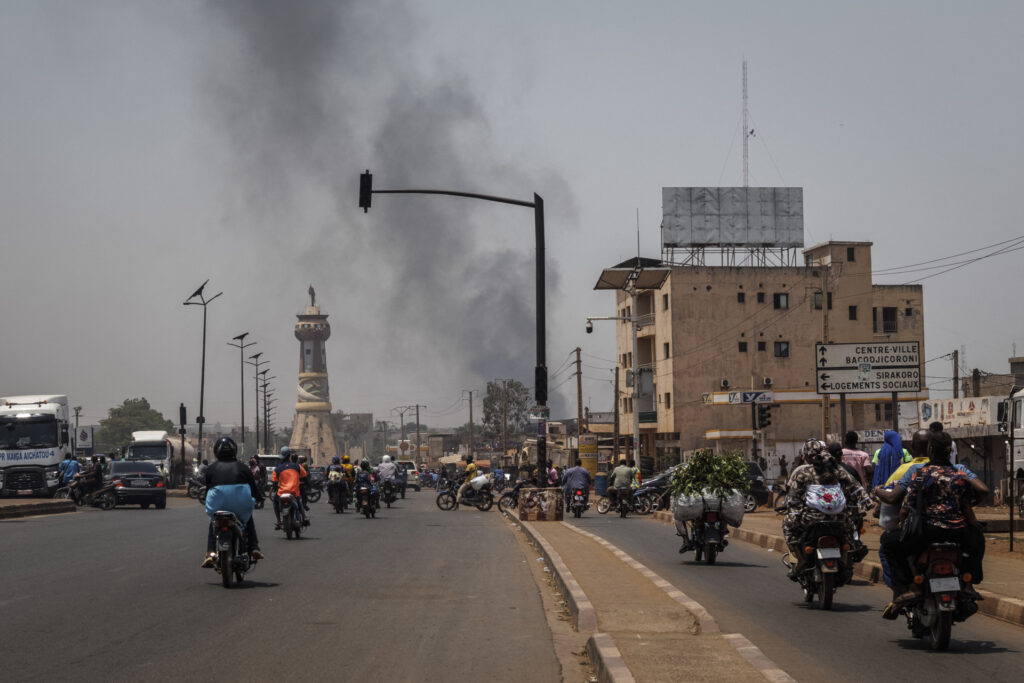
TOPSHOT - A column of black smoke rises above buildings as traffic passes the Africa Tower monument in Bamako on April 26, 2026. April 25, 2026's shock attacks, synchronised by Tuareg rebels of the Azawad Liberation Front (FLA) coalition and the jihadist Group for the Support of Islam and Muslims (JNIM), targeted several areas in the vast arid country. Fighting resumed on April 26 in several areas, including Kita near Bamako, Kidal, Gao and Severe. Tuareg rebels meanwhile announced an agreement allowing Russian forces backing Mali's army to withdraw from the northern city of Kidal, which they claimed was "totally" under their control. (Photo by AFP via Getty Images)
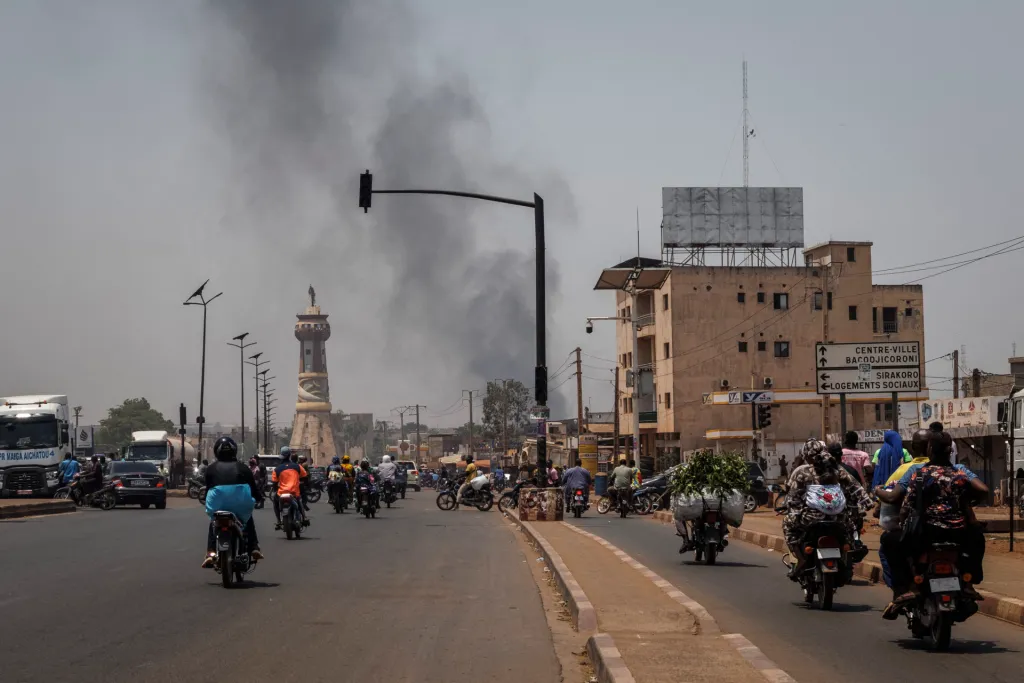
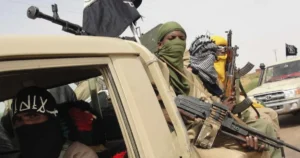
In the early hours of April 25, the peace of Kati—a military stronghold located just 15 kilometers from Mali’s capital, Bamako—was shattered by heavy gunfire and blasts. This marked the beginning of a massive, nationwide operation claimed by a rare partnership between the jihadist group JNIM (Jama’at Nusrat al-Islam wal-Muslimin) and the Tuareg separatist FLA (Front de Libération de l’Azawad). By the following day, the military government confirmed that Defense Minister Sadio Camara had died from wounds received during an assault on his home. Rumors also circulated that Modibo Koné, the head of intelligence, had either been killed or critically injured. Despite these high-profile losses and ongoing combat, the junta insisted the situation was stable, further highlighting the disconnect between official narratives and the violent reality on the ground.
This surge in violence represents the gravest threat to Colonel Assimi Goïta since his 2020 coup. The regime was already struggling under a month-long blockade by JNIM, which targeted over 130 fuel tankers and cut off vital supply lines from Sénégal and Côte d’Ivoire. This economic siege has led to widespread shortages and the closure of schools. Although the government denied it, reports suggest they may have released over 100 militants in a desperate bid to secure a brief truce for fuel deliveries. These developments prove that JNIM’s strategy of attrition is effectively paralyzing the Malian state far beyond the front lines.
The current crisis serves as a referendum on the junta’s core promise: that swapping Western alliances for Russian military support and restricted civil freedoms would bring peace. As insurgent forces gain ground, the failure of this model is likely to cause anxiety for similar military regimes in Burkina Faso and Niger.
A renewed jihadist-separatist coalition
The current situation mirrors events from 2012, when a similar alliance of religious extremists and ethnic Tuareg rebels overwhelmed the Malian military in the north. Back then, fighters returning from Libya with heavy weaponry sought to create an independent state called Azawad and an Islamic emirate. While that coalition eventually dissolved into infighting, the new cooperation between JNIM and the FLA suggests a calculated tactical partnership. Their goals remain different, but they share a common interest in demonstrating that the Malian government cannot protect its own institutions. For JNIM, this is part of a long-term plan to exhaust the junta’s resources until the government collapses from within.
The late Sadio Camara was the architect of Mali’s pivot toward Moscow, facilitating the arrival of the Wagner Group in 2021. This move led to the departure of French forces and the end of the United Nations peacekeeping mission. Following the death of Yevgeny Prigozhin, the Russian presence was rebranded as Africa Corps and placed under the formal control of the Russian Ministry of Defense. However, this change has seemingly diminished their combat effectiveness. Africa Corps has shifted toward an advisory role rather than active frontline fighting, and the ongoing war in Ukraine has further limited the number of Russian personnel available for deployment in Africa.
The significance of the Kidal withdrawal
The shift in Russia’s approach became evident in Kidal. While Malian and Wagner forces celebrated the capture of the city in late 2023 after a decade of rebel control, the recent offensive saw Africa Corps facilitate an orderly retreat, giving up the city without resistance. This retreat symbolizes the faltering credibility of the Alliance of Sahel States (AES). Mali, Burkina Faso, and Niger all abandoned traditional partnerships and left the Economic Community of West African States (ECOWAS), claiming they could better manage their own security. Instead, they are now overseeing a region that is significantly more dangerous than when they took power.
Since 2012, the Sahel has seen numerous coups justified by the need for better security. Goïta himself led two such takeovers in Mali. However, he now faces the same risks as Paul-Henri Sandaogo Damiba in Burkina Faso, who was ousted by his own officers for failing to stop insurgencies. With the death of Camara, Goïta has lost a key ally and competitor, but the vacuum in the security leadership is expanding. The junta’s decision to ban political parties and grant Goïta a five-year term extension has only further eroded the state’s legitimacy.
Internal fractures are appearing within the military as well. A reported coup plot in August led to the arrest of several high-ranking officers. The failure to prevent the April 25 attacks will likely intensify blame-shifting among the leadership. The junta’s survival now depends on whether they believe their alliance with Russia still provides the “regime insurance” they were promised.
The role of United States counterterrorism
For years, Mali was central to American efforts to combat extremism in the region. However, U.S. law mandates the suspension of aid following military coups. Recently, there have been signs that the Trump administration might be looking to reset this relationship. Sanctions on several Malian officials were recently lifted, and high-level discussions have taken place in Bamako regarding intelligence sharing and access to critical minerals like gold and lithium.
Ironically, the junta’s current weakness may give Washington more influence. The failure of the Russian-backed strategy is now undeniable. The U.S. may be considering a “minerals-for-security” arrangement, similar to a recent deal with the Democratic Republic of the Congo. Such an agreement could involve private security firms and advanced surveillance technology to help the junta regain control in exchange for resource access.
The latest offensive confirms that JNIM can now strike Bamako at will and has integrated advanced tools like drones and economic sabotage into its operations. Meanwhile, the Malian state is more isolated than ever, having severed ties with regional bodies like ECOWAS. Neighbors in the Sahel and beyond are watching closely. Governments in the Central African Republic and Madagascar, which have also sought Russian protection, may now be questioning the true value of Moscow’s security guarantees when faced with a determined insurgency.