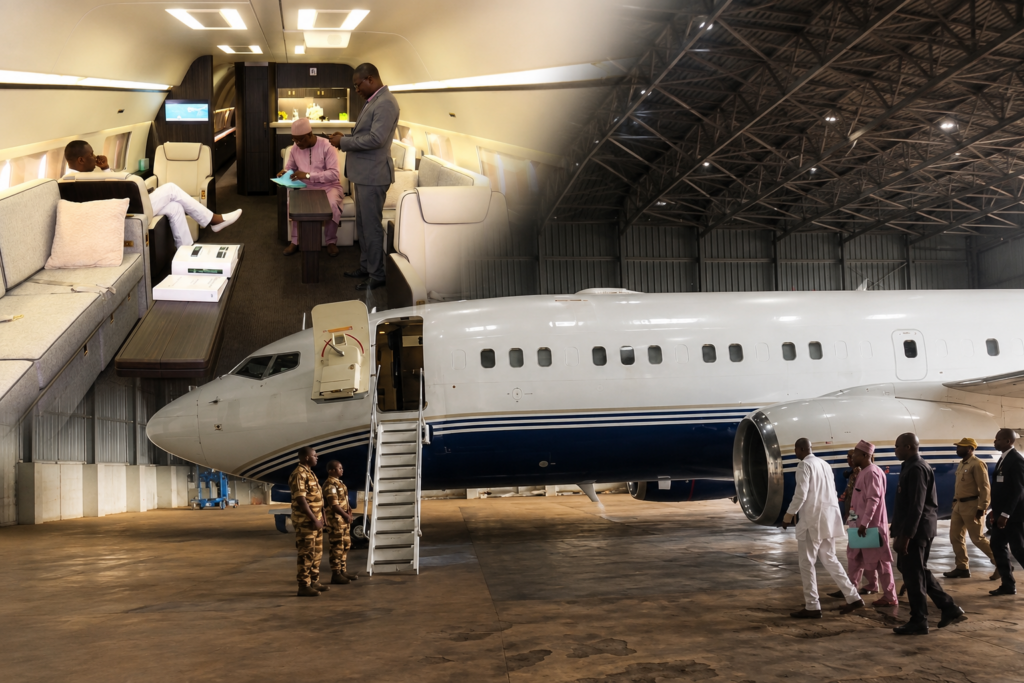
The unveiling of Mali’s newly acquired Boeing 737 presidential aircraft on state television has ignited a fierce debate about the government’s priorities, particularly as the nation grapples with deepening security crises and economic strain. Authorities justified the purchase by highlighting financial prudence, claiming that after insurance compensations and the resale of components from the previous aircraft, the net cost would amount to approximately six billion West African francs rather than the gross expenditure of 15.6 billion.
Timing draws sharp criticism
The timing of the announcement has drawn widespread criticism. While leaders urge national resilience and collective sacrifice, the introduction of a state-of-the-art presidential jet appears to many as a stark contradiction. The move has fueled perceptions that the government is prioritizing symbolic power over the pressing needs of its people.
Across several regions, insecurity remains a daily reality. Military posts are frequently targeted, road ambushes persist, and civilian communities continue to suffer violence. Numerous areas remain inaccessible, and the state struggles to reassert its authority in parts of the country.
Security challenges persist despite stated priorities
Three years after the Transition pledged to reclaim national territory, the security situation remains dire. In the north, coalitions such as the Permanent Strategic Framework including the Azawad Liberation Front—maintain significant operational capacity and contest control over key zones. In central and southern regions, Jama’at Nusrat al-Islam wal Muslimin (JNIM) continues to expand its reach, launching attacks on military bases, state infrastructure, and civilian targets. Critical transport routes remain hazardous, disrupting trade, mobility, and economic activity nationwide.
Financial priorities under scrutiny
While officials emphasize cost efficiency, critics argue that billions of West African francs could have been directed toward more urgent needs, including:
Enhancing the operational readiness of the Malian Armed Forces;
Acquiring armored vehicles, secure communication systems, and protective equipment;
Strengthening intelligence and aerial surveillance capabilities;
Providing care and compensation for wounded soldiers and the families of fallen personnel;
Supporting internally displaced populations and restoring damaged infrastructure.
The transaction thus raises fundamental questions not only about fiscal responsibility, but about the hierarchy of national priorities.
Legitimacy of governance in question
Since assuming power, the Transition has sought to distinguish itself through a discourse of austerity and national service, promising transparent and citizen-centered governance. The acquisition of a long-range presidential aircraft, however, undermines this narrative for many observers. It is seen as a return to the trappings of power that the current leadership once condemned reinforcing perceptions of personal privilege rather than public service.
The contrast is especially stark given ongoing economic hardships: rising living costs, strained public finances, unmet social needs, and sluggish economic activity across key sectors.
Diplomatic utility vs. domestic credibility
Proponents argue that a modern presidential aircraft facilitates high-level diplomatic missions and international representation. Yet detractors contend that a nation’s credibility abroad is rooted first and foremost in internal stability, the protection of its citizens, and the effective functioning of its institutions.
They suggest that sovereignty is not measured by the sophistication of an official fleet, but by the state’s capacity to secure its territory and uphold its responsibilities to its people.
Symbol of power, not of governance
In opposition circles and among critics, the new aircraft has become a potent symbol of misplaced priorities. Some interpret it as evidence that the government prioritizes its own mobility over that of the state. Others speculate that such an asset provides top officials with a means of rapid evacuation in the event of further deterioration though such claims remain unverified. Regardless, the move has deepened public skepticism toward official decisions.
Restoring public trust through action
The introduction of the Boeing 737 transcends a mere procurement decision. It reflects broader concerns about the Transition’s strategic direction. As security threats persist and economic difficulties mount, every expenditure perceived as emblematic of excess is increasingly scrutinized.
For many Malians, true sovereignty is not demonstrated by a modernized presidential fleet, but by the state’s ability to protect its citizens, restore territorial integrity, and improve living conditions. Until these core obligations are fulfilled, investments in prestige risk underscoring a growing disconnect between government actions and the aspirations of the population.