The Alliance of Sahel States: sovereignty claims crumble under terror pressure
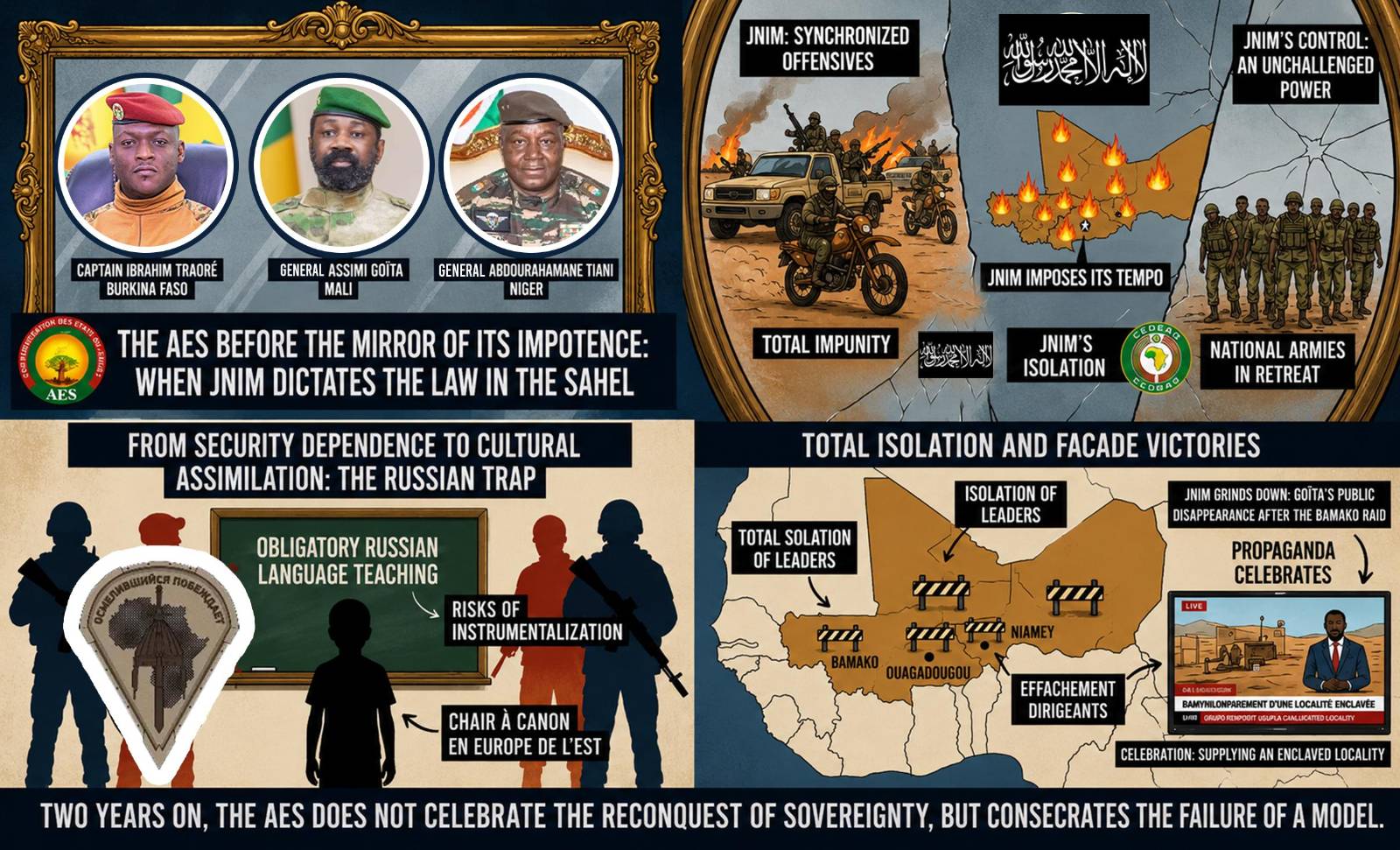
Two years after the Alliance of Sahel States (AES) emerged with bold declarations of self-reliance, the reality facing Mali, Burkina Faso and Niger tells a starkly different story. Behind the fiery speeches of juntas in Bamako, Ouagadougou and Niamey, one armed force continues to dictate the pace of conflict: the Support Group for Islam and Muslims (JNIM).
Despite theoretical intelligence-sharing agreements and full alignment with Moscow, the AES has failed to counter the coordinated, large-scale offensives of this terrorist network. The group’s synchronized attacks across multiple regions repeatedly overwhelm national armies equipped with advanced weaponry, exposing the hollowness of the alliance’s security claims.
Cultural shift under Moscow’s shadow
The junta leaders, led by Captain Ibrahim Traoré, have sought to fill this security void by forging deep ties with Russia. Yet the collaboration extends far beyond military support or the presence of Russian mercenaries under the Africa Corps banner. A recent announcement mandating Russian language instruction in Burkinabè schools from the next academic year signals a deliberate ideological pivot.
Officially framed as an act of cultural decolonization, this policy carries ominous implications. By embedding Russian into the national curriculum, the regime is not merely altering school programs—it is laying the psychological groundwork for long-term integration into Moscow’s sphere of influence. The concern is clear: as these students later pursue higher education or vocational training in Russia, they risk becoming tools in a global confrontation, potentially deployed as cannon fodder or human shields in conflicts far removed from the Sahel.
Propaganda cannot conceal military failure
While the juntas pursue this cultural realignment, the JNIM continues its relentless territorial expansion. The group’s strategic paralysis of state leaderships has reached near-total levels. In Mali, the prolonged public absence of transitional leader Assimi Goïta following a deadly raid in Bamako—allegedly claiming the life of the Defense Minister—exemplifies the depth of this crisis.
The contrast is striking: as terrorist forces advance, military and political elites are reduced to clinging to hollow victories. Official propaganda now celebrates minor logistical successes or defensive reactions as major triumphs, a tacit admission of defeat. Two years into the AES experiment, the alliance does not represent a return to sovereignty—it embodies the collapse of a flawed model. By swapping dependence on the West for cultural and military subjugation to Russia, the juntas have ceded control, allowing the JNIM to set the agenda. The Sahel has not been liberated; it has merely exchanged one form of domination for another, with its youth bearing the heaviest burden.