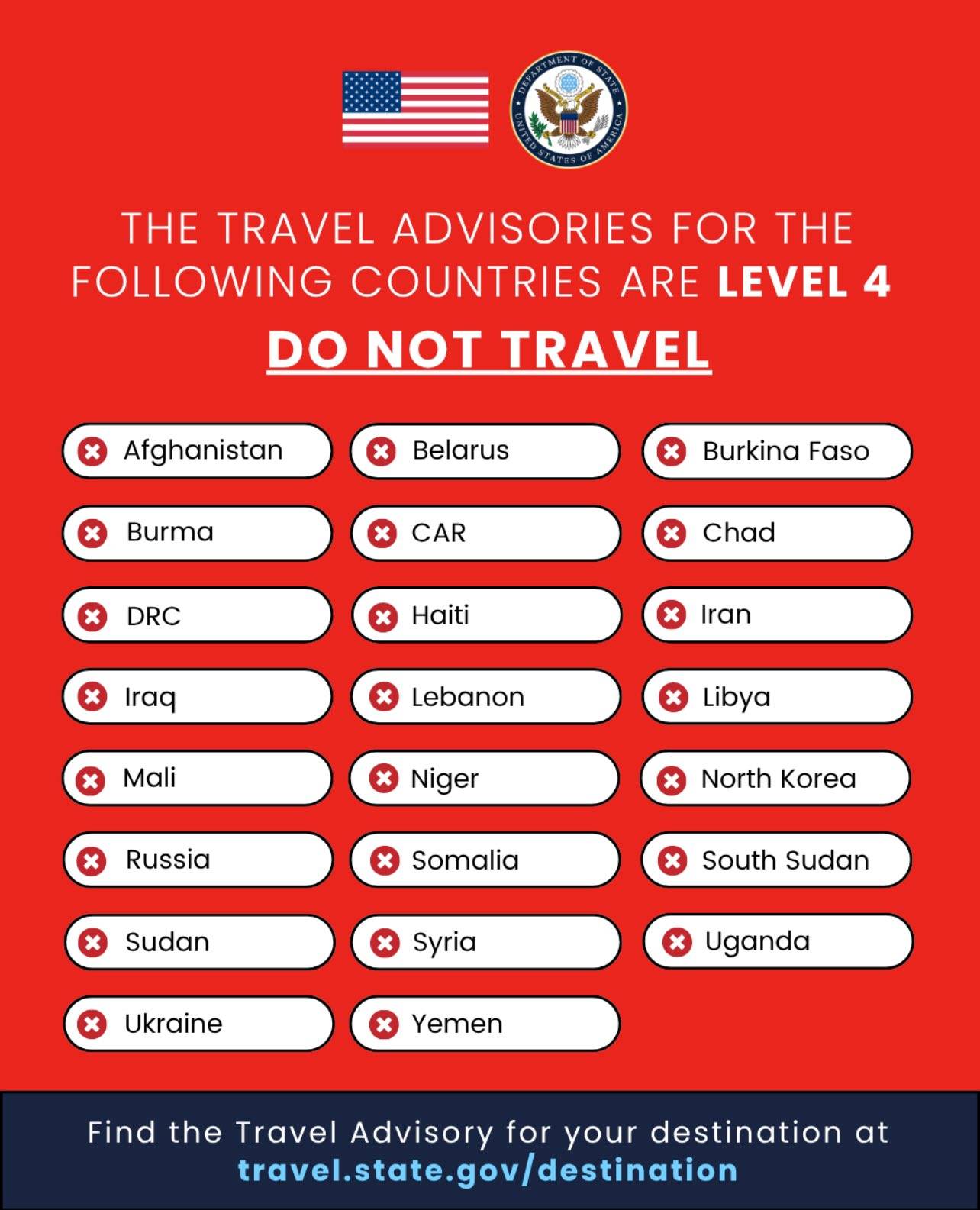
The United States Department of State has once again updated its global travel advisory, placing 23 nations under its highest-risk category—Level 4, labeled “Do Not Travel.” Among the countries now deemed too dangerous for American citizens are three West African nations that form the Alliance of Sahel States (AES): Burkina Faso, Mali, and Niger. The justification? A sharp deterioration in security conditions and the relentless spread of terrorist networks across the region, which has become a global hotspot for instability.
Washington’s stark warning: no exceptions for travel
America’s travel advisory system uses a four-tier scale to assess safety risks for travelers. Level 4 is the most severe classification, signaling that the U.S. government not only discourages travel but actively advises against it. In these countries, officials warn that emergency assistance—whether consular or medical—is either severely restricted or completely unavailable due to the withdrawal of non-essential diplomatic staff. The message is clear: travelers enter at their own extreme peril.
This latest update underscores a harsh geopolitical reality—large swaths of the world are slipping beyond the control of central governments, leaving Western nationals vulnerable to kidnappings, bombings, and hostage situations.
The AES under siege: Burkina Faso, Mali, and Niger face unprecedented threats
The simultaneous downgrading of Burkina Faso, Mali, and Niger to Level 4 is not unexpected. These nations, united under the Alliance of Sahel States (AES), are grappling with deep-rooted crises that include military takeovers, strained ties with traditional Western allies, and a growing reliance on new security partnerships—particularly with Russia. The combination of state absence in remote and border areas, widespread poverty, and shifting military alliances has created a perfect storm for insurgent groups to thrive.
Burkina Faso: a nation under siege by armed factions
Burkina Faso is bearing the brunt of the Sahel’s security collapse. Terrorist factions now control or encircle vast portions of the country, imposing strict blockades that sever entire towns from the outside world. Supply convoys and military outposts are frequent targets, forcing mass internal displacement and leaving civilians with little to no access to basic services.
Mali: from north to south, violence spreads unchecked
In Mali, the security vacuum has deepened following the departure of the UN peacekeeping mission and renewed clashes between government forces and northern rebel groups. Terrorist organizations are exploiting this instability to launch coordinated attacks, pushing their reach further south. Even the capital, Bamako, once considered relatively safe, now faces growing threats.
Niger: triple-front insecurity strains stability
Niger is battling twin security challenges: the volatile “tri-border” region shared with Burkina Faso and Mali to the west, and the Lake Chad Basin in the southeast, where Boko Haram and ISWAP continue their deadly campaigns. Despite efforts to reorganize its armed forces, persistent insecurity and regional diplomatic tensions hamper cross-border cooperation, leaving the country in a state of chronic vulnerability.
A global pattern of instability: beyond the Sahel
The U.S. advisory extends well beyond Africa, reflecting a world increasingly fractured by conflict and political upheaval. Russia remains at Level 4 due to the war in Ukraine and the arbitrary detention risks faced by American citizens. In the Democratic Republic of the Congo, active armed groups like the M23 are perpetrating civilian massacres and abductions. Meanwhile, Chad, bordering both the Sahel and war-torn Sudan, faces spillover threats from terrorism and potential civil unrest.
Economic and humanitarian fallout of the “red zone” designation
A Level 4 classification carries severe economic and humanitarian consequences for affected nations. For the Alliance of Sahel States, the advisory acts as a deterrent to foreign direct investment. Multinational corporations, burdened by exorbitant insurance costs, are halting or scrapping infrastructure and resource projects. Humanitarian organizations also face crippling restrictions, as stringent safety protocols limit their ability to deliver critical aid—food, medicine, and education—to populations already in desperate need.
The decision by the U.S. Department of State to keep the AES countries at the highest alert level highlights the failure of past stabilization efforts. Despite political transitions and realignment with new security partners, the underlying issues—governance failures, social injustice, and lack of economic opportunity—remain unaddressed. Until these root causes are tackled, the Sahel’s map of instability will likely remain painted in red for years to come.