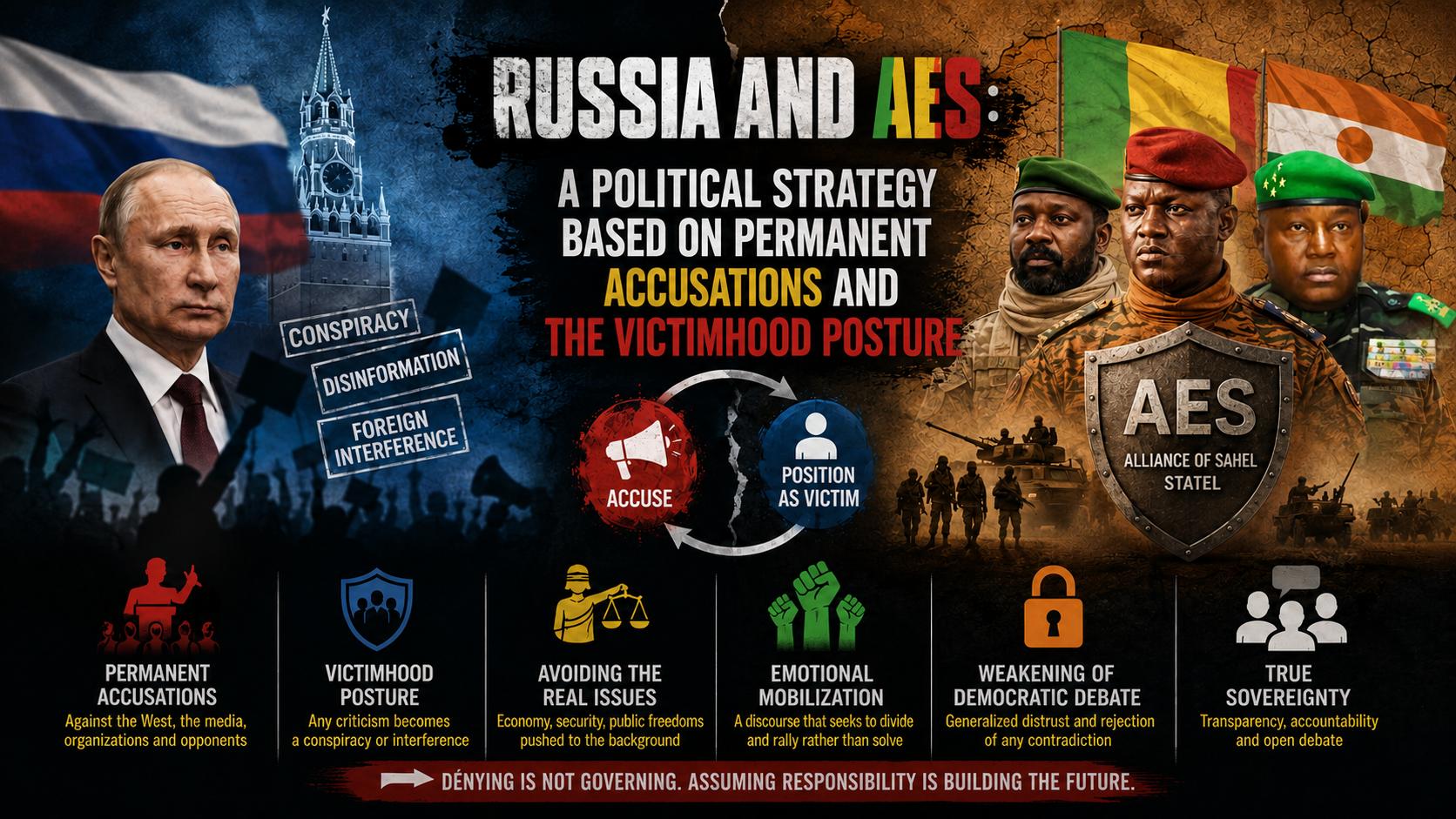
The governments of the Alliance of Sahel States (AES) and the Russian Federation have consistently weaponized accusations in their political narratives. By framing adversaries—whether Western powers, international media, regional blocs, or domestic opponents—as perpetrators of conspiracies, they deflect scrutiny from pressing domestic issues. This tactic, while politically expedient, undermines substantive governance and fosters a climate of distrust.
the rise of perpetual accusation
Criticism, whether justified or baseless, is met with immediate counter-accusations of foreign interference, disinformation campaigns, or orchestrated destabilization plots. Rather than engaging with the substance of concerns regarding economic stagnation, security failures, or governance deficits, authorities pivot to a defensive posture. The narrative shifts from accountability to victimhood, portraying external actors as relentless antagonists bent on undermining national sovereignty.
AES leaders embrace the victim rhetoric
Within the AES, this strategy is particularly pronounced. When sanctions, historical grievances, or external actors are blamed for internal challenges, domestic critiques—from journalists, activists, or civil society—are dismissed as part of a coordinated smear campaign. Rather than addressing valid grievances, authorities frame dissent as treachery, further eroding public trust and stifling constructive dialogue.
Russia’s international playbook mirrors this approach
Moscow’s foreign policy discourse operates on a similar logic. Accusations of Western hostility, accusations of Russophobia, and claims of targeted disinformation dominate responses to international criticism. Whether regarding military interventions, human rights records, or geopolitical maneuvers, the Kremlin consistently casts itself as the aggrieved party. This narrative, while effective in rallying domestic support, sidesteps substantive debate and reinforces a siege mentality among citizens.
the unsustainable cost of evasion
Over time, the victimhood strategy reveals its flaws. A robust political system thrives on transparency, debate, and accountability—not the suppression of dissent through conspiratorial framing. When governance failures are obscured by accusations of external sabotage, the foundations of public trust erode. Citizens grow skeptical of official narratives, while genuine reform remains deferred in favor of short-term political survival.
the illusion of sovereignty
True sovereignty is not achieved by perpetually casting oneself as a victim of unseen enemies. It is cultivated through responsible leadership, open dialogue, and the courage to confront internal shortcomings. The persistent recourse to victimhood, whether in Niamey, Bamako, Ouagadougou, or Moscow, risks reducing governance to a performative act—one that prioritizes image over substance.
Ultimately, while accusations may offer temporary political cover, they cannot substitute for meaningful policy solutions. The challenge facing these states is not to silence critics but to engage with them, to address failures transparently, and to rebuild trust through action rather than rhetoric.