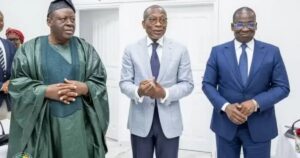
The arrest this week in Benin of three prominent figures, including a high-ranking military officer and two close associates of President Patrice Talon, has thrust the debate over his 2026 succession into the spotlight.
On Wednesday, the prosecutor of Benin’s Court for the Repression of Economic and Terrorist Offenses (CRIET) revealed that Djimon Dieudonné Tévoédjrè, commander of the Republican Guard, former sports minister Oswald Homéky, and businessman Olivier Boko were detained between Monday and Tuesday nights. Authorities allege they conspired to stage a coup d’état in the West African nation of 13 million people. Notably, Tévoédjrè has since been released, according to reports.
The prosecutor further stated that Boko and Homéky allegedly opened a bank account with NSIA Côte d’Ivoire—under the Republican Guard commander’s name—to finance violent regime change on September 27, 2024. NSIA Côte d’Ivoire, however, denied any such account existed. Meanwhile, Olivier Boko, a 60-year-old entrepreneur and close confidant of Talon for over two decades, has recently signaled political ambitions, reportedly positioning himself as a potential 2026 presidential candidate—a move that reportedly displeased the president. Boko’s campaign was reportedly backed by Homéky, a former government minister.
Benin’s constitution limits presidents to two terms, meaning Talon’s second mandate will conclude in 2026.
election 2026: political uncertainty or stability?
“We’ve entered a new phase on the path to the 2026 general elections,” political analyst Tiburce Adagbè told AFP. He cautioned that if legal proceedings follow standard timelines, one of the accused—Boko—”a leading contender in the post-Talon succession race“—could face significant setbacks. Adagbè added, “We operate in an unstable environment where subregional geopolitics raises concerns.”
Echoing these concerns, Euloge Francis Atadé, a governance expert, highlighted the recent wave of coups across West Africa—including in Burkina Faso, Mali, and Niger—as a backdrop to Benin’s current tensions. However, Gilles Gohy, a member of the Union Progressiste le Renouveau party and Talon supporter, struck a reassuring tone: “I have no concerns. Trust the justice system to do its job. Let’s remain calm,” he stated.
Valentin Djenontin, an exiled opposition figure, took a different stance, predicting that if the prosecutor issues a detention warrant for Boko, “pro-Talon demonstrations would likely follow, reinforcing his grip on power.”
The opposition FCBE party condemned the alleged coup attempt, reaffirming its commitment to democratic transitions via elections. Similarly, the Bloc Republicain, part of Talon’s coalition, decried the “extreme gravity of the alleged acts” and any attempts to undermine democracy. Boko’s 2026 campaign team, Objectif Bénin 2026 (OB26), condemned his arrest as a “severe violation of fundamental rights“, “clear political persecution“, and “unacceptable repressive tactics“. Critics of Talon frequently accuse him of adopting authoritarian measures in a country once praised for its vibrant democracy.
What’s next for Benin’s political landscape?
The unfolding developments underscore the high stakes of the 2026 elections and the broader implications for regional stability. As Benin navigates these turbulent waters, the justice system’s role in determining the credibility of the alleged coup—and the broader political fallout—will be closely watched.