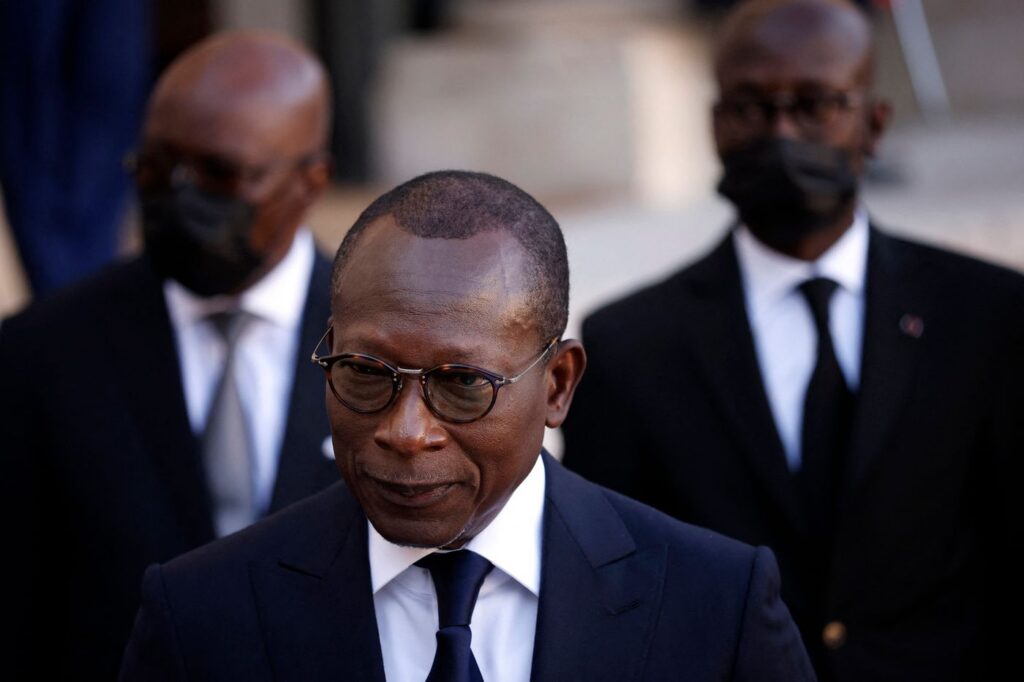
Paris (France), 09/11/2021.- President of Benin Patrice Talon makes a statement with French President Emmanuel Macron (not pictured) following their meeting at the Elysee Palace in Paris, France, 09 November 2021. Both meet to sign an agreement on the return of 26 works of art to the former French colony, according to the French president's Elysee office. (Francia) EFE/EPA/YOAN VALAT (MaxPPP TagID: efespfourteen700595.jpg) [Photo via MaxPPP]
On Sunday morning, December 7, a group of soldiers in Bénin announced during a broadcast on national television that they had « removed from office » President Patrice Talon. However, the president’s inner circle swiftly dismissed the claim, asserting that he was safe and that the regular army had regained control.
Government response to the alleged coup
The presidency confirmed that President Talon remained secure while military sources reported that the situation was « under control ». A military spokesperson stated, « This is merely a small group attempting to seize control of the television. The legitimate army is restoring order. The city of Cotonou and the entire country are fully secured. It’s only a matter of time before everything returns to normal. The cleanup operation is progressing smoothly. »
Meanwhile, the French Embassy in Bénin issued an advisory on X, warning of gunfire near the president’s residence in Cotonou and urging French citizens to remain indoors « for safety reasons ».
Restricted access in key areas
Journalists on the ground reported that military personnel had blocked access to the national television headquarters and the presidential palace. Several high-traffic zones, including the Sofitel hotel in the economic capital and areas housing international institutions, were also cordoned off. Notably, no military presence was observed at the airport or elsewhere in the city, where daily life continued as usual.
Bénin’s political landscape and economic outlook
President Patrice Talon, who has led the country since 2016, is set to complete his second and final term in 2026, as permitted by the Constitution. While his administration has been credited with fostering economic growth, critics argue that democratic freedoms have eroded under his leadership. The upcoming election will feature the ruling party and a self-described « moderate » opposition candidate, as the main opposition party has been excluded from the race.
The Bénin government has faced criticism for its handling of security challenges, particularly the rise of jihadist violence in the northern regions. The country’s stable economic growth contrasts with the instability seen in neighboring nations such as Mali, Burkina Faso, Niger, and Guinée, which have experienced multiple coups in recent years.