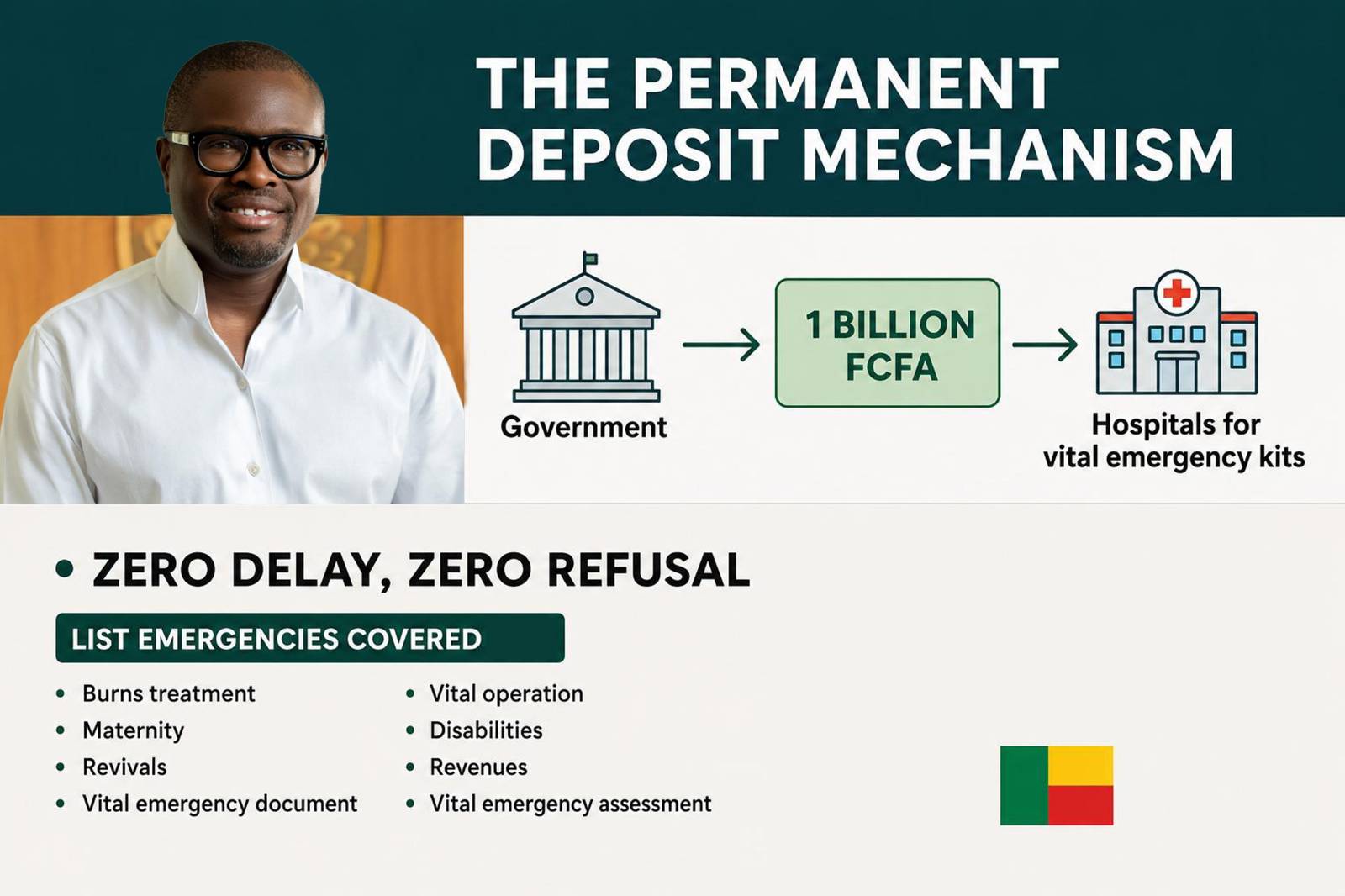
The Republic of Benin has taken a historic step toward ensuring equitable healthcare access with a landmark financial commitment. On June 3, 2026, President Romuald Wadagni unveiled an exceptional allocation of 1 billion West African CFA francs to public health facilities, designed to guarantee free emergency care for life-threatening conditions.
The initiative marks a decisive shift in Benin’s healthcare policy, prioritizing urgent medical interventions before financial considerations. President Wadagni’s directive—‘Treat first, handle paperwork later’—underscores a commitment to saving lives without delay, particularly in cases of severe obstetric complications, road accidents, respiratory distress, and cardiac emergencies.
Under this new framework, financial constraints will no longer impede access to critical care. Patients arriving at public hospitals with life-threatening conditions will receive immediate treatment, regardless of their ability to pay or the presence of family members to cover expenses. This eliminates a long-standing barrier that has tragically claimed lives due to delayed or denied care.
Measurable impact on vulnerable populations
While the exact number of beneficiaries remains variable—given the unpredictable nature of medical emergencies—an analysis of average costs for emergency stabilization provides insight into the initiative’s reach. The allocation is expected to cover between 10,000 and 40,000 emergency cases, with estimated costs ranging from 25,000 CFA francs for moderate cases to 100,000 CFA francs for severe trauma or major surgical interventions.
The ripple effect of this policy extends far beyond individual patients. In Benin, where a single hospitalization can destabilize an entire household’s finances, this measure serves as a protective shield for families. By preventing financial ruin, asset liquidation, or sudden bereavement, the initiative safeguards the economic stability of up to 200,000 individuals, including direct and indirect beneficiaries.
Empowering healthcare professionals
For medical staff, this reform alleviates a persistent ethical dilemma. Doctors and nurses in public hospitals will no longer face the distressing choice between prioritizing patient survival and enforcing payment requirements. The new system restores their ability to focus on clinical excellence and humanitarian care, aligning with the core principles of their profession.
President Wadagni reinforced this vision, stating, ‘No life should be lost because financial constraints delay or prevent urgent treatment. Human life is priceless.’
A broader vision for equitable healthcare
This 1-billion-CFA emergency care fund is part of a wider initiative to strengthen Benin’s public health infrastructure. In parallel, an additional 10 billion CFA francs has been earmarked to ensure universal access to clean water and reliable electricity in all public health centers still lacking these essential services.
Together, these measures represent a pivotal advancement toward Benin’s goal of achieving universal healthcare by 2030. The reforms demonstrate that medical efficacy and social justice are inseparable pillars of a resilient healthcare system. All eyes are now on the Ministry of Health to ensure seamless implementation, guaranteeing that every franc allocated translates into tangible protection for citizens’ lives and livelihoods.