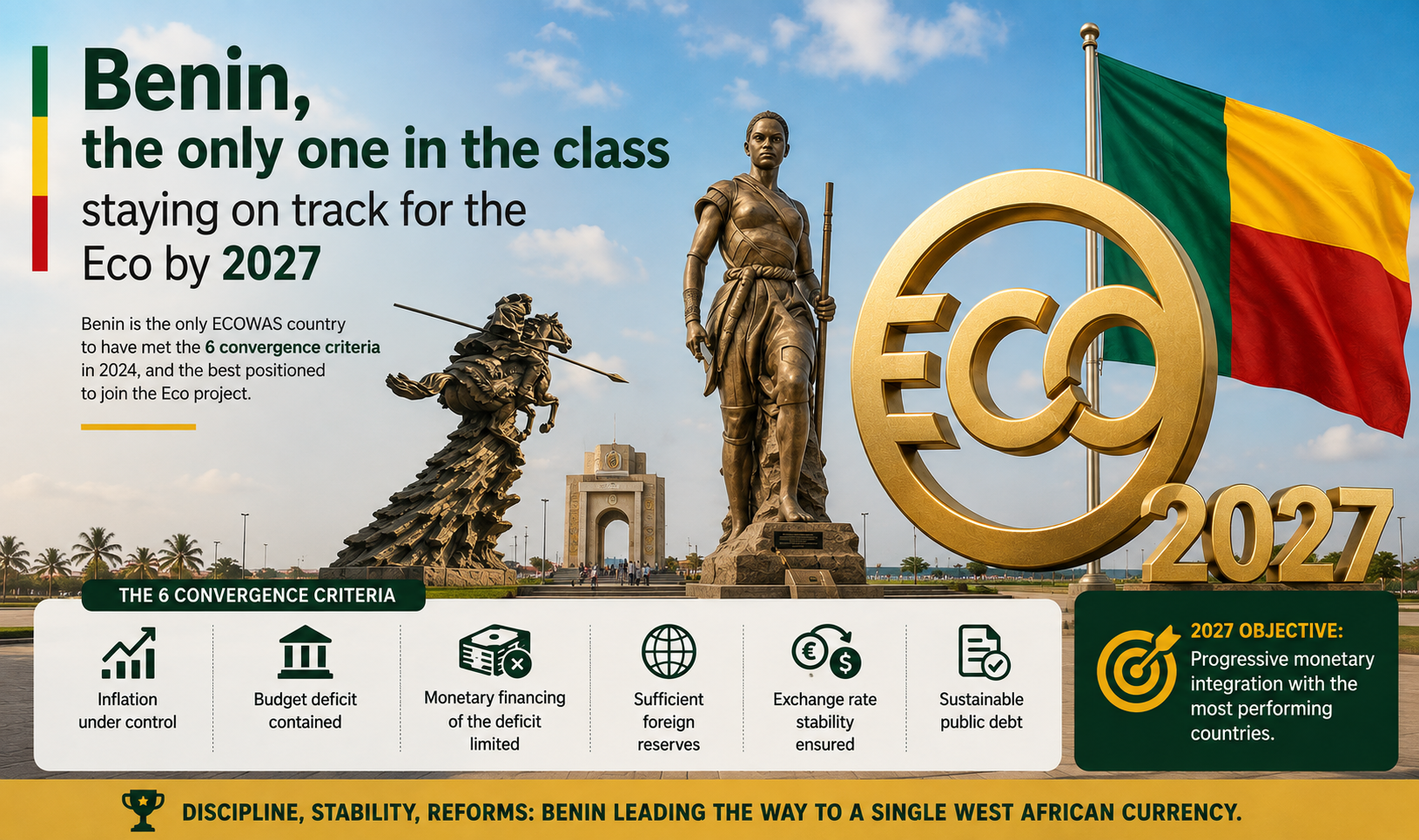
The Economic Community of West African States (ECOWAS) remains committed to launching the Eco as a single currency by 2027, yet economic disparities across the region suggest an uneven pace of adoption. Among the 15 member states, Benin stands out as one of the most prepared to participate in an initial phase of monetary integration.
Eco’s long journey toward reality
While the concept of a unified West African currency has been discussed for decades, translating ambition into practice requires overcoming significant economic hurdles. Persistent inflation, public debt burdens, fluctuating foreign reserves, and divergent monetary policies among member states continue to pose challenges. Recognizing these obstacles, ECOWAS has signaled a phased approach, allowing countries that meet convergence criteria to adopt the Eco sooner while others continue aligning their economies.
Benin’s macroeconomic discipline earns top marks
In 2024, Benin achieved a milestone by becoming the only ECOWAS member to fulfill all six primary convergence criteria required for monetary integration. These benchmarks assess a country’s economic resilience across multiple dimensions:
Inflation control: Ensuring price stability to protect purchasing power.
Fiscal deficit limits: Keeping budget shortfalls within agreed thresholds.
Monetary financing restrictions: Preventing excessive currency creation to fund government spending.
Foreign reserve adequacy: Maintaining sufficient reserves to cover several months of imports.
Exchange rate stability: Upholding a predictable currency value.
Sustainable public debt: Keeping national debt at manageable levels.
Meeting these criteria simultaneously reflects a coherent and disciplined macroeconomic strategy one that goes beyond short-term compliance to demonstrate long-term reliability.
A deliberate path built on reform
Benin’s progress stems from years of deliberate economic restructuring. The government has prioritized revenue mobilization, tightened public financial management, and increased investments in critical infrastructure and social services. Balancing fiscal discipline with development needs has required strategic trade-offs, particularly in a developing economy where resources are often scarce.
The next critical phase will involve sustaining this performance. While compliance in a single year is commendable, maintaining these standards over multiple years will be essential to cement Benin’s credibility as a founding member of the Eco.
Progressive integration: a pragmatic solution
The heterogeneity of West African economies presents the project’s greatest challenge. Member states vary widely in debt levels, fiscal flexibility, inflation rates, and exposure to external shocks such as security crises and regional trade disruptions. A staggered adoption timeline offers a more viable alternative than a simultaneous transition, allowing countries that meet the criteria to proceed while others continue convergence efforts.
Strategic positioning for Benin
If the phased approach materializes, Benin could emerge as a frontrunner in the Eco’s initial rollout. This early adoption would not only enhance the country’s economic influence within ECOWAS but also signal strong financial governance to international partners. A shared currency demands deeper coordination in fiscal, monetary, and trade policies a reality that could position Benin as a regional leader in economic integration.
Uncertainty lingers despite progress
The 2027 deadline remains contingent on collective political will and sustained economic performance. Key questions such as governance structures for the Eco, monetary policy frameworks, and mechanisms for fiscal solidarity among states must be resolved. Additionally, the recent withdrawal of several Sahelian countries from ECOWAS complicates the integration landscape, altering the original vision for the monetary union.
For Benin, the challenge ahead is twofold: preserving macroeconomic stability while advancing structural reforms to avoid falling behind. Inflation must be kept in check, debt levels must remain sustainable, and public investments should not compromise fiscal prudence. The true test will be whether the country can maintain its leading position as the Eco transitions from policy proposal to economic reality.
The road ahead: staying ahead of the curve
Benin’s current advantage is significant but not irreversible. Success in 2027 will depend on continuous adherence to convergence criteria, proactive debt management, and adaptability to regional shifts. As the countdown to the Eco’s potential launch continues, the nation’s ability to sustain its economic momentum will determine whether it remains at the forefront of West Africa’s monetary transformation.