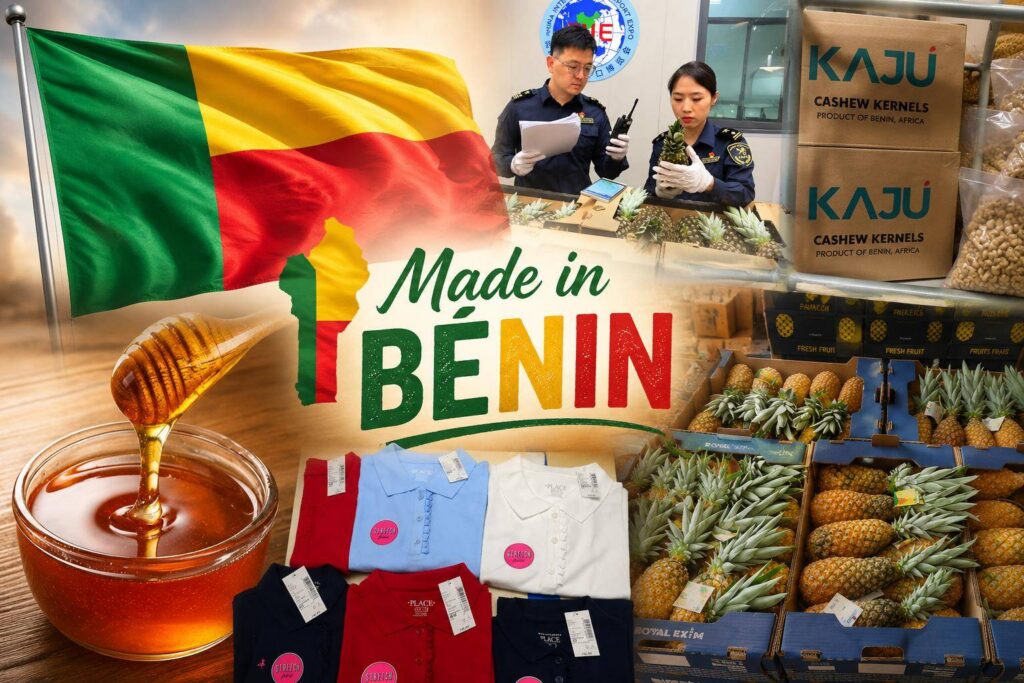
From the sweet pineapples of Allada to the organic soybeans of Ouémé Valley and the golden honey of the northern hills, Benin‘s agricultural treasures are making waves across international tables. This export boom is no accident—it’s the result of a deliberate government strategy led by President Patrice Talon to break through stringent customs and health barriers. Discover how a green revolution is transforming local farmers’ lives and reshaping the nation’s economy.
Overcoming global standards: the quality leap
For years, Benin’s agricultural ingenuity struggled to reach beyond regional borders, stifled by rigorous phytosanitary requirements—especially those imposed by the European Union and China. The case of Beninese pineapples perfectly illustrates this challenge: after a voluntary halt in exports to Europe in 2017 due to compliance issues, the country had to overhaul its entire approach. Exporting isn’t just about selling; it’s about meeting—and exceeding—global standards.
Recognizing the urgency, the government took decisive action. Under the leadership of President Patrice Talon, substantial investments were poured into upgrading national laboratories, including the Beninese Agency for Food Safety (ABSSA). These structural reforms paid off, securing the certifications needed to unlock long-term access to Western and Asian markets. Today, Beninese products aren’t just delicious—they’re trusted for their uncompromising traceability and safety credentials.
The golden honey of Benin: a sweet success story in Europe
The turning point came in early 2018 when European authorities officially approved Benin’s honey for export to the EU. This landmark decision validated the purity and uniqueness of Beninese honey, often harvested through sustainable, biodiversity-friendly beekeeping practices.
For beekeepers in northern and central Benin, this 2018 breakthrough was transformative. No longer just a local staple, Beninese honey is now a sought-after luxury product abroad, prized for its therapeutic benefits and distinct flavor profile. The result? Stable, rewarding prices that are turning beekeeping into a lucrative career for rural youth.
Diversified champions on the world stage
While honey has been a star performer, the pineapple sector reached its own milestone in October 2021. The Pineapple of Allada Plateau earned Benin’s first Protected Geographical Indication (PGI) registration from OAPI. Celebrated for its exceptional sweetness, this pineapple is now shipped fresh to Western markets or exported as 100% pure juice, carrying the banner of Beninese freshness worldwide.
Soybeans—particularly organic varieties—are also in high demand across Europe and Asia. Thanks to the industrial zone at Glo-Djigbé (GDIZ), Benin is no longer exporting raw beans but value-added products. Meanwhile, cashew nuts are following a similar upward trajectory: the gradual phasing out of raw nut exports has enabled local processing, creating thousands of jobs before global distribution.
Real impacts: smiles on farmers’ faces
On the ground, this success isn’t just about economic numbers—it’s about people. Farmers are seeing tangible benefits.
« Today, we sell our soybeans with the certainty of a fair price, » shares a producer from Savalou. « The reforms have stabilized our income, strengthened our cooperatives, and reduced rural precarity. »
Compliance with international standards has also driven professionalization. Farmers receive training, adopt modern harvesting techniques, and cut back on chemical inputs, safeguarding soils for future generations. For Benin, this means a steady stream of foreign currency and a powerful tool for balancing trade deficits. With agriculture employing over 60% of the workforce, it’s clear that the sector is the backbone of the nation’s development.
The « Made in Benin » label: a mark of prestige
Benin’s agricultural identity has undergone a remarkable transformation. From the honey certification in 2018 to the pineapple’s PGI recognition in 2021, the country has carved out a reputation for excellence on the global stage. Whether it’s the golden honey from the forests or the sweet pineapples from the highlands, Beninese craftsmanship is now synonymous with quality and trust. The « Made in Benin » label isn’t just a tag—it’s a promise of premium, sustainable, and globally admired produce.