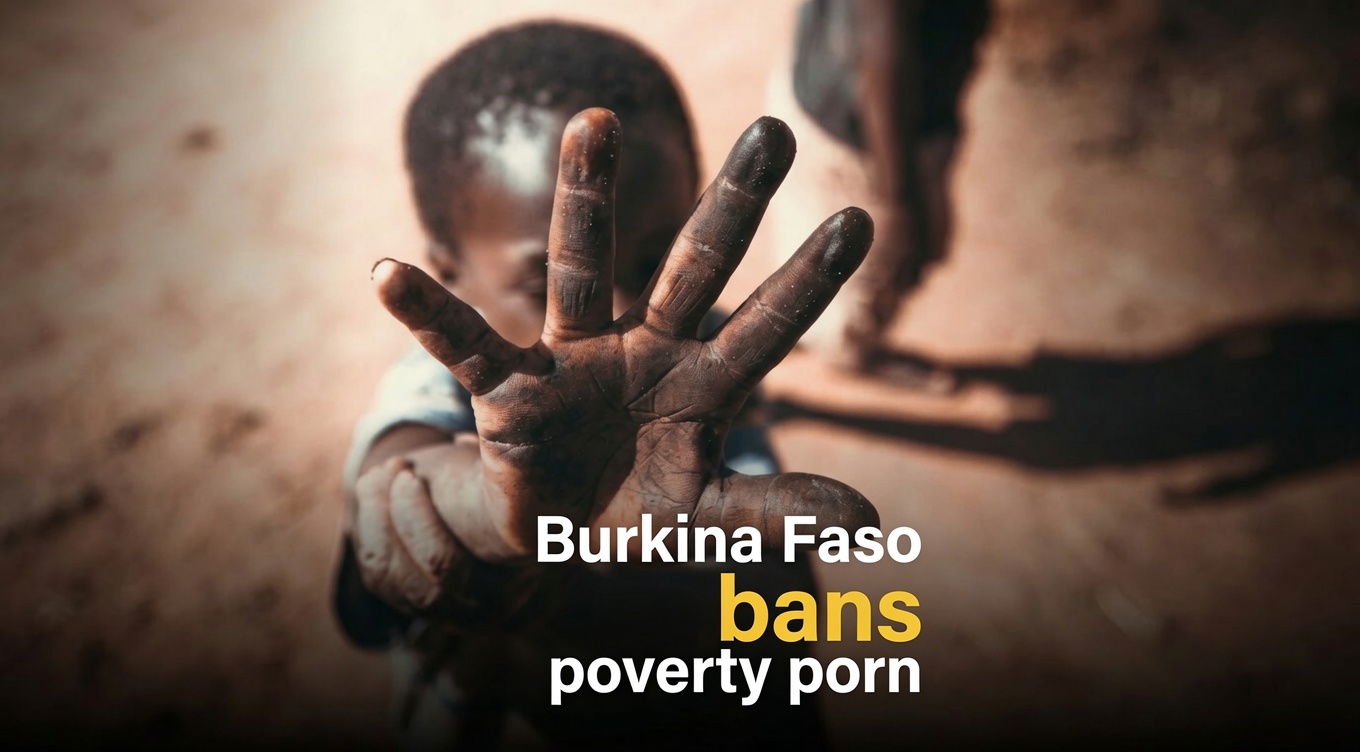
In a landmark decision, Burkina Faso’s transitional government has outlawed the practice of poverty porn—the exploitation of human suffering for engagement or funding. This move challenges long-standing content creation and humanitarian reporting norms, reigniting the critical dialogue on human dignity versus the lens of the camera.
Ethical concerns and the commodification of distress
The rapid expansion of digital platforms has turned misérabilisme into a highly profitable currency. A familiar pattern emerges: influencers or organizations capture close-up footage of malnourished children, internally displaced persons, or families in dire straits, often with the stated goal of raising funds or raising awareness. While the intention may appear noble, the execution raises profound ethical dilemmas. By turning suffering into spectacle, these videos strip individuals of their dignity and privacy, reducing them to passive objects of pity. It is this very voyeurism that Burkina Faso now seeks to eradicate.
National image and strategic implications
Beyond ethical considerations, the ban carries significant political and security implications. Burkina Faso is navigating a multifaceted crisis, and the unrestricted circulation of images portraying the nation solely through the prism of suffering poses a challenge to the government’s narrative. Authorities argue that poverty porn not only undermines individual dignity but also fuels a damaging external perception, often manipulated to tarnish the country’s image. By regulating the dissemination of such distressing imagery, the administration aims not to obscure reality but to reject the reduction of Burkina Faso to a simplistic stereotype of helplessness.
The counterargument: silencing critical voices
Critics, including civil society members and opposition figures, view the ban as more than a moral stance. They contend that under the guise of combating poverty porn, the administration, led by Captain Ibrahim Traoré, is tightening control over information and concealing the harsh realities faced by Burkinabè citizens. The ban, they argue, provides a legal mechanism to obscure the severity of a humanitarian crisis—millions displaced by insecurity, communities under blockade struggling for supplies, and daily battles against hunger and lack of healthcare. For regime opponents, the law functions as a smokescreen, preserving the illusion of an infallible transition by silencing the very alarms that, despite their flaws, these distressing videos represented.
Rethinking humanitarian communication
Despite the controversy, the new legislation compels humanitarian actors and communicators to urgently reassess their strategies. How can they continue to mobilize solidarity and report on urgent needs without resorting to sensationalism or falling afoul of censorship? The solution lies in solution-oriented communication and courageous on-the-ground journalism. Experts emphasize that crises can be documented with respect by highlighting resilience, courage, and collective action rather than solely vulnerability. A dignified narrative does not diminish the gravity of the situation; it restores agency to those affected while keeping the spotlight on a Burkina Faso that suffers yet refuses to succumb to silence.