Economic realities challenge Burkina Faso’s strategic narratives
In Burkina Faso, economic pressures are beginning to undermine long-standing geopolitical narratives. The issue of fuel prices has emerged as a particularly stark illustration. While the administration of Captain Ibrahim Traoré has for years positioned Russia as a strategic partner capable of supporting the country’s quest for sovereignty, recent tensions surrounding hydrocarbon supply reveal a fundamental truth: in energy matters, political alliances alone cannot reduce expenses.
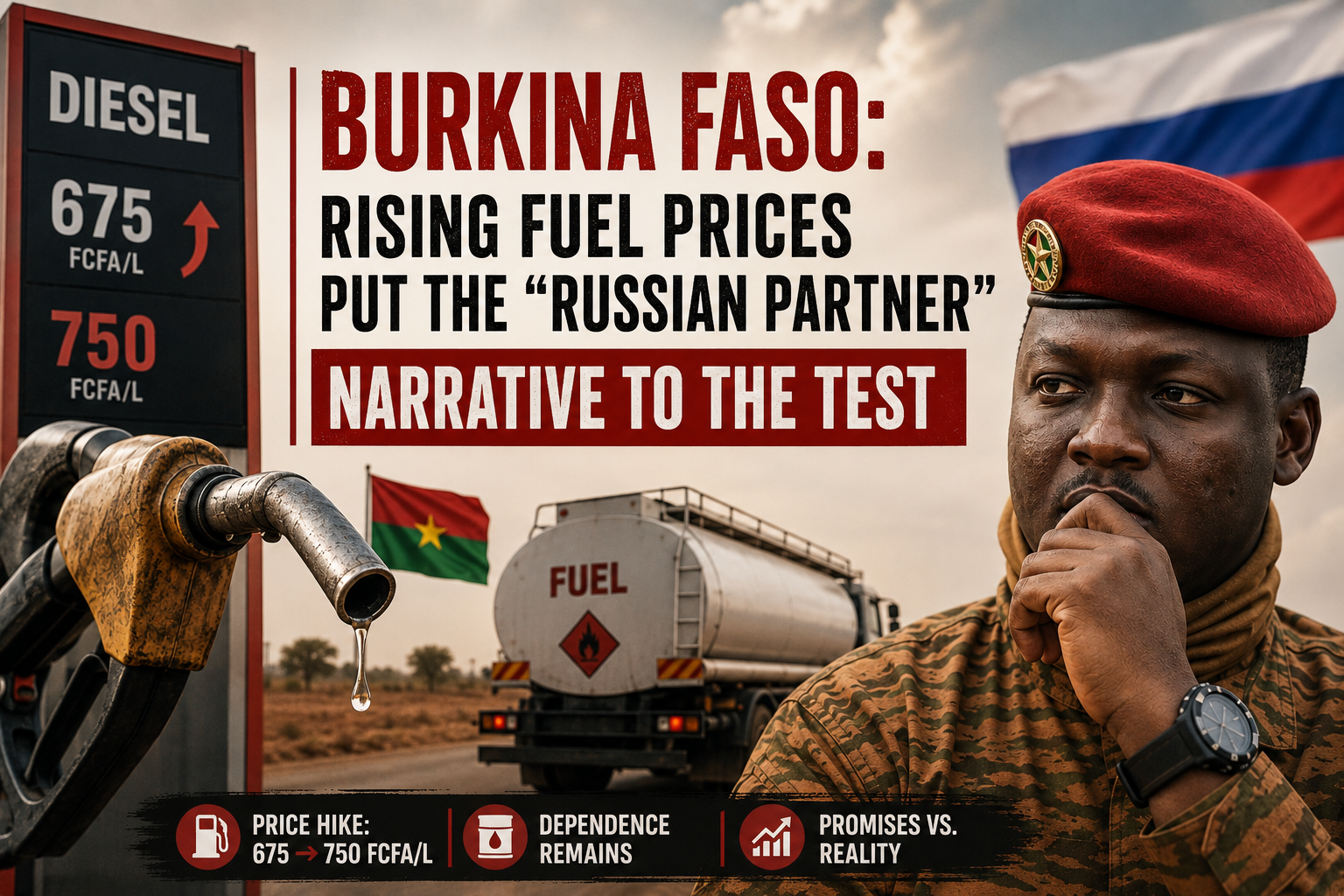
If confirmed as reported, the increase in diesel prices from 675 to 750 West African CFA francs per liter adds to a broader regional trend. Earlier this year, several West African nations adjusted fuel prices upward. Côte d’Ivoire raised diesel costs from 675 to 700 CFA francs per liter in May, while Benin witnessed an increase to 750 CFA francs per liter.
This regional comparison underscores a critical point: the Burkinabè price adjustment cannot be attributed solely to relations with Moscow. Yet it raises a pressing political question: if closer cooperation with Russia was meant to reduce external dependency, why does Burkina Faso remain so exposed to international hydrocarbon market fluctuations?
Proclaimed sovereignty faces market constraints
Since assuming leadership, Captain Ibrahim Traoré has framed economic and political sovereignty as central pillars of national policy. The shift in diplomatic alignment marked by distancing from certain Western partners and a marked rapprochement with Russia has been presented as a strategy of diversification.
However, sovereignty is not declared; it is built through tangible measures: infrastructure development, storage capacity, refining capabilities, secure transport routes, and a diversified supply chain resilient to external shocks. Burkina Faso, a landlocked nation, faces inherent geographical limitations that severely restrict its operational flexibility. The country relies heavily on regional corridors for the import of essential petroleum products, and no diplomatic realignment can eliminate this structural constraint.
It is here that geopolitical rhetoric encounters its practical limitations.
Russia’s role as a pragmatic partner, not a savior
The portrayal of Moscow as a disinterested benefactor capable of replacing traditional Western partners represents a hazardous oversimplification. Russia, like any exporting power, pursues its own economic, commercial, and strategic interests. Contracts are negotiated based on production costs, transport logistics, insurance, geopolitical risks, and expected profitability. There is no inherent mechanism ensuring preferential pricing or sustained economic relief for partner nations.
A strategic partnership does not automatically translate into preferential trade terms, nor does it guarantee perpetual mitigation of a partner country’s economic challenges. While Russia may supply equipment, expertise, investments, or open new trade channels, it does not operate as a perpetual provider of subsidized resources. It is essential to distinguish between diplomatic rhetoric and commercial realities.
The ripple effect of fuel price increases
Fuel is a uniquely sensitive commodity, as it underpins virtually every sector of the economy. A rise in diesel prices does not merely affect drivers; it cascades through the transport sector, agricultural supply chains, manufacturing, services, and ultimately household budgets.
In Burkina Faso, where land transport is the primary means of moving goods across vast distances, any increase in fuel costs is magnified. Trucks transporting food, construction materials, and merchandise consume diesel. As fuel expenses rise, transporters pass on a portion of the burden through higher freight rates. Traders adjust prices accordingly, and consumers bear the final cost. Energy policy, therefore, directly influences purchasing power.
The paradox of regional indispensability
Burkina Faso’s diplomatic posture has grown increasingly assertive toward several neighboring states and regional organizations. Yet its landlocked status compels it to maintain functional relations with these very neighbors. Regional ports remain vital to its supply chains, and transit corridors through neighboring countries serve as economic arteries. Côte d’Ivoire, for instance, holds a central logistical position in West Africa, while Nigeria exerts significant influence in the regional energy sector.
A truly sovereign energy strategy is not about choosing between Moscow, Abidjan, or Lagos; it is about cultivating multiple partnerships and supply routes. Sovereignty is not synonymous with autarky. It is the capacity to avoid reliance on a single supplier, corridor, or foreign power.
The illusion of replacing one dependency with another
The core paradox is clear: Ouagadougou seeks to reduce dependence on certain Western powers a legitimate sovereign objective. Yet substituting one dependency for another does not equate to true independence.
As Burkina Faso gradually disengages from certain Western economic circuits, it risks becoming heavily reliant on new partners. The structural problem persists: energy security is not achieved by switching allegiances, but by building resilience. The question is not whether Russia is a “good” or “bad” partner for Burkina Faso. The question is whether this partnership enhances the country’s ability to produce, transport, refine, and distribute its own resources.
Sovereignty must be measured by outcomes, not by slogans.
The political cost of unfulfilled promises
The administration of Ibrahim Traoré will be judged on this front. Citizens may accept fuel price increases if they are clearly justified by international crises or supply chain disruptions. However, public skepticism intensifies when new partnerships promoted as solutions to old dependencies fail to deliver tangible benefits.
Political communication creates expectations. When a government presents a new partner as an alternative capable of liberating the nation from prior constraints, every price increase becomes politically charged. The Burkinabè government must now answer a direct question: what concrete economic benefits does the Russian partnership deliver to the average citizen today?
Diplomatic cooperation, sovereignty rhetoric, and military collaboration are important, but they do not translate into immediate improvements in daily life. Citizens are concerned with tangible changes: fuel prices, product availability, transport costs, employment, investment, energy access, and purchasing power.
The economic test ahead
Russia can serve as an important partner for Burkina Faso. It may contribute to diversifying the country’s alliances. However, it cannot, by itself, resolve the structural challenges of a landlocked economy exposed to global price volatility.
Burkina Faso would benefit from a more pragmatic approach: maintaining its new partnership with Moscow while preserving balanced economic relations with regional neighbors. This is not a call to revert to former dependencies, but a recognition that effective diplomacy is not built on perpetual rupture. It is about defending national interests through all available partnerships.
The fuel price increase serves as a warning: economic sovereignty is not measured by the number of foreign flags displayed at official ceremonies, but by a state’s ability to secure supply chains, control costs, and protect the purchasing power of its people.
The true measure of the Russian-Burkinabè partnership will not be the volume of declarations of friendship between Ouagadougou and Moscow. It will be far more concrete: how much does this partnership cost, how much does it generate, and above all, what does it deliver to ordinary Burkinabè citizens?