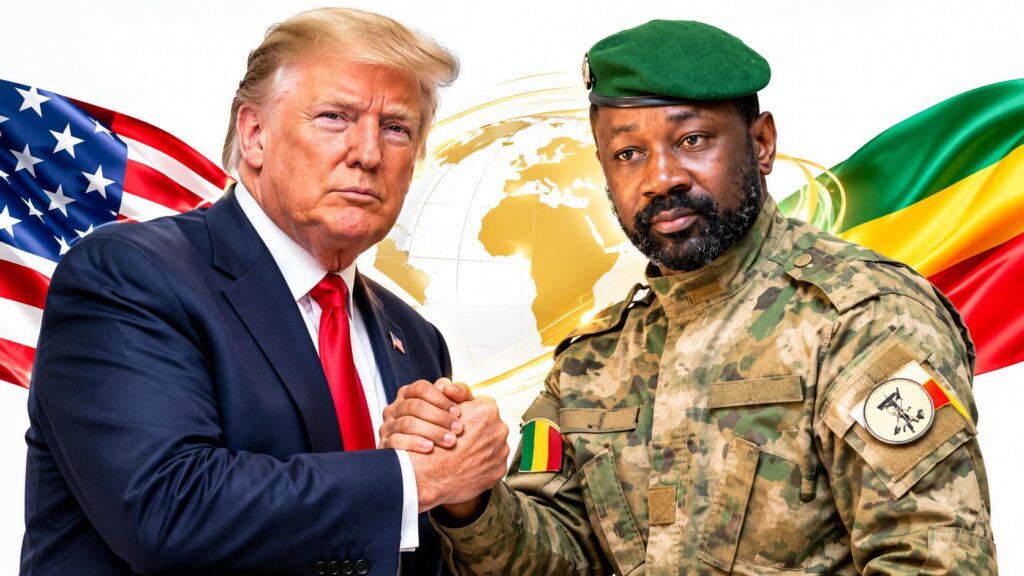
Is the Sahel alliance’s rupture with the West truly as absolute as its leaders proclaim, or is a $410 million migration contract quietly redrawing the line? That is the dilemma now hovering over the capitals of the Alliance of Sahel States (AES), where Mali, Niger and Burkina Faso have turned a radical ideological break with their traditional Western partners — the United States and France above all — into a founding political identity. Yet those same governments have left diplomatic and economic channels with Washington conspicuously open. The explanation sits in the back rooms of American financial diplomacy: a $410 million envelope (roughly €370 million) unlocked by the US administration to shift migration management offshore toward third countries.
Why the American envelope lands at precisely the right moment
Since transitional regimes took power in Bamako, Niamey and Ouagadougou, relations with conventional lenders — the European Union and the World Bank among them — have come under heavy strain, while earlier financial sanctions emptied state coffers. Against that backdrop of economic asphyxiation, a US programme that pledges a total of $410 million to countries across Africa and Latin America willing to host or process migrants expelled from the United States looks like a genuine lifeline for AES treasuries. For governments weighed down by massive military spending and short on foreign currency, the pull of capturing a slice of that money outweighs anti-Western ideological reflexes.
A sub-regional precedent: cheque-book diplomacy already delivering
Migration transfer agreements financed with tens of millions of dollars — Cameroon, the DR Congo and Eswatini are already part of the arrangement — demonstrate how persuasive Washington’s cheque-book approach can be. For the AES capitals, the mechanism offers two clear strategic openings.
What Bamako, Niamey and Ouagadougou stand to gain
- A direct budget opportunity: securing funding, whether directly or through specialised agencies, to cover logistics and equip infrastructure.
- A diplomatic bargaining lever: by positioning themselves as unavoidable partners on security and global migration control, these regimes confirm their financial dependence on the international stage when facing Washington.
Sovereignty on paper, pragmatism in the ledger
The official AES narrative rests on reclaimed sovereignty and the rejection of foreign interference. The posture adopted toward Washington’s proposals, however, exposes the limits of a strictly independent line. While American and European presence is pushed out of the Sahel in the name of national dignity, the door remains wide open to bilateral talks with Washington over contracts worth hundreds of millions of dollars. Such a double standard makes one thing plain: monetary pragmatism prevails as soon as the sums involved cross a critical threshold.
The stakes: what the $410 million says about the region’s realignments
The magnetism of the $410 million attached to the US migration outsourcing programme shows that economic realism remains the main brake on alliances across the Sahel. Far from the slogans of total rupture, the pragmatic proximity maintained between the AES and Washington confirms that the hunt for liquidity is still the true arbiter of geopolitical realignment in the region.