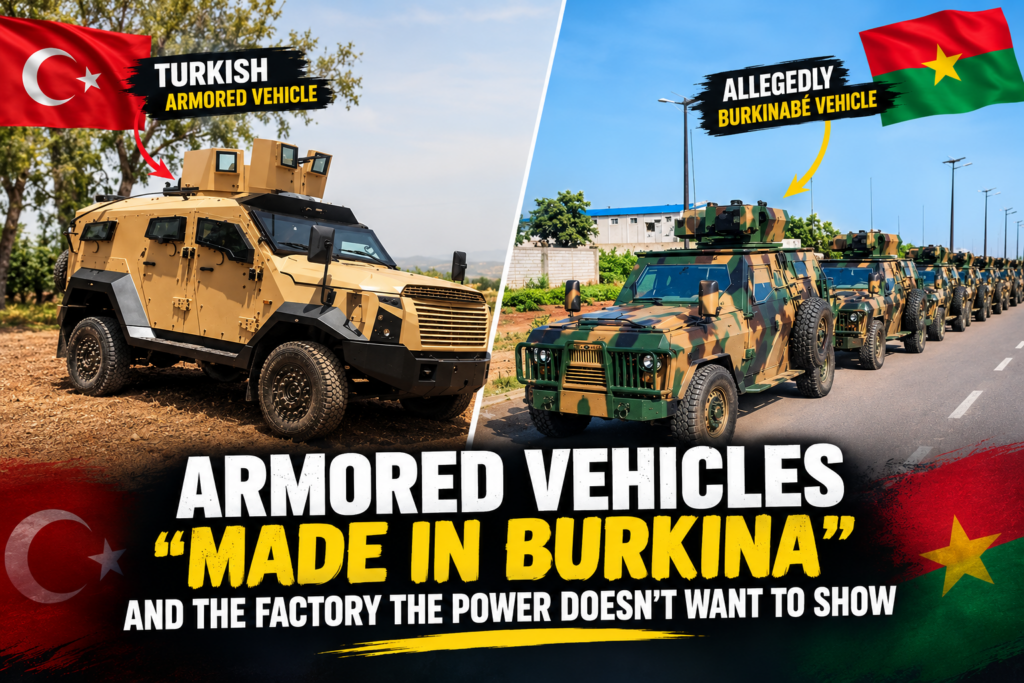
Nearly 300 armoured vehicles, a company nobody has ever seen, and a slogan: “made in Burkina Faso”. When Burkina Faso’s military leader, Ibrahim Traoré, presented the Nanga vehicles on 21 September as fresh proof that his country can equip its own army, he opened a debate that has not closed since. The reason is straightforward: the one piece of evidence capable of ending it a verifiable production line has never been put on display.
Traoré says close to 300 vehicles have been produced or adapted in Burkina Faso since November 2025. Faso Armored, the firm behind the programme, is described as a Burkinabè company that will stay deliberately out of the public eye on grounds of defence secrecy. The stakes are not symbolic. A claim of this kind underpins a sovereignty narrative, justifies public spending and shapes how soldiers and taxpayers judge the state’s industrial ambitions.
A paradox the authorities have not resolved
There is no hesitation about showing the machines themselves. Numbers are announced, their entry into the defence and security forces is publicised, and the Nanga name has become part of the official story of a nation building its own military capability.
The difficulty starts the moment the conversation turns to the facility supposed to have built them. The junta leader has stated that Faso Armored will never be inaugurated or opened to the public, precisely because of defence secrecy. He also refers to four or five other companies operating discreetly in the military sector.
Secrecy is a legitimate argument, up to a point. No government is expected to publish the coordinates of a sensitive plant, its output capacity or its manufacturing methods. But proving that an industry exists is a different exercise altogether. A workshop can be filmed, a production line photographed and a monthly output figure released without revealing a single technical secret. Refusing even that leaves a visible gap between the announcement and the evidence.
The Turkish trail: what earlier deliveries reveal
The December 2022 Ejder 6×6 delivery
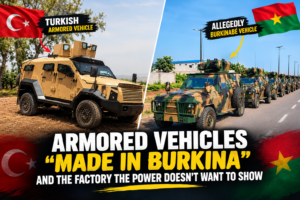
Burkina Faso’s recent arms purchases make the question sharper rather than softer. In December 2022, the arrival of four Turkish-made Nurol Ejder 6×6 armoured vehicles was documented. They were built by the Turkish manufacturer Nurol Makina, and images circulating at the time allowed their Turkish origin to be identified.
None of this proves that the vehicles shown in September 2026 are the same machines. It does, however, raise a legitimate possibility that the authorities could settle in a sentence: were the Nanga designed and built from the ground up in Burkina Faso, or were foreign hulls converted locally re-armoured, refitted and then presented as a national product?
‘Manufactured’ and ‘adapted’ are not the same thing
Official descriptions themselves contain a telling detail. The Nanga are presented as vehicles whose original bodywork was replaced with an armoured structure designed and built locally, with modifications tailored to the country’s terrain. Other accounts speak plainly of vehicles “adapted and transformed” on Burkinabè soil.
That nuance carries real weight. If the chassis, engine, transmission and other essential components come from abroad while the armouring, assembly or conversion happens at home, then the accurate description is local adaptation not domestic manufacture. The issue is not whether Burkinabè workers took part in the process. The issue is what share of each vehicle is genuinely Burkinabè.
Questions that a production line would answer in minutes
Claiming close to 300 armoured vehicles in under a year amounts to a considerable industrial performance. Yet no independent demonstration of that capacity has been made public, and several basic questions remain open:
Where are the assembly chains?
Where are the welding and armouring workshops?
How many vehicles actually leave the plant each month?
Which engines are fitted?
Who supplies the chassis?
Where do the transmissions, electronic systems and other components come from?
And above all: what proportion of each Nanga is produced in Burkina Faso?
For now, none of these answers is publicly documented.
Uniforms in Bobo-Dioulasso, silence around armour
The contrast with the TEXFORCES-BF uniform project is instructive. On that file, the authorities communicated openly about the infrastructure, its location, its funding and its launch. The complex in Bobo-Dioulasso was formally commissioned on 9 September 2026.
For armoured vehicles, the machines are paraded while the industrial tool stays invisible. That difference invites a question of its own. If the objective is to demonstrate a real national industrial capability, a few verifiable images of a production floor would achieve more than any statement and would silence the doubt instead of feeding it.
What the available evidence does and does not establish
It would be premature, on the basis of what is currently known, to assert that the Nanga are Turkish vehicles simply given a new name. It would be just as premature to treat as settled fact the claim of 300 armoured vehicles entirely built in Burkina Faso.
What is established is more measured. The government asserts a local production or adaptation process, names Faso Armored as the operator and invokes defence secrecy to keep the company out of sight. Turkish armoured vehicles were, separately, delivered to Burkina Faso in the past.
Between those two realities sits a question that only a genuine industrial verification can resolve: are the Nanga a Burkinabè product, foreign vehicles deeply modified locally, or a mixture of both? Until the plant, the production line, the origin of the main components and the technical data are documented, “made in Burkina” remains an official claim that deserves verification rather than repetition.
By Ousmane Tandja — Senior correspondent