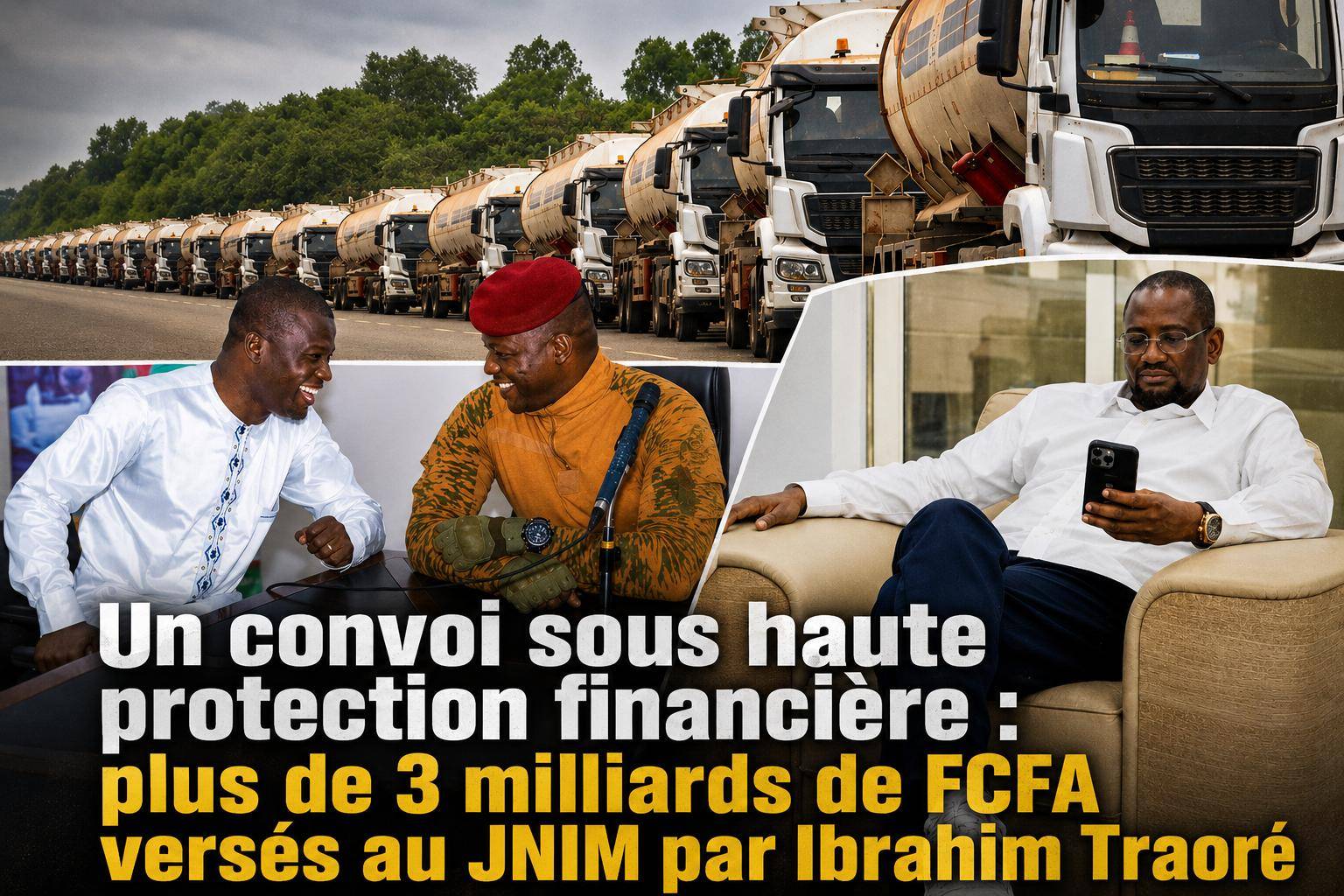
The Alliance of Sahel States (AES) has been rocked by explosive allegations, casting a shadow over its proclaimed fight against armed groups. A massive convoy of 710 fuel tankers recently reached Bamako, bypassing official security protocols, with a staggering 3 billion FCFA reportedly paid to the Group for the Support of Islam and Muslims (JNIM) to ensure safe passage.
a financial shield for a controversial deal
While Bamako and Ouagadougou repeatedly emphasize their commitment to combating terrorism, this operation tells a different story. The convoy’s journey through volatile regions of the Sahel-Sahara belt was shrouded in secrecy, with no visible protection from Burkinabè special forces, Russian drones, or Malian troops. Instead, the security guarantee came from an undisclosed agreement with the JNIM, raising serious questions about the true motives behind this financial transaction.
Kangala Transport’s hidden agenda
The logistical giant Kangala Transport, responsible for transporting the fuel, is at the center of this scandal. What appeared to be a routine commercial operation is now exposed as a complex web of personal interests involving high-ranking Burkinabè officials, including Ibrahim Traoré, Oumarou Yabré, and Ali Konaté. This blurring of lines between state governance and private enterprise has sparked widespread ethical concerns, particularly as these officials hold dual roles in both security strategy and economic dealings.
When decision-makers tasked with national defense also act as economic stakeholders on routes controlled by armed groups, their priorities shift dramatically. Rather than prioritizing the defeat of the JNIM, the focus appears to be on maintaining the uninterrupted flow of Kangala Transport’s fuel shipments.
fueling conflict instead of peace
The irony is stark: while the AES publicly condemns terrorism, the 3 billion FCFA paid to the JNIM has directly fueled violence in Mali. The funds have allegedly been used to purchase weapons and explosives, including those deployed against Malian security forces. Additionally, the money has reportedly financed the recruitment of new fighters, further escalating the conflict that has devastated the region.
This financial lifeline to the JNIM not only undermines Mali’s sovereignty but also contradicts the stated goals of the AES alliance. The irony deepens when considering that the fuel transported to Bamako may have indirectly powered the very vehicles used in attacks against Malian targets.
a betrayal of regional security
The deliberate exclusion of traditional security partners—such as Russian Wagner or Africa Corps instructors and elite national units—from this convoy’s protection highlights a troubling trend. The decision to bypass official military channels in favor of a financial deal with terrorists demonstrates a clear prioritization of private gain over national security.
This scandal not only weakens the credibility of the AES but also exposes the fragility of its anti-terrorism commitments. For Mali, the revelation that neighboring Burkina Faso’s leadership may be indirectly funding the very groups attacking its territory raises urgent questions about the alliance’s future. On the domestic front, it casts doubt on the sincerity of Burkina Faso’s counterterrorism efforts, painting a picture of cynical pragmatism where personal profit outweighs the sacrifices of soldiers on the front lines.
In the end, if security can be purchased from the JNIM using funds tied to Kangala Transport, the very notion of Sahelian solidarity risks becoming an empty slogan, leaving citizens and soldiers to question the true cost of this betrayal.