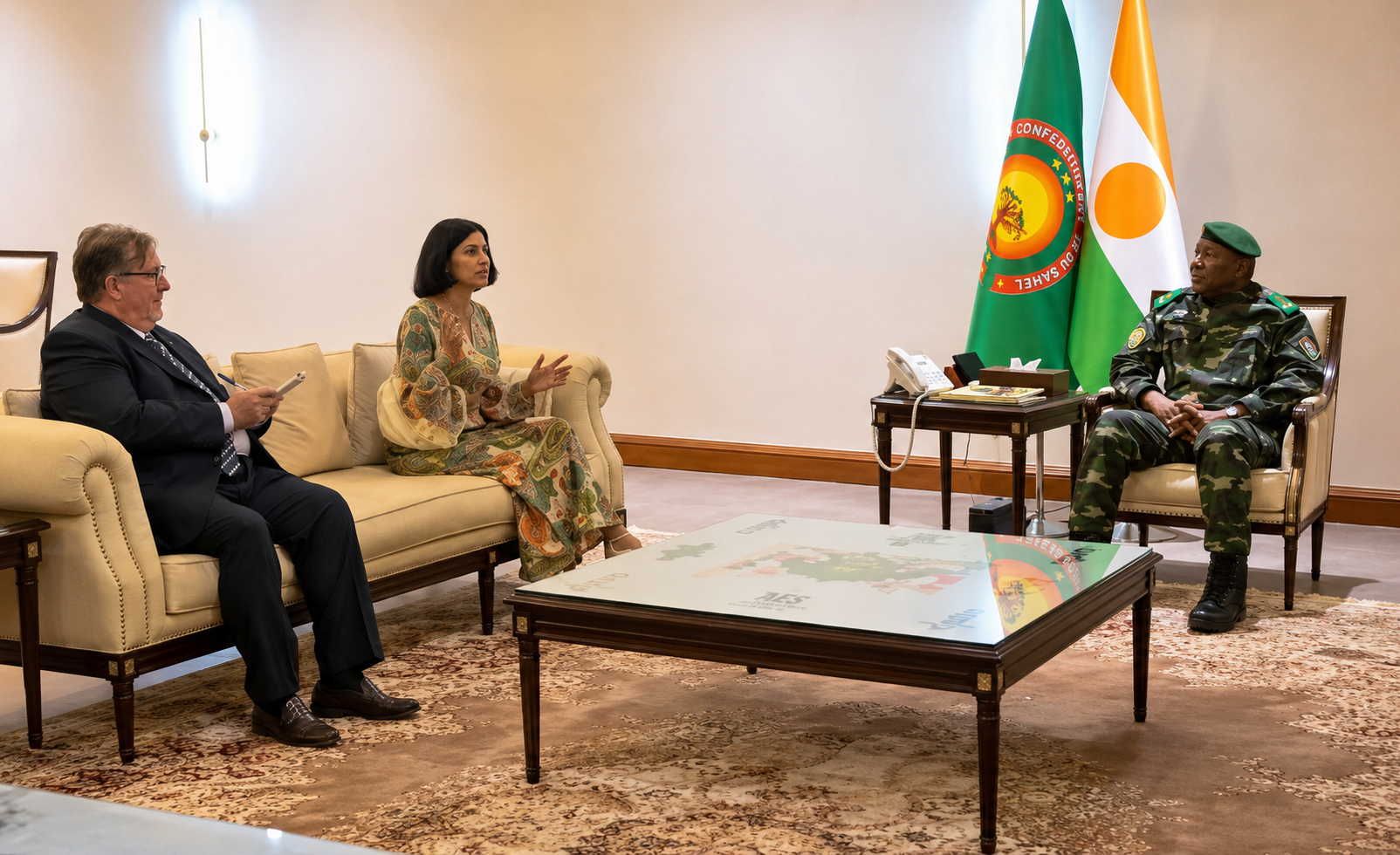
The presidential palace in Niamey radiated its customary pomp and ceremony as General Abdourahmane Tiani, Head of State of the National Council for the Safeguarding of the Homeland (CNSP), received Spain’s Ambassador to Niger, Gloria Minguez Ropiñon. While the official communiqué from Niamey’s leadership endeavors to portray a robust and forward-looking partnership, this carefully staged diplomatic encounter does little to conceal the regime’s true intentions: deflecting attention from internal crises, particularly the mounting allegations surrounding the illicit trade of official passports.
A calculated narrative of continuity amid turmoil
During the post-audience remarks, Ambassador Minguez Ropiñon underscored the “continuity” and “sustainability” of bilateral relations, dismissing any notion of a “replacement” of traditional partners. The collaborative pillars highlighted for 2026 and 2027 included food security initiatives, women’s empowerment programs, educational advancements, and the promotion of the Spanish language. Yet, to seasoned observers of Sahelian politics, this surge in diplomatic communication is anything but coincidental. It serves as a deliberate strategy to secure international legitimacy on the cheap by leveraging consensus-driven agendas, thereby diverting scrutiny from the regime’s domestic controversies.
The looming shadow of passport trafficking allegations
The timing of this high-profile meeting is particularly telling. Niamey’s leadership is embroiled in serious accusations of opaque allocation and potential trafficking of official passports—diplomatic and service passports in particular. By orchestrating a spectacle that prominently featured the Minister of Foreign Affairs, Bakary Yaou Sangaré, and key strategic advisors, the regime seeks to project an image of administrative competence and responsible governance. The paradox, however, remains stark: while the official discourse champions the integration of Nigerien youth into the global market through Spanish language initiatives, the mechanisms governing the issuance of travel documents remain shrouded in opacity, fueling suspicions of favoritism and corruption.
Public relations over substance
The audience, attended by high-ranking officials including Dr. Soumana Boubacar, Director of the Cabinet and Spokesperson, and Ambassador Illo Adani, was a textbook example of a carefully choreographed public relations exercise designed for domestic consumption. Critiquing this official narrative exposes the underlying reality the CNSP seeks to obscure: an attempt at image management. By showcasing engagement with major European powers, the regime aims to dilute criticism of its governance while legitimizing administrative practices that are widely contested among its citizens.
The youth of Niger, often hailed in official rhetoric as the cornerstone of future educational and economic progress, are paradoxically the most affected by the ongoing crisis surrounding identity and travel documents—documents that are essential for the very international integration promised by Spanish diplomatic initiatives.
The communiqué from Niamey’s presidency exemplifies a textbook case of crisis communication through deflection. Faced with allegations of administrative misconduct and passport trafficking, General Tiani’s regime appears to be banking on the veneer of diplomatic respectability to salvage its tarnished image. Whether this facade of diplomacy will suffice to reassure international partners and Nigerien citizens alike remains an open question, hinging on the tangible transparency of the state’s administrative apparatus.