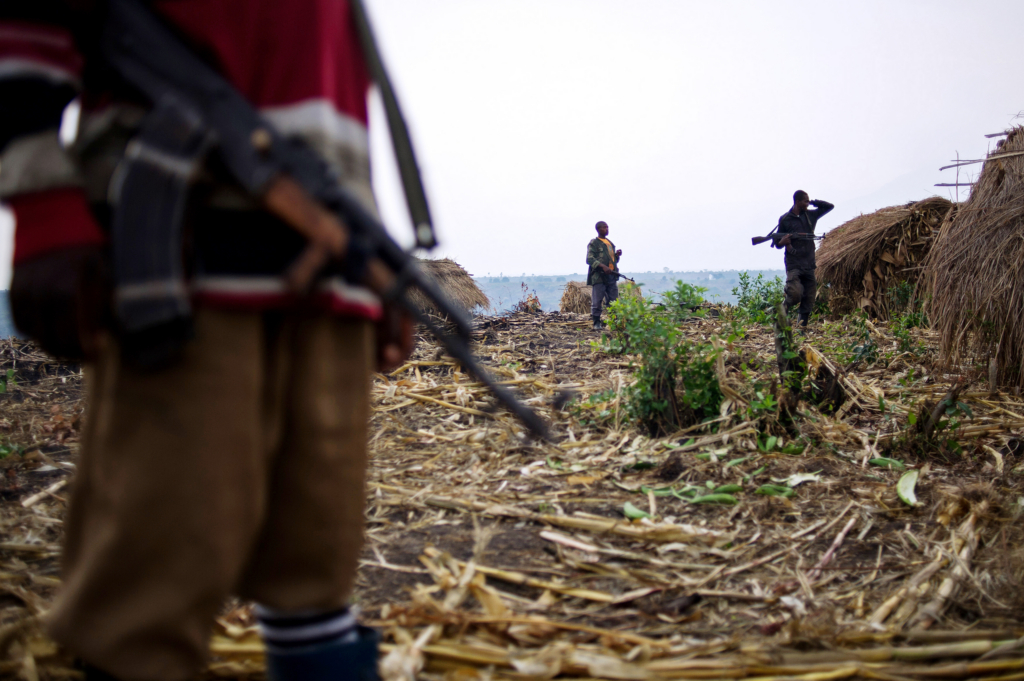
An armed faction operating with backing from the Forces Armées de la République Démocratique du Congo (FARDC) has been responsible for the killing and torture of civilians, widespread looting, and the abduction of women, who were subsequently subjected to sexual slavery in the Rutshuru territory of eastern Democratic Republic of Congo (DRC). These findings were brought to light on June 25.
Known as the Collectif des Mouvements pour le Changement-Forces de Défense du Peuple (CMC-FDP), this group is a component of the Wazalendo, a loosely organized coalition of armed entities. The Congolese army utilizes these groups as auxiliary forces in its ongoing conflict against the Mouvement du 23 mars (M23), which receives support from Rwanda. The CMC-FDP primarily operates within the Bukombo grouping in Rutshuru, an area currently under M23 control.
Civilians residing in and around Bukombo find themselves caught in a terrible vise between the brutality of the M23 and that of the CMC-FDP. The daily ordeal they are forced to endure is horrific, particularly in remote areas where the CMC-FDP acts with complete impunity.
Tigere Chagutah, regional director for East and Southern Africa
The CMC-FDP maintains isolated bases within Bukombo and deliberately targets civilians, often under the cover of night or in locations where M23 fighters are less numerous. Following engagements with the M23, CMC-FDP combatants have retaliated against individuals perceived to have family ties to M23 members. Such human rights violations against civilians flagrantly disregard international humanitarian law and could constitute war crimes.
As Tigere Chagutah, regional director for East and Southern Africa, emphasized: “Civilians residing in and around Bukombo find themselves caught in a terrible vise between the brutality of the M23 and that of the CMC-FDP. The daily ordeal they are forced to endure is horrific, particularly in remote areas where the CMC-FDP acts with complete impunity.”
Congolese authorities frequently and justifiably condemn M23 violence, yet they consistently overlook similar violence and human rights abuses perpetrated by the Wazalendo, including the CMC-FDP. In effect, this condones these crimes and absolves the authorities of their duty to protect civilians and bring Wazalendo combatants to justice. The international community must exert pressure on the DRC government to immediately cease its support for these armed groups.
Between March and April 2026, investigations were conducted remotely via secure phone applications, involving interviews with 16 victims and survivors. These included individuals who had experienced rape and sexual assault, as well as family members of civilians killed, raped, tortured, abducted, or subjected to ill-treatment by CMC-FDP combatants between June and December 2025. Credible information was also received from human rights defenders, detailing similar violence attributed to the group in the region, such as summary executions and the burning of homes.
The international community must exert pressure on the DRC government to immediately cease its support for these armed groups.
Tigere Chagutah
On June 8, 2026, the CMC-FDP received a communication outlining these findings and requesting information regarding the conduct of its commanders and fighters towards civilians in controlled areas. The CMC-FDP spokesperson, Héritier Donald Gashegu, responded in writing on June 16, 2026, denying any responsibility for the documented human rights abuses and asserting the group’s commitment to respecting human rights and maintaining discipline among its combatants.
Rape and other sexual violence against women
One woman, in her early twenties, recounted that after her husband joined the M23 in May 2025, CMC-FDP combatants abducted her from her home and held her captive for three months. She stated, “They gave me a choice: either I went with them, or they would kill me.”
She described being held in a house within their camp, where combatants introduced her to a commander who was to become her “husband.” Daily, she was given a cup of taro and corn to eat. She observed two other women detained in the camp but was threatened with being shot if she spoke to them. The commander, she reported, repeatedly raped her. “I thought he would kill me if I refused. He came every night [for sexual relations].” This woman managed to escape when the M23 attacked the CMC-FDP camp.
Another 22-year-old woman interviewed reported that CMC-FDP fighters abducted her in June 2025, also after her husband joined the M23. She was taken to their base in Mudugudu, Bukombo, and forced to become a commander’s “wife.” She recalled him saying, “If you don’t sleep with me, I will kill you.” She witnessed four other women in the camp similarly forced into becoming “wives” of combatants.
She further disclosed seeing civilians detained and mistreated at the camp. “They took people and brought them to the base. If you had nothing of value, they beat you. If you were lucky, they left you alone. They put people in [underground detention cells]. They detained people to make money.” Such actions bear the hallmarks of the war crime of hostage-taking.
This woman escaped in October 2025, following an M23 attack on the camp.
Both victims of sexual violence interviewed were held in conditions akin to sexual slavery. They reported contracting sexually transmitted infections as a result of the rapes, leading to pain and suffering. While both received treatment at health centers, many victims of sexual violence perpetrated by Wazalendo armed groups lack access to adequate medical or psychological care.
Sexual slavery and other forms of sexual violence committed during armed conflict constitute grave violations of international humanitarian law, amounting to war crimes. They also infringe upon numerous human rights, including the right to equality and non-discrimination, the right to physical integrity, and the right to be free from torture and other forms of ill-treatment.
The CMC-FDP has “categorically rejected” allegations that its combatants raped, sexually enslaved, or forced women to “marry” their commanders. They stated, “No complaint, official report, or referral has been brought to the attention of our internal disciplinary or judicial bodies concerning the facts mentioned.”
CMC-FDP leaders should have been aware of the violence perpetrated by their commanders. They could be considered complicit if they knew such violence was occurring and failed to act to prevent or stop it.
Ill-treatment and other violence against women
On November 20, 2025, eight individuals, including a pregnant woman and her husband, sought refuge in a banana plantation in Mashango, a Bukombo village, during an exchange of fire between the M23 and local armed groups, likely including the CMC-FDP.
Armed combatants discovered them and demanded cooking oil. “We told them we had no more oil. They [then] looted everything from our home and burned our houses. One [of the combatants] took pity on me. He said, ‘This woman is pregnant and will soon give birth, we must spare her.’”
The woman identified them as CMC-FDP combatants because the group maintained a base in Mashango, within the Bukombo grouping, a region it controlled.
The combatants took her husband and killed him. “They cut him with a machete. Everyone was killed with a machete. I [then] went searching for the bodies… when we found them, they were already decomposing.” This woman gave birth to a baby boy, alone in the forest, at 5:30 p.m. that same day.
Another female victim told investigators that her husband joined the M23 in June 2025, and CMC-FDP combatants came to her home the following month. “Four of them [arrived] at noon,” she stated. “Two had pistols, the other two had whips. I asked them to have mercy on me because I was pregnant. They replied, ‘Your pregnancy is not our problem; we want to see your husband.’ They beat me severely. They hit and wounded me with a knife. The next day, I had a miscarriage.”
The CMC-FDP denied allegations of looting and burning homes.
Revenge killings and summary executions
Nine victims and survivors informed investigators that CMC-FDP combatants killed their husbands or abducted them because their sons or husbands had joined the M23.
A 35-year-old woman reported that a CMC-FDP commander and six combatants came to her home in Kyahemba, a village in the Bukombo grouping, in November 2025. She explained that the commander entered the house and asked her, “Did you let [the M23] recruit your child?” The woman stated that her 15-year-old son had left without warning earlier that month to join the M23. “I replied that I didn’t know how he was recruited. At that moment, he started shooting my husband.” She specified that her husband was shot three times in the chest in front of their eight- and six-year-old children. She was later informed that her son had died while part of the M23.
They shot him [my husband] three times in the chest and in his genitals. After killing him, they looted the house. They left with four goats, clothes, and cooking pots.
Elisabeth*
According to four victims and information provided by a human rights defender, a CMC-FDP commander based in Kyahemba was involved in the detention or killing of their relatives.
Another woman, Elisabeth*, stated that six CMC-FDP combatants, four of whom were former neighbors, came to her home in November 2025, searching for her husband. “They told us to leave the house. They said, ‘You are collaborating with the [M23]…’ They acted as if [my husband] was in league with the M23. They shot him three times in the chest and in his genitals. After killing him, they looted the house. They left with four goats, clothes, and cooking pots.”
In its response, the CMC-FDP did not specify measures taken to investigate allegations of its combatants killing civilians. It claimed insufficient information to conduct such inquiries.
Extortion and threats
Before the M23’s arrival in the region, the CMC-FDP extorted money from residents through a form of tax known as lala salama (“sleep peacefully” in Swahili). These “taxes” were purportedly for civilian protection. One victim stated her husband joined the M23 due to his frustration with these extortions.
Innocent*, who worked in Kyahemba, reported that CMC-FDP combatants approached him three times since his son joined the M23 in August 2025, demanding money on this basis. He paid them 300 US dollars. “Each time, they told me to make my son join their group. I said I didn’t take him there. How was I supposed to find him? Each time they came, they beat me. They burned three houses, mine and two others. They said they would kill me if I didn’t give them money.”
Justine*, a 20-year-old woman, stated that her husband fled in July or August of last year without warning. In September, CMC-FDP combatants came to her home. “I look like a Tutsi. [The CMC-FDP combatants] forced the door, entered, and whipped me once on my back and once on my chest. They tied my hands. They told me, ‘Tell us where your husband is.’” When she replied she didn’t know, they explained they would take her to one of the CMC-FDP military commanders, implying he would force her to reveal her husband’s whereabouts.
Each time they came, they beat me. They burned three houses, mine and two others. They said they would kill me if I didn’t give them money.
Innocent*
En route, one of the combatants helped her escape. “I was carrying a child, and the combatant took pity on the baby. He said, ‘If you go this way, they will kill you.’”
Justine believed fear drove her husband to join the M23. She explained that in July or August, the M23 had threatened her husband, saying, “[You] are a Tutsi from Rwanda, and all Tutsis who do not join the M23 will be beheaded.”
The CMC-FDP wrote that it had “neither a policy nor a practice of demanding ransoms or payments from relatives of those who have joined the M23 or any other enemy movement. If isolated cases of behavior contrary to our principles existed, we would be the first interested in identifying the perpetrators so that appropriate measures are taken in accordance with disciplinary rules and the requirements of justice.”
CMC-FDP leaders should have been aware of the extortion and ransom practices occurring and bore the responsibility to investigate them and hold involved combatants accountable. If they knew these actions were taking place and failed to take necessary steps to end them, they could be considered complicit.
Congolese army support for the CMC-FDP
In May 2023, the DRC enacted a law establishing the Armed Reserve for Defense, which provided for the integration of certain local armed groups, including the CMC-FDP, into the Congolese army, thereby forming an auxiliary force to combat the M23.
The FARDC provides financial aid and supplies weapons and ammunition to these armed groups. In December 2025, the DRC’s Minister of Finance informed the National Assembly’s Defense and Security Commission that the state was paying Wazalendo groups 4 million US dollars monthly.
According to an internal document from the North Kivu military government, obtained by Ebuteli, a Congolese research group, the CMC-FDP received over 100,000 rounds of ammunition and more than 100 40-millimeter rockets from the FARDC in late 2023 and early 2024.
It is unacceptable that the Congolese army continues to support CMC-FDP combatants despite the terrible human rights abuses they inflict on civilians.
Tigere Chagutah
In July 2024, the European Union sanctioned CMC-FDP commander-in-chief Dominique “Domi” Kamanzi Ndaruhutse for “committing acts that constitute serious human rights violations and abuses.” Kamanzi Ndaruhutse has fought with various nyatura (“strike hard” in Kinyarwanda) groups for over 10 years and, according to the United Nations Group of Experts on the DRC, has collaborated with the Forces Démocratiques de Libération du Rwanda (FDLR), particularly in the Bwito grouping (Rutshuru territory). The FDLR is an armed opposition group operating in eastern DRC, composed of Rwandan and Congolese fighters. Its ranks include former Interahamwe members and ex-Rwandan soldiers responsible for the 1994 genocide, as well as combatants who did not participate in the genocide.
“It is unacceptable that the Congolese army continues to support CMC-FDP combatants despite the terrible human rights abuses they inflict on civilians,” Tigere Chagutah stated. “The group has engaged in rampant violence for years. Congolese authorities must immediately end their collaboration with and support for the CMC-FDP and other abusive Wazalendo groups, and ensure they are held accountable.”
* Pseudonyms are used to protect the identity of interviewees for security and confidentiality reasons.