For a long time, a recurring criticism echoed in Gabon’s public debate. Since taking power on August 30, 2023, Brice Clotaire Oligui Nguema was seen everywhere in the field, but rarely in direct exchanges with national journalists. Speeches, inaugurations, and trips multiplied. Spontaneous answers to citizens’ questions, however, remained scarce.
This perception appears to have shifted in recent weeks. Not through a solemn press conference or a carefully staged institutional exercise, but via a series of interviews conducted by journalist Chamberland Moukouama during the president’s stay in Mayumba and Tchibanga, then in Libreville, particularly in Baraka, Bikelé, and at Poste SA in the city center.
Beyond mere media success, this initiative may reveal a deeper evolution. One of a presidential communication that now seeks to break away from classic formats to reconnect with a form of political authenticity that has become rare on the continent.
The power of simplicity
The originality of the approach lies not only in the journalist’s personality. It lies mainly in the method used.
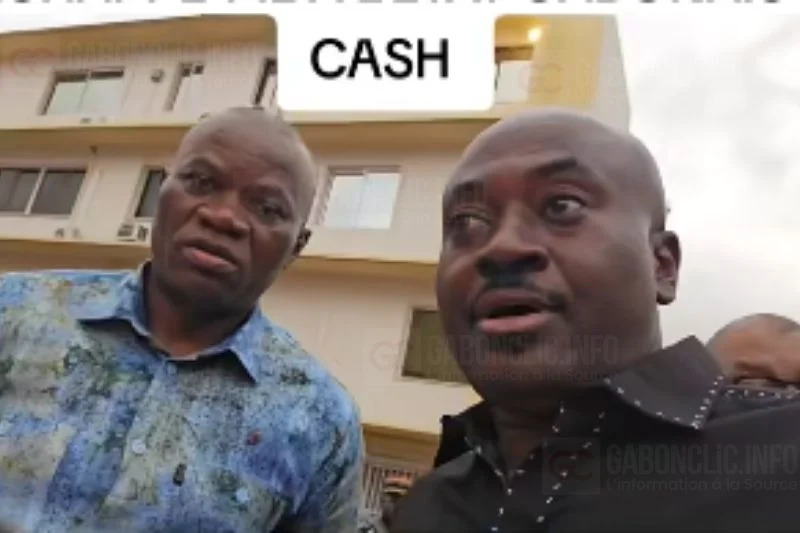
Founder of the ‘CASH’ concept, Chamberland Moukouama advocates an approach centered on citizen education, popular education, and frankness. His goal is not only to inform but also to translate public issues into language everyone can understand.
In Mayumba, he chose to ask the questions ordinary citizens ask themselves daily. Simple, direct, sometimes unsettling inquiries, often absent from traditional institutional interviews.
Even more significant, the exchange took place far from official lounges. By accompanying the president on a nocturnal fishing trip, the journalist moved the political debate into an unusual setting. Protocol gave way to spontaneity.
This closeness allowed for addressing sensitive topics. Governance, criticism of the authorities, the influence of certain advisors, perception of reforms, or more personal aspects of wielding power.
The result surprised many observers. Gabonese people discovered a head of state who is less institutional, more accessible, able to answer without apparent filter to concerns that circulate in neighborhoods, on social media, and in everyday conversations.
When communication becomes a political act
In major democracies, some journalists have marked their era by reducing the distance between leaders and citizens.
Jean-Pierre Elkabbach in France built his reputation on intellectual confrontation with political figures. Jean-Jacques Bourdin imposed a style based on concrete public concerns. Christophe Boisbouvier, on the African continent, distinguished himself by his ability to question leaders in sometimes unexpected contexts.
In his own way, Chamberland Moukouama fits into this tradition. With a notable difference. Where others prefer the studio, he chooses the field.
This approach comes at a particular moment in Gabon’s political history. After the transition and presidential election, expectations for transparency are high. Citizens demand more than top-down communication. They want to understand, question, sometimes challenge.
In this context, accepting direct and less formatted exchanges already constitutes a political message. Because modern communication is no longer just about disseminating information. It involves creating the conditions for dialogue, even when questions are uncomfortable.
Authenticity as a power strategy
This media sequence also sheds light on the philosophy that Brice Clotaire Oligui Nguema says he wants to imprint on his mandate. ‘The best guarantee against hubris is memory. I do not forget where I come from,’ the Gabonese president explained.
This statement takes on special significance when contrasted with these informal exchanges. The head of state recalls his knowledge of the field, social realities, and daily difficulties faced by the population.
He also responds to a criticism voiced for several months by many national journalists, who felt they had limited access to presidential information.
By engaging in this exercise, Oligui Nguema sends a clear signal. One of a power that intends to stay connected to its base and not lock itself into institutional circles. It remains to be seen whether this occasional openness will become a lasting practice. Because the stakes go far beyond a successful interview.
It touches on the quality of the link between power and citizens. If this experience were to multiply, Mayumba could remain in Gabon’s recent political history as the place where presidential communication changed nature. A moment when official discourse ceased to be only vertical and became more conversational.
On a continent where distrust of institutions remains high, this evolution could constitute much more than a media innovation. It could become a real governance tool. Because in the 21st century, proximity is no longer just a political quality. It has become a condition of legitimacy.