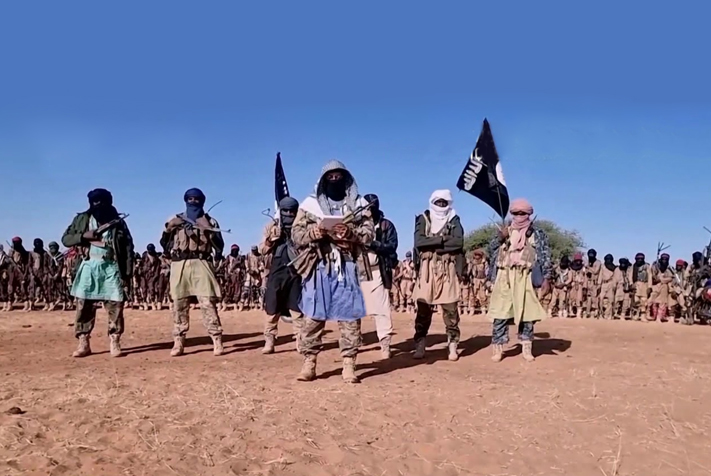
The Islamic State’s Sahel Province continues to exert influence in northeastern Mali, even as attention shifts to the JNIM.
The Gao region, particularly the Ansongo district, and the Ménaka region remain hotspots where the Islamic State in the Greater Sahara (ISSP) maintains a firm grip. Within these areas, the group operates in key locations known as the “3 T“—Talataye, Tin-Hama, and Tessit—alongside Labbezanga, where it enforces territorial control and exerts relentless pressure on local communities.
Leadership and Adaptation
The ISSP is currently led by Abou Al-Bara, who took over after the death of Adnan Abu Al-Walid Sahraoui in 2021. While the group’s command structure remains partially unclear, it has shifted tactics since 2020, moving away from high-profile executions and mass terror toward a more strategic approach of territorial governance and localized influence. This shift includes efforts to win over populations through subtle social control rather than overt violence.
Despite ongoing military pressure, the ISSP persists. In a recent operation, Malian forces neutralized an operational commander in Bara, Ansongo district, during an overnight airstrike on May 14-15, 2026. The strike also eliminated several affiliated fighters, highlighting both the military’s determination and the group’s resilience in rebuilding its networks along border regions.
Strategic Operations and Rivalries
The ISSP continues to target critical zones along the Mali-Niger border, including Talataye, Tin-Hama, Tessit, Labbezanga, and Ménaka. By controlling the movement of people and goods, the group reinforces its dominance over regional trade corridors while exerting influence over local armed factions.
The rivalry between the ISSP and the JNIM remains a defining feature of Sahel security dynamics. While the JNIM has gained visibility through high-profile attacks, such as the coordinated assaults on April 25, 2026, near Bamako and other localities, this does not mean the ISSP has faded. The two groups operate under different strategies: the JNIM focuses on dramatic, media-attracting strikes, whereas the ISSP prioritizes quiet territorial control, community pressure, and securing key transit routes.
Former JNIM members once contributed to a temporary truce in direct confrontations, but this relative calm has eroded since 2020. Current military offensives in Mali have led the two groups to temporarily shift focus toward their shared adversary, though no formal peace agreement has been reached.
Escalating Threats and Governance
According to ACLED data from May 15, 2026, 86% of Islamic State activity globally in Q1 2026 occurred in Africa, marked by increased use of armed drones, motorized assaults, and economic pressure targeting both urban and rural areas. The ISSP has intensified attacks on civilian and military infrastructure along the Ménaka-Ansongo-Tessit axis and in Labbezanga, exploiting local vulnerabilities to impose de facto governance. A February 7, 2026 attack on a civilian convoy near Kobé, 35 km from Gao, underscores the group’s growing boldness.
While international cooperation has led to the neutralization of key figures—such as Abu-Bilal Al-Minuki, eliminated in a joint operation between Nigeria and the United States in the Lake Chad Basin on May 16, 2026—the ISSP’s threat remains deeply rooted in northeastern Mali. Its territorial control and influence over local armed groups persist, particularly in the “3 T” areas and Labbezanga.
The ISSP continues to thrive by leveraging media focus on the JNIM and other factions to quietly expand its influence, govern local populations, and pressure Malian forces. Its entrenched organizational structure and ongoing operations confirm that the threat is far from eradicated. Strengthening security measures, especially along the Niger-Mali border, remains essential to curbing its expansion.