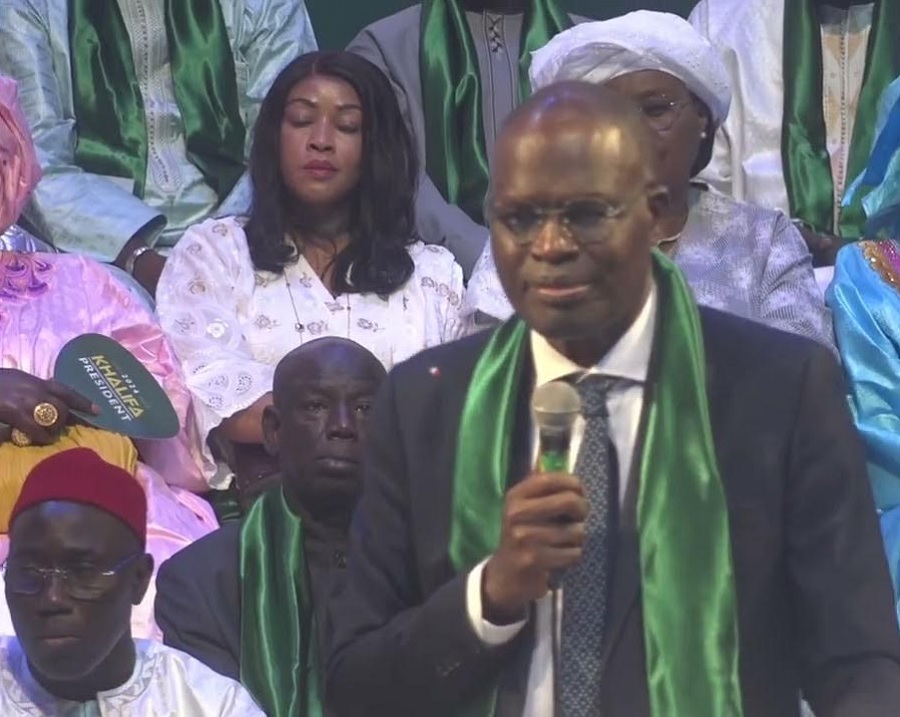
Taxawu Sénégal officially transitioned from a political platform to a fully structured party during its constitutive congress in Dakar on Sunday, May 10. The landmark event, held under the theme “From platform to political party: Rethinking the social contract for a sovereign, just, united and prosperous Sénégal”, brought together militants, leaders and supporters to define a bold new strategic direction.
At the end of the proceedings, Khalifa Ababacar Sall was overwhelmingly acclaimed as the party’s leader in an atmosphere of enthusiasm and unwavering commitment. In a speech blending sharp critique with a forward-looking vision, the newly elected head of Taxawu Sénégal delivered a sobering assessment of the nation’s state, highlighting “profound questions” and “real struggles faced daily by our fellow citizens.”
Addressing the assembly, Khalifa Sall declared: “From our cities to our rural areas, in neighborhoods and villages alike, one truth stands clear: Senegalese men and women feel—and, indeed, know—that promises of social justice, prosperity and transparency remain unfulfilled.”
The socialist leader painted a vivid picture of a nation grappling with multifaceted social crises: underpaid teachers, students enduring harsh learning conditions, workers demanding fair labor standards, farmers in distress, fishermen facing dwindling marine resources, and women navigating worsening economic precarity. He warned of “total disarray among our farmers” and cautioned that “the progressive depletion of fisheries threatens not only coastal livelihoods but the very fabric of Senegal’s maritime economy.”
Youth unemployment emerged as a central concern. “When a nation’s youth falter, the entire country trembles,” he cautioned, adding pointedly: “We find youth seeking work; we struggle to find youth who have found it.”
Taxawu Sénégal’s response? A bold proposal for a refounded social contract. At its core lies “an impartial, efficient and exemplary state,” coupled with expanded access to education, healthcare, employment and social protection. The party champions stronger decentralization—empowering autonomous and accountable local governments—transparent budgets and grassroots governance that puts citizens at the heart of decision-making.
Institutional integrity is non-negotiable. Khalifa Sall called for an independent judiciary, free from political interference or “selective justice”, and defended fundamental freedoms: free speech, press liberty and political pluralism. “A democracy without a vibrant opposition is merely an autocracy in denial,” he asserted.
International engagement must align with national sovereignty. He advocated for a Senegalese diplomacy rooted in “peace, multilateralism, African solidarity and economic independence”—especially vital in today’s volatile geopolitical climate.
Taxawu Sénégal’s ideological foundation is unequivocally socialist. “We are socialists. We cannot accept a system where inequality is passed down through generations,” he affirmed. The party’s societal vision rests on a triptych of Human dignity, Water and Land, aiming to build a productive, distributive economy that generates wealth and shares its benefits equitably.
In a solemn appeal to left-wing allies, Khalifa Sall urged unity: “Sénégal needs a united opposition. Unity is our strength—and it will be our victory.” The closing ovation from the crowd underscored the moment’s historic weight.