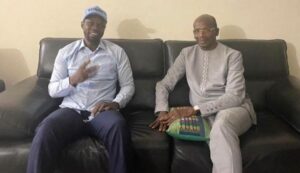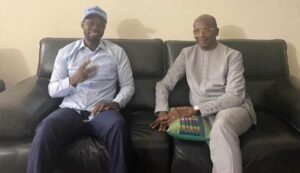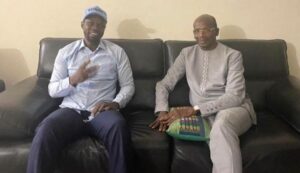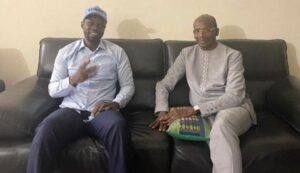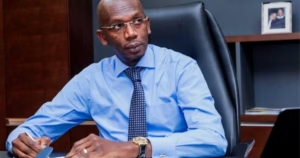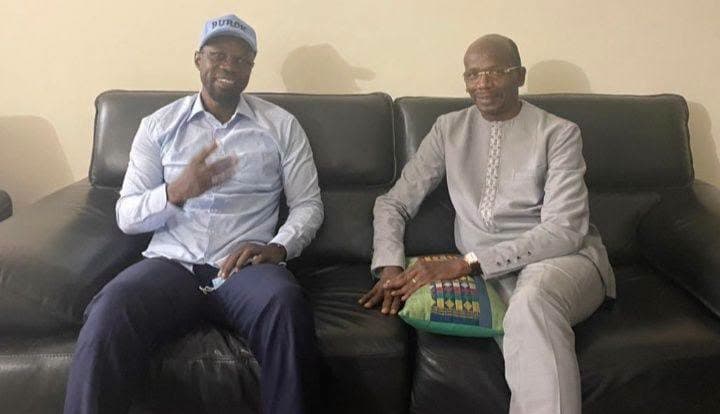
In a bold public statement, Lansana Gagny Sakho, Chairman of the Board of Directors of APIX, clarified his stance on the political rift that has emerged within the ranks of Pastef. Speaking during a television appearance, he outlined his unwavering commitment to the Republic, contrasting his own principles with what he describes as Ousmane Sonko’s persistent disregard for institutional unity.
Sakho’s remarks came in response to a question about his decision to distance himself from the party’s co-founder. He recounted how his initial alignment with Pastef stemmed from admiration for its founding figures. However, after the political transition, when offered a high-profile position in the water and sanitation sector, he declined to uphold his core values. « Prioritizing principles over positions allowed me to leave with clarity. From the outset, I chose the Republic over personal gain, » he asserted.
Sonko’s alleged undermining of state authority
Addressing Sonko’s public criticism of the government during the President’s official visits abroad—first to the United States and later to China—Sakho condemned the timing and substance of those remarks. He argued that such statements, which questioned the government’s authority while the head of state was representing the nation, were not only disrespectful but also destabilizing. « A leader who claims to seek national cohesion cannot, at the same time, publicly question the very institutions meant to guide the country forward, » he remarked.
Institutional continuity over partisan divides
Sakho emphasized that his political allegiance lies with the institutions of the Republic, not with any individual party. He acknowledged that challenges have arisen on both sides of the political spectrum but pointed to significant progress—particularly in the judiciary—as evidence of a functioning state. Reflecting on recent changes at the Ministry of Justice, he dismissed rumors of external manipulation, noting that the outgoing Justice Minister, Ousmane Diagne, had publicly declared his independence before the National Assembly.
« Those who believe magistrates can be controlled are gravely mistaken, » Sakho stated, underscoring the professional integrity of Senegal’s judicial system. He cautioned against underestimating the resilience of institutions, asserting that real power dynamics are far more complex than opposition narratives suggest.
Growing defection in Pastef amid shifting political alliances
Sakho’s intervention follows a wave of resignations within Pastef, with several high-profile members crossing the aisle to align with President Diomaye Faye’s administration. This shift coincides with preparations for the imminent launch of the Kiiraay party, signaling a potential realignment of Senegal’s political landscape. Sakho, who has repeatedly voiced his support for Faye’s leadership, framed his decision as a defense of institutional stability over partisan loyalty.
« The Republic endures beyond individuals and parties, »
he concluded, reaffirming his belief in a state governed by law, not by personal ambitions or fleeting alliances.