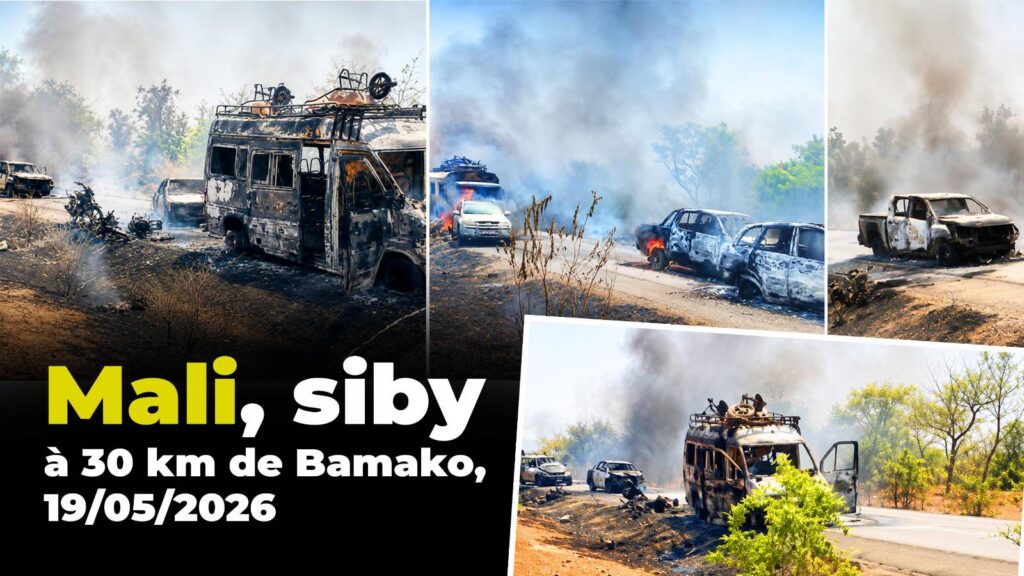
The safety of Bamako is no longer a given. Once a forbidden topic, this harsh reality now dominates daily discussions across the city. On May 19, 2026, the rural commune of Siby, just 30 kilometers from the capital, became the stage for an unprecedented assault that exposed the fragility of Mali’s security situation.
Flames at the gates of the capital
In the afternoon of that day, the highway linking Bamako to Guinea erupted into chaos. Witnesses recounted how armed assailants on motorcycles converged on the national road near Siby, intercepting convoys of commercial trucks, passenger vans, and private vehicles. The attackers, who met little resistance, torched the entire fleet, leaving behind smoldering wrecks and thick plumes of black smoke visible from the outskirts of the city.
Beyond the immediate financial losses for struggling merchants, the attack carried a chilling symbolic weight. Siby, a cultural and tourist hub steeped in the legacy of the Charte de Kouroukan Fouga, had long been considered a sanctuary. Yet the JNIM’s ability to strike with impunity revealed a grim truth: no area in Mali is truly secure.
A calculated strangulation of Bamako
The assault on Siby was not an isolated incident. It marked the latest escalation in a deliberate campaign by the JNIM to encircle Bamako. Over the past months, the group has tightened its grip on nearly every major route supplying the capital, turning transportation into a deadly gamble.
Travelers on the roads to Ségou, Sénégal, or the southern corridors leading to Guinée and Côte d’Ivoire now face a harrowing choice: pay a toll to armed groups or risk losing their cargo to arson. The blockade’s goal is clear—suffocate Bamako’s economy and plunge its residents into hardship. Prices of essential goods have skyrocketed in local markets, fueling public frustration that the transitional government struggles to contain.
Military partnership falls short
As the JNIM’s blockade tightens, the official narrative of Mali’s military recovery clashes sharply with ground realities. Since international forces withdrew, the junta has staked its legitimacy on a partnership with Russian paramilitary forces, known as Africa Corps. Yet the events of May 19 cast severe doubt on this alliance’s effectiveness.
The Russian fighters, funded by Malian taxpayers, have proven unable to thwart or even anticipate attacks just half an hour’s drive from the presidential palace in Koulouba. Their tactics—often centered on punitive raids or securing mining sites—offer little defense against the insurgents’ asymmetric warfare. Joint patrols between Malian troops and Russian mercenaries lack the foresight and territorial coverage needed to protect critical supply routes. Even the junta’s heavy investment in propaganda fails to mask the glaring operational failures on the security front.
The moment of reckoning for Bamako
The attack on Siby serves as a final warning. Denial can no longer substitute for a coherent defense policy. By allowing the JNIM to establish a blockade around Bamako and strike with impunity, the junta and its Russian allies have exposed their strategic shortcomings. For ordinary Malians, the promise of restored sovereignty and total security has dissolved into the sight of burning trucks and severed roads.
If Bamako is to avoid complete paralysis, a fundamental reevaluation of its military strategy and alliances is no longer optional—it is a matter of national survival.