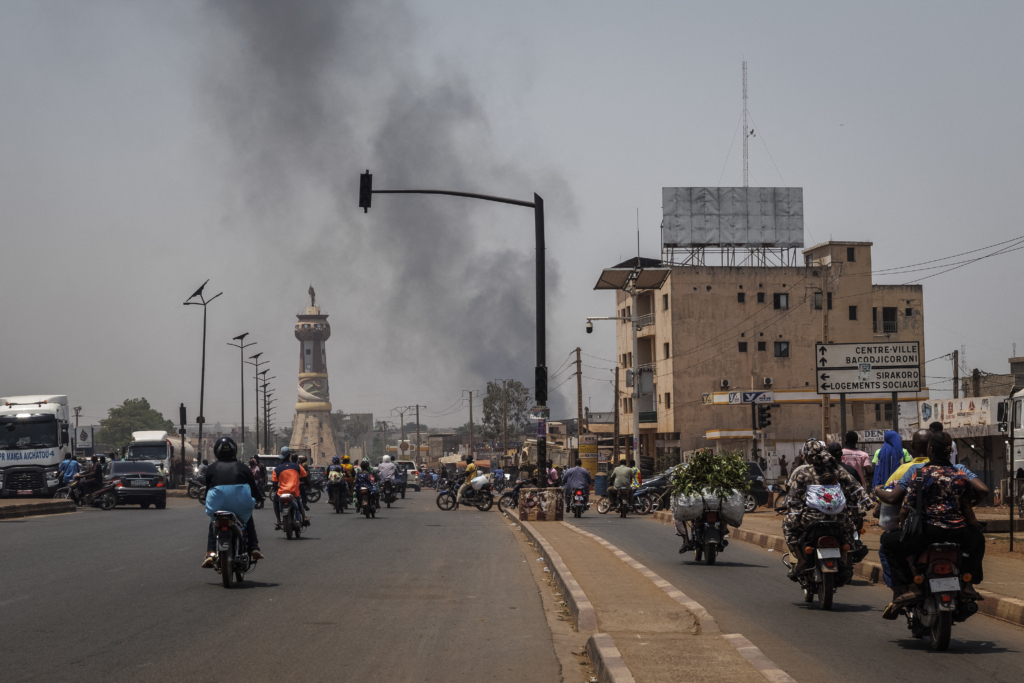
Bamako’s ongoing blockade is inflicting unacceptable hardship on civilians, threatening their fundamental rights to food, health, and safety, warns a leading human rights organization. The Groupe de soutien à l’islam et aux musulmans (GSIM), an Al-Qaeda-affiliated armed group, has been urged to comply with international humanitarian law and cease actions that endanger civilian lives.
Since April 28, three of Bamako’s six major supply routes have been severed by GSIM attacks, cutting off the capital from critical food, fuel, and medical deliveries. On May 6, the group targeted a civilian truck convoy carrying goods—including fresh produce—between Bamako and Bougouni. Eyewitnesses confirmed the trucks were unescorted and transported no military personnel or equipment, rendering the attack a clear violation of civilian protections under wartime laws.
‘Targeting civilian vehicles is unlawful,’ stated a regional director at the organization. ‘International humanitarian law demands strict separation between combatants and civilians. Any attack on unarmed drivers, supply chains, or essential infrastructure constitutes a war crime.’
Blockades must not trample on civilians’ economic and social rights. The GSIM must ensure Bamako’s population retains access to clean water, food, and life-saving supplies.
Regional Director, Human Rights Organization
Blockade escalates into full-scale humanitarian crisis
The GSIM’s April 28 announcement marked a decisive shift from its September 2025 blockade, which had targeted only fuel tankers. This new phase halts all commercial traffic, leaving markets barren and prices soaring. By May 15, traders and residents reported acute shortages of staples like rice, cooking oil, and medicines, with transportation costs doubling overnight.
‘The blockade’s ripple effects are catastrophic,’ noted a UN human rights spokesperson. ‘Civilians are paying the price—denied freedom of movement, cut off from livelihoods, and forced into survival mode.’
On May 6, the GSIM pledged a partial easing, permitting medical evacuations. However, independent verification remains impossible, leaving families in limbo.
Previous assault reveals pattern of brutality
In January 2026, a survivor recounted a January ambush near Diboli, Kayes, where GSIM fighters—over 200 strong—ambushed a military-escorted fuel convoy. The attackers executed drivers and apprentices at point-blank range, then burned military vehicles after slaughtering the reinforcements. ‘They made us dig graves for their dead before cutting our throats,’ the driver recalled.
Such tactics flagrantly breach international law, which prohibits indiscriminate attacks on civilians and the destruction of civilian property. The organization has called for urgent investigations into potential war crimes, emphasizing victims’ rights to truth, justice, and reparations.
Escalating violence fuels instability
The blockade follows coordinated GSIM attacks on April 25 across Bamako, Kati, Mopti, Sévaré, Gao, and Kidal. Targets included military bases and officials’ residences, with Defense Minister Sadio Camara among the fatalities in Kati after a car bomb detonated outside his home.
May 6 saw further bloodshed in Kori Kori and Gomassagou villages, where GSIM assailants reportedly massacred 40 people, leaving several others missing. The assaults underscore the group’s escalating campaign to destabilize Mali’s fragile security landscape.