The coordinated attacks by the JNIM and FLA on April 25, 2026, represent a pivotal shift in Mali’s security landscape since 2012. Striking simultaneously at Bamako, Kati, Kidal, Gao, and Sévaré, these groups exposed the vulnerabilities of a security model overly reliant on external support. The recapture of Kidal has dealt a severe blow to the junta’s legitimacy narrative, while also undermining the perceived effectiveness of Russia’s military partnership. Though a direct assault on Bamako remains unlikely in the short term, the JNIM is waging a relentless war of attrition, escalating regional instability across the Sahel and the Gulf of Guinea.
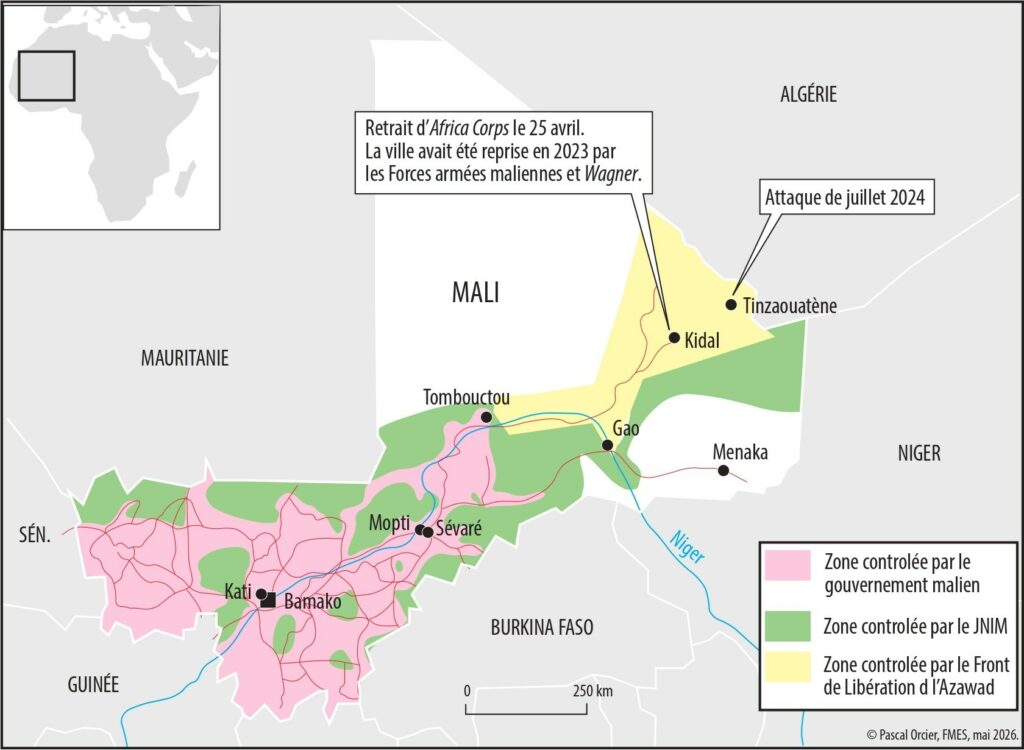
The tightening grip on Bamako
The April 25 offensive marks a significant escalation in Mali’s security crisis. The simultaneous strikes on multiple key locations were meticulously coordinated, catching security forces off guard. This escalation follows a long-term trend of deteriorating security since 2020, compounded by the junta’s rise to power in August of that year.
The JNIM’s reach has expanded dramatically over recent years. Once primarily active in northern rural areas, the group has progressively extended its operations westward and southward, into regions previously considered relatively secure. Its influence now extends beyond Mali’s borders, impacting coastal nations such as Togo, Benin, and Nigeria. The frequency of attacks attributed to the JNIM has surged, particularly those targeting the Malian Armed Forces (FAMA). In July 2024, FAMA suffered a significant setback when supported by Russia’s Africa Corps, it was defeated by a coalition of JNIM and CSD-DPA forces. Since then, the JNIM has launched a series of attacks against military bases in Tombouctou, Bamako, and Kayes. While FAMA has bolstered its capabilities with Turkish Bayraktar drones, these remain insufficient for comprehensive territorial surveillance.
Since September 2025, the JNIM has implemented an economic strangulation strategy against Bamako, targeting fuel convoys and disrupting supply routes. This tactic aims to erode the junta’s legitimacy by directly impacting civilian life through fuel shortages and economic instability. By demonstrating an alternative governance model in areas under its control—based on Islamic justice, taxation, and regulated trade—the JNIM positions itself as a viable alternative to the absent state. While a military takeover of Bamako appears unlikely due to the group’s estimated 5,000 to 6,000 fighters facing a concentrated security force, the psychological pressure is mounting. The blockade of Bamako underscores a strategy of attrition rather than immediate conquest.
Kidal’s fall and the unraveling of Russia’s narrative
The April 25 attacks highlight the JNIM’s growing capabilities. In Kati, a strategic military hub, the Malian Defense Minister was killed. Bamako’s Modibo Keita International Airport was also struck. Most critically, the JNIM and FLA reclaimed Kidal, a city recaptured by FAMA and Wagner forces in 2023 as a historic victory. This reversal marks a unprecedented setback since 2013, forcing the Africa Corps to withdraw from Kidal and Gao. The ability of FAMA to reclaim the city remains uncertain.
Kidal’s recapture evokes memories of 2012, when Tuareg rebels and jihadist groups initially collaborated before diverging due to ideological differences. The JNIM advocates for Sharia law, while Tuareg rebels focus on an autonomy-driven agenda for Azawad. Historical tensions persist, but shared adversaries—the junta and its Russian partners—have fostered a tactical alliance. Signals of rapprochement emerged as early as March 2025, with reports suggesting negotiations began in December 2024. The durability of this coalition remains uncertain, particularly in light of the power struggle over Kidal.
The timing of these attacks coincides with a supposed truce agreement in late March 2026, which included the release of ‘jihadist’ prisoners in exchange for lifting the fuel blockade to Bamako. The Malian government later denied releasing 200 ‘jihadists,’ casting doubt on the agreement’s validity. Regardless, the JNIM’s offensive momentum remains unchecked.
On April 28, the JNIM declared a ‘total siege’ of Bamako, demanding the withdrawal of Russian forces. The following day, its spokesperson, Mohamed Ramadane, declared the regime’s imminent collapse and vowed to ‘liberate’ Gao, Tombouctou, and Ménaka. Such maximalist rhetoric suggests little immediate inclination toward negotiation.
The junta’s political and military standing has been severely undermined. The assassination of the Defense Minister is a symbolic blow, but the retreat of Africa Corps from Kidal has shattered the narrative of regained sovereignty through Russian partnership. Wagner, and later Africa Corps, were touted as the junta’s solution to insecurity and a counterbalance to French influence. Kidal’s fall has exposed the fragility of this security model, even if Africa Corps has shielded the junta’s leadership from direct threats.
External allies under scrutiny
While the JNIM’s immediate ambitions appear limited, its strategy does not include toppling the regime outright. A weakened junta still serves the group’s interests by fueling its own legitimacy among civilians. An immediate collapse could invite international actors the JNIM seeks to exclude, while direct confrontation with Russia risks costly repercussions. Though Russia lacks the air superiority once held by French forces, Moscow retains the capacity to deploy reinforcements to salvage its position. A withdrawal from Mali would signal a significant loss of credibility for Russia, which views the country as a showcase for its African security model through Wagner and Africa Corps. The Kremlin is likely to double down on its commitment, despite the setback.
Russia is not the only external actor supporting the junta. Turkey, through the SADAT security firm, has maintained a presence in Mali since 2024, reportedly engaged in protecting the junta and training special forces. This involvement may have played a role in safeguarding the junta leader during the April 25 attacks. As the situation deteriorates, Ankara’s role in protecting the regime could expand. On May 1, the FLA spokesperson, Mohamed Ramadane, called on Turkey to ‘reassess its support for the Bamako junta’ and play a constructive role in Mali.
A shifting Sahelian landscape
The Alliance of Sahel States (AES) has adopted a cautious stance. While a statement condemning the attacks was issued on April 27, neither Niger nor Burkina Faso intervened militarily. The Liptako-Gourma Charter, which underpins the alliance formed in September 2023, includes a mutual assistance clause for threats to sovereignty and territorial integrity. Article 6 states:
“Any attack on the sovereignty or territorial integrity of one or more Contracting Parties shall be considered an aggression against the others, triggering a duty of assistance and support, including the use of armed force, to restore and ensure security within the alliance’s scope.”
At a meeting of chiefs of staff on April 16 and 17, 2026, the three countries announced plans to expand their unified force to 15,000 soldiers, up from the original 5,000. Given their shared jihadist threats, Niger and Burkina Faso have opted not to divert forces to Mali.
Algeria stands to gain from the current instability. The shifting focus of attacks toward central and southern Mali reduces pressure on its borders, where threats have historically been concentrated. Algiers has been re-engaging in the Sahel through high-level visits, such as President Tiani’s state visit to Niger in February 2026, and initiatives like the proposed trans-Saharan gas pipeline. Algeria views its influence in the Sahel as an extension of its natural sphere of control. Morocco, Algeria’s historical rival, is advancing its own agenda with the Atlantic Initiative, launched in 2023, which aims to provide landlocked Sahelian nations with Atlantic access via Mauritania. Algeria may leverage its historical ties with the FLA to mediate between Bamako and the Tuareg rebels, positioning itself as a key negotiator in the region.
Meanwhile, the United States is attempting to re-engage with Bamako. In February 2026, Nick Checker, head of the U.S. State Department’s African Affairs Bureau, visited Mali to express Washington’s respect for Malian sovereignty. This rapprochement aligns with the Trump administration’s new strategy toward the AES juntas to counter Russian influence. The April 25 attacks further complicate these efforts, weakening a potential interlocutor with whom the U.S. is seeking to rebuild relations.
Regional spillover: a fragmented threat
The April 25 attacks signal a new phase of more coordinated, geographically diffuse, and tactically collaborative operations between two groups with distinct agendas. However, the risk of regional spillover is not uniform and requires analyzing the specific dynamics of each actor.
The FLA, driven by a nationalist agenda focused on Azawad, has neither the intention nor the capability to operate beyond northern Mali. Its strategy is territorial and identity-driven, not transnational. Consequently, it does not pose a direct destabilization threat to Burkina Faso, Niger, or coastal states.
The JNIM, in contrast, has demonstrated a regional projection capability. It operates in Burkina Faso and Niger and is expanding pressure toward the Gulf of Guinea. A sustained weakening or collapse of the Malian junta would provide the JNIM with a broader sanctuary from which to intensify operations. Burkina Faso and Niger, whose political survival is partly tied to Bamako’s stability, would be the first exposed to these developments.
This divergence in agendas raises questions about the durability of the coalition between the two groups. Their alliance is opportunistic, driven by a shared adversary rather than a unified political vision. The coalition may persist as long as the fight against the junta remains the priority, but fractures are likely to emerge once this objective is addressed. The control of Kidal will serve as a critical test of this fragile partnership.
Further west, Senegal and Mauritania, relatively unscathed until now, are not immune. They represent key transit routes for fuel and goods destined for landlocked Mali—axes already targeted by the JNIM in the Kayes region. While the JNIM does not pose an existential threat to these countries, the trajectory is concerning. Border skirmishes could escalate, exposing their economies to the security upheavals in Mali.
In the Gulf of Guinea, Benin and Togo face a different risk. Their vulnerability stems not directly from Mali’s instability but from its potential consequences. The primary vector of contagion is the instability in Burkina Faso, a neighboring country. A further deterioration in Burkina Faso—potentially exacerbated by a collapse in Bamako—would pose the most immediate threat to these coastal states.
The threat is not solely external. Internal coups within Mali remain a possibility. The junta’s increasing repression risks accelerating its own fragility. As analyst Wassim Nasr notes, this radicalization could push opponents to view the junta’s overthrow as the only viable solution. Such a scenario would provide the JNIM with an additional opportunity to consolidate its gains. Ultimately, these attacks underscore the accumulated weaknesses of a regional security system overly dependent on external partners with contested results, and a Malian state whose legitimacy wanes as its ability to protect citizens erodes.