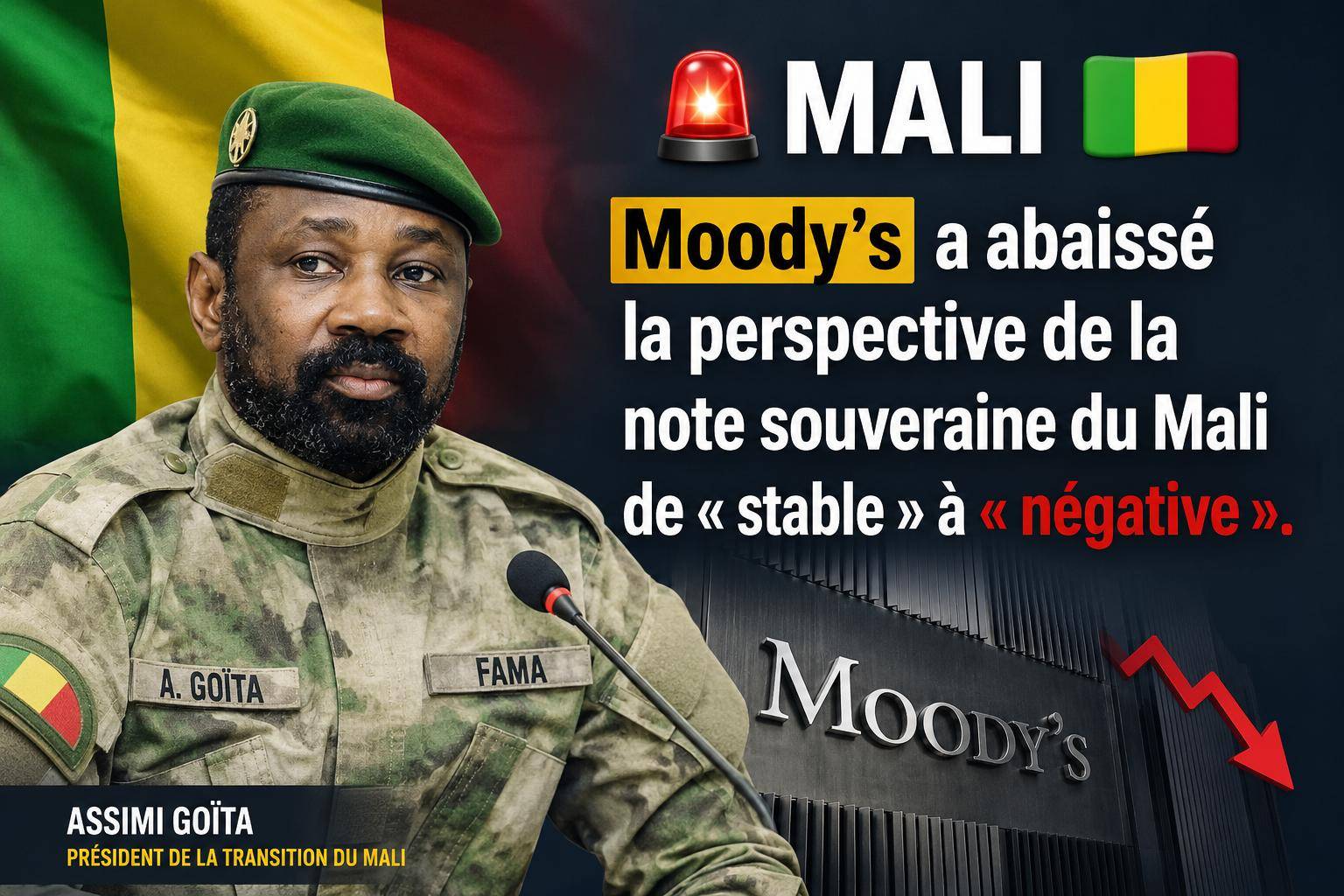
The credit rating agency Moody’s has revised its outlook for Mali’s sovereign debt, moving it from “stable” to “negative” while maintaining the overall grade at Caa2. This adjustment reflects growing concerns over security threats, tightening liquidity in the regional financial market, and a climate of political ambiguity. For the Malian economy, this signal to international and regional investors complicates the process of securing the capital essential for national development.
Financial warnings driven by ground realities
The assessment by Moody’s serves as a barometer for market confidence. By shifting the outlook to negative, the agency is issuing a clear caution: the likelihood of a full downgrade of Mali’s credit rating in the near future has risen. The current Caa2 status already places the nation’s debt in a high-risk category, often viewed as speculative by global lenders.
A primary driver behind this decision is the persistent degradation of the security environment. Despite ongoing efforts to modernize the national defense and conduct military operations, instability continues to stifle economic growth. Frequent attacks and geographical volatility disrupt supply chains, damage the agricultural sector, and hinder the government’s ability to collect taxes effectively across various regions.
The challenge of regional market financing
Beyond security concerns, the core of the issue is financial. Mali is encountering significant hurdles in raising funds. With traditional external funding sources restricted due to diplomatic shifts, Bamako has turned heavily toward the West African Economic and Monetary Union (UEMOA) securities market.
However, conditions in this regional market have become increasingly difficult. Rising interest rates, implemented by the Central Bank of West African States (BCEAO) to combat inflation, have driven up the cost of borrowing. For the Malian Treasury, securing loans is now much more expensive. Recent debt issuances have seen fluctuating coverage rates, signaling a growing hesitation among regional commercial banks to take on Malian risk. This financial squeeze limits the government’s ability to fund infrastructure and daily operations.
Political transitions and institutional shifts
The third factor cited involves governance and the political timeline. Mali is currently navigating an extended transition phase. Repeated delays in election schedules and the lack of a clear path back to a normalized constitutional framework have made multilateral partners and lenders cautious.
Furthermore, Mali’s departure from the Economic Community of West African States (ECOWAS) to form the Alliance of Sahel States (AES) with Niger and Burkina Faso is reshaping regional geopolitics. While the transition authorities emphasize national sovereignty and new strategic partnerships, global financial markets interpret this move as a source of legal and commercial uncertainty. Investors are concerned about potential future trade barriers or restrictions on the movement of capital within the sub-region.
Consequences for the Malian population
The decision by Moody’s carries weight far beyond financial spreadsheets; it has tangible effects on daily life. When the state borrows at higher rates, fewer resources are available for critical social services such as healthcare, education, and subsidies for essential goods.
Local businesses are also feeling the impact. Malian banks, which hold significant amounts of public debt, are becoming more reluctant to provide credit to the private sector. Small and medium-sized enterprises, the backbone of the national economy, face a credit crunch that prevents investment and job creation.
This outlook revision highlights the urgent structural hurdles facing Mali. Although the economy shows resilience through gold mining and cotton production, it remains susceptible to the pressures of global finance. To stabilize the outlook and regain investor trust, a careful balance must be struck between improving security, clarifying the political roadmap, and maintaining disciplined fiscal management.