Hundreds of Families Left Stranded in Niamey’s Unplanned Eviction Crisis
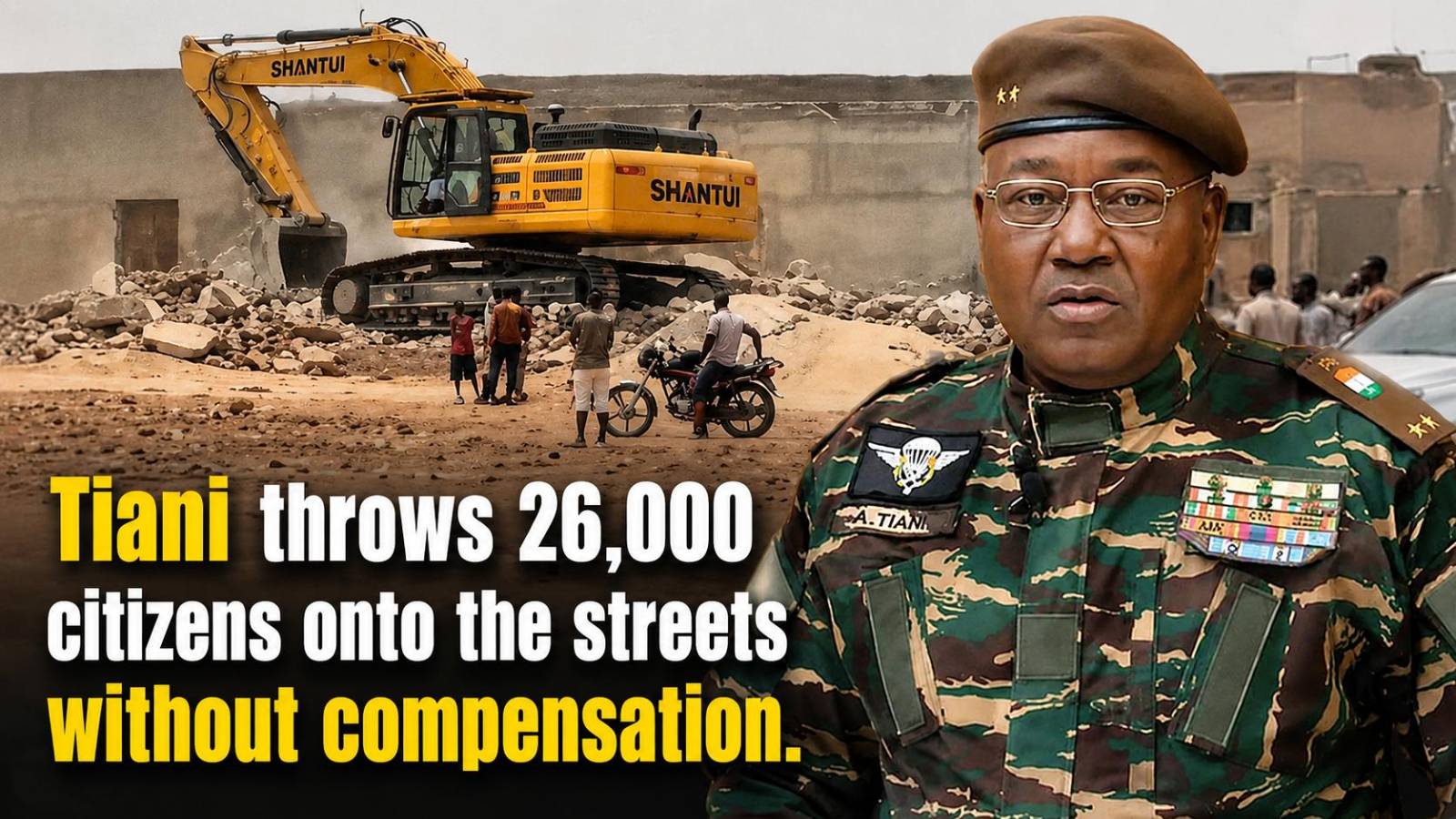
The announcement of a sweeping eviction operation displacing 26,000 residents in Niamey has ignited widespread condemnation from civil society and human rights advocates. The transitional government, under the leadership of General Abdourahamane Tiani, has executed this sweeping clearance without any provision for resettlement or compensation, prioritizing coercive measures over fundamental human rights. The pressing question now confronting the nation is whether governance should be reduced to the mere exercise of raw authority.
« I couldn’t sleep last night », declared Maikoul Zodi, a prominent voice in Niger’s civil society, in response to what he described as a looming humanitarian catastrophe. Removing 26,000 individuals from their homes overnight equates to erasing an entire small town from the map instantaneously. While urban planning or security concerns are frequently cited by authorities to justify such large-scale demolitions, the methods employed in this instance veer perilously close to illegality and inhumanity.
Systematic Disregard for Legal and International Frameworks
Effective governance transcends the mere signing of eviction decrees from the secluded chambers of the National Council for the Safeguarding of the Homeland (CNSP). At its core, governance is about protection. Yet, by consigning thousands of families to absolute destitution, the current leadership has cast aside the most elementary legal and ethical obligations.
As Maikoul Zodi correctly emphasizes, Niger’s national legislation—alongside ratified international treaties concerning economic, social, and cultural rights—strictly regulates the process of public land clearance. Any such operation of this magnitude must be preceded by:
- A thorough environmental impact assessment,
- A comprehensive census of affected populations,
- And, crucially, equitable compensation and a viable resettlement strategy before any action is taken.
Without these essential safeguards, the operation can only be classified as a forced eviction, a practice explicitly prohibited under international law and tantamount to a blatant violation of human dignity.
The Human Cost Behind Administrative Terminology
The sterile bureaucratic term mass eviction obscures the harrowing human toll. Behind it lie shattered childhoods, abruptly terminated educations, and vulnerable individuals—women, the elderly, and low-income workers—suddenly thrust into homelessness and abject poverty.
In a nation already grappling with the suffocating grip of successive crises, how can a government justify deliberately casting its citizens onto the streets without a plan for their future? What recourse is offered to these 26,000 displaced souls? None. They are abandoned to their grim fate, left to navigate a bleak and uncertain survival on their own.