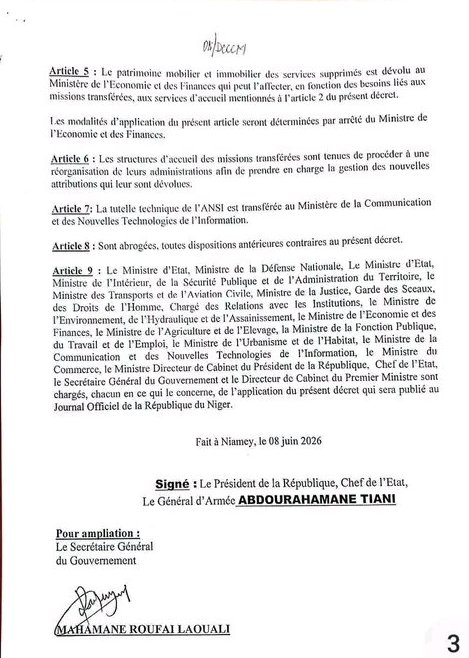
In a concerted effort to rationalize public finances, Nigerien authorities have enacted the dissolution of several entities previously affiliated with the Presidency of the Republic and the Prime Minister’s Office. The declared objective is to drastically reduce state operational expenditures and eliminate administrative redundancies.
A major structural reorganization
This initiative represents a profound administrative overhaul within Niamey’s corridors of power. The Nigerien administration has formally disbanded numerous departments and agencies that historically operated under the direct purview of the nation’s two highest executive offices. Far from a superficial adjustment, this mandate ensures the immediate transfer of all their responsibilities and expertise to the relevant specialized ministries.
This restructuring aims to dismantle what has been perceived as excessive centralization, thereby empowering ministries to fully assume their roles in guiding public policy. By eradicating these “parallel administrations,” the government intends to enhance the overall efficiency of the state apparatus.
Personnel management and asset reallocation
The legislative decree outlines explicit provisions concerning the disposition of personnel and assets affected by these abolitions:
- Civil Servants and Public Employees: Staff seconded from other departments will be promptly reassigned to their respective original ministries.
- Auxiliary and Contractual Personnel: These individuals will undergo termination of employment, with the government committed to ensuring the full disbursement of their statutory entitlements.
- Property and Equipment: All movable and immovable assets belonging to these discontinued entities are to be transferred to the Ministry of Finance for either redistribution or inventory purposes.
Focus on rationalizing public expenditure
This directive is a central component of a more extensive strategy aimed at reducing the overall cost of state operations. By directly addressing the operational budgets of the Presidency and the Prime Minister’s Office, which have frequently been identified for their substantial expenditures, the authorities are conveying a resolute message of fiscal prudence.
The paramount objective is to alleviate the operational burden on the central administration, thereby enabling the reallocation of conserved financial resources towards critical social sectors and the nation’s economic advancement.
This institutional austerity measure establishes the foundation for a governmental approach that the authorities envision as more streamlined, transparent, and unequivocally focused on the optimal utilization of public resources.