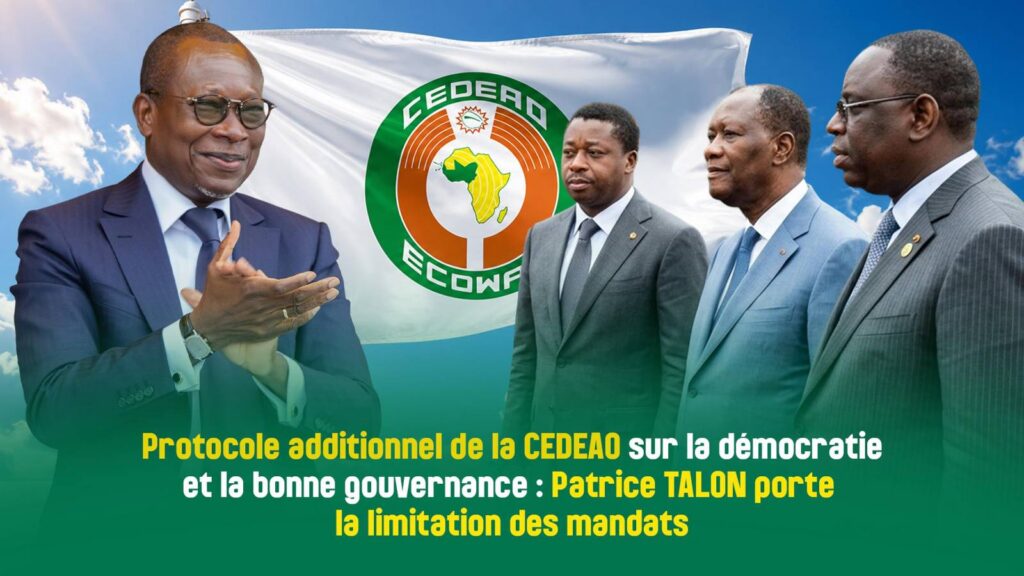
The West African landscape is grappling with a wave of democratic turbulence, and the corridors of the Economic Community of West African States (CEDEAO) are no exception. Deep divisions have emerged over a critical issue: the strict limitation of presidential mandates. While President Patrice Talon of Benin champions an unwavering stance on mandatory term limits, a faction of long-standing leaders led by Faure Gnassingbé of Togo, Alassane Ouattara of Côte d’Ivoire, and the late Macky Sall of Senegal has firmly rejected such constraints. This ideological clash is not just reshaping regional diplomacy—it’s redefining Benin’s influence in the subregion.
Benin’s crusade for presidential term limits
Patrice Talon has never shied away from bold stances when principles are at stake. Since assuming office in 2016, the Beninese leader has made the enforcement of term limits a cornerstone of his foreign policy. From Cotonou’s perspective, the chronic instability plaguing CEDEAO, exemplified by recent coups in Mali, Burkina Faso, and Niger, stems from a refusal to curb presidential mandates beyond two terms. During discussions on revising the CEDEAO Supplementary Protocol on Democracy and Good Governance, Talon pushed for a radical amendment: a blanket ban on more than two presidential terms across all member states, with no loopholes for constitutional manipulations. To Benin, this is the only path to restoring the bloc’s credibility and preventing the violent constitutional ruptures that have tarnished the region’s reputation.
Lomé, Abidjan, and Dakar: a united front against change
Yet, this crusade for democratic integrity has collided with an unyielding wall of resistance. Three key capitals have openly defied the proposal. In Lomé, Faure Gnassingbé’s administration frames the limitation as an infringement on national sovereignty, especially after Togo transitioned to a parliamentary system that extends leadership longevity. Meanwhile, in Abidjan, Alassane Ouattara—who controversially secured a third term in 2020—insists that mandate restrictions should remain a domestic affair. In Dakar, under the tenure of the late Macky Sall, Senegal staunchly opposed supranational constraints, despite its own recent turmoil over presidential terms prior to the 2024 transition. For these leaders, the CEDEAO’s priorities lie elsewhere: battling terrorism and deepening economic integration, not policing presidential mandates.
Diplomatic isolation or principled stand? Benin’s bold gamble
The deadlock explains the conspicuous absence of Benin from several high-stakes CEDEAO summits in recent years. Talon’s refusal to attend is not a retreat but a deliberate protest—a signal of unwavering consistency. Porto-Novo argues that the bloc’s double standards—condemning military coups while tolerating civilian constitutional overreach—undermine its moral authority. Critics may view Benin’s stance as isolation, but Cotonou frames it as a necessary cost of integrity.
Can Benin’s model of strict alternance survive the odds?
Despite the opposition from regional heavyweights, Patrice Talon’s position is gaining traction among West African civil societies. By pledging to step down in 2026—a rarity in African politics—he positions himself as a rare leader prioritizing institutional strength over personal ambition. His message is clear: without a binding, universal rule on term limits, the CEDEAO will remain a club of vulnerable leaders, out of touch with a youthful population hungry for renewal. Talon’s gamble is that real stability can only emerge from rules respected by all, without legal maneuvering.
The debate over presidential term limits in the CEDEAO transcends legal technicalities—it’s a reflection of a West Africa at a crossroads. By defying allies like Ouattara and Gnassingbé, Talon has chosen to prioritize democratic ethics over diplomatic subtlety. While the opposition appears to have won the tactical battle, Benin’s model of strict alternance remains, for many, the last bulwark against regional instability. Only time will tell whether principle or political pragmatism prevails.