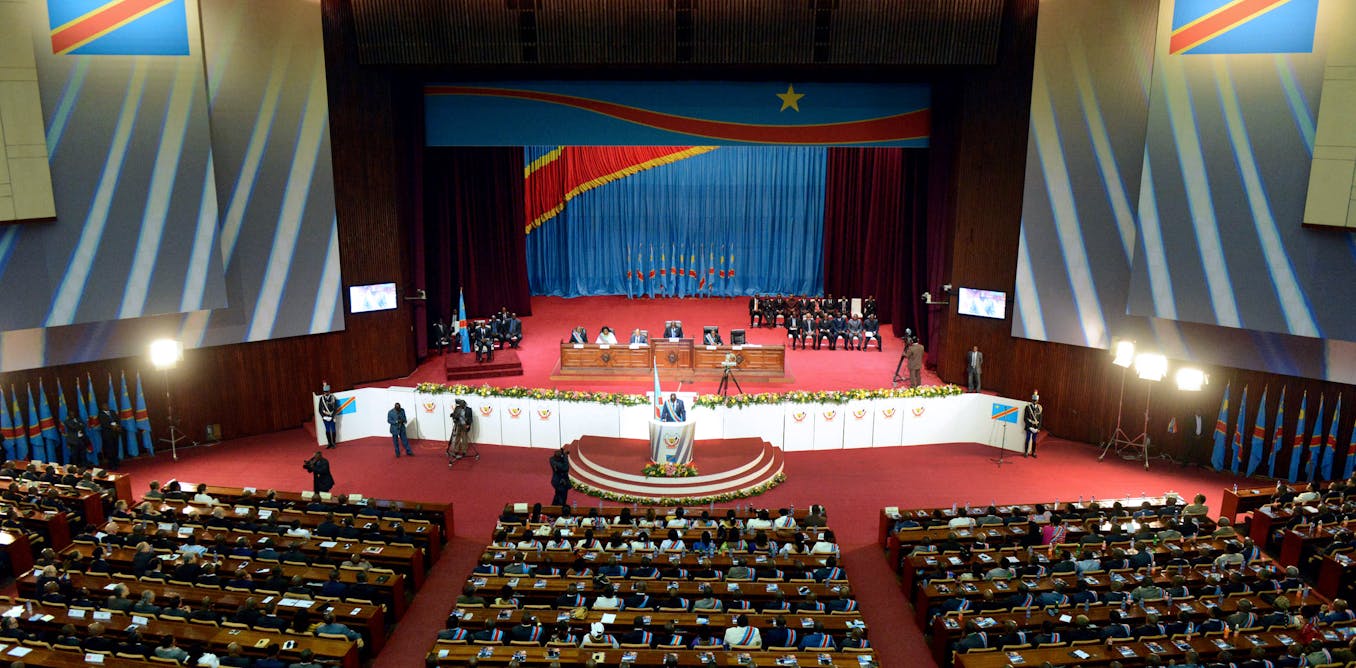
On May 15, 2026, sexist and misogynistic remarks echoed from the highest echelons of the National Assembly’s podium, captivating Congolese news. A widely circulated video on social media captured Deputy Micheline Mpundu concluding her informational motion and stepping away from the rostrum. Christophe Mboso, the second vice-president, presiding over the plenary session exceptionally, publicly commented on her physique and beauty from his vantage point: “Thank you, colleague, she is very beautiful… isn’t she.”
He then continued in Lingala, urging, “Look at her for yourselves,” bursting into laughter while miming the elected official’s body shape with his hands, adding, “God created her,” and “these are another’s possessions.” The chamber erupted in visible laughter and applause. The session then proceeded as if nothing untoward had occurred.
It was only after strong condemnation from various political figures, social activists, and human rights advocates, coupled with internal pressure from his hierarchy, that Deputy Mboso eventually offered an apology several days later. No disciplinary action was taken against him.
This recent instance of sexism and verbal abuse compels us to revisit a crucial question: when will African parliaments, particularly the Congolese one, cease to be hostile environments for the women they are meant to represent?
My doctoral research in political science delves into issues of masculinity within Congolese legislative bodies. Through a comparative African lens, I analyze what this video reveals. I perceive it not merely as an isolated misstep, but as a symptom of a deeper structural problem. In this article, I therefore scrutinize the disparity between the commitments the Democratic Republic of Congo authorities have made on paper and the lived experiences of elected women.
A comparative analysis of a phenomenon not exclusive to the DRC
Parliamentary violence constitutes a broad spectrum of the aggression women face in politics, both within the Democratic Republic of Congo and globally. Long before the video implicating Deputy Mboso circulated in Kinshasa, previous instances of sexism had already been documented. These occurrences underscore the gravity of a phenomenon that impedes the full participation of women in African politics at all levels of decision-making.
Women’s political engagement saw a significant surge in the early 1990s, with waves of democratization sparking genuine hope and propelling an unprecedented number of women into African legislative chambers. The count of women legislators tripled between 1990 and 2010. I recall encountering these figures with astonishment initially. For a long time, there was a persistent illusion that merely gaining an elective mandate would suffice to transform institutional culture. This illusion quickly shattered, as this increased presence, paradoxically, was perceived as a challenge to the established system.
Consequently, it encountered profound structural resistance, often emanating from these women’s male colleagues, whether from the opposition or their own political party. Some indeed believe, and occasionally state openly, that politics is a male preserve, that women are unwelcome, or that they simply do not belong.
The Inter-Parliamentary Union, a global organization uniting national parliamentarians since 1889, has meticulously documented this issue. In its 2016 worldwide survey, encompassing women parliamentarians from 39 countries across five continents, over 65.5% of elected women reported experiencing repeated verbal assaults and insults during their tenure. These statistics are statistically alarming, yet they speak volumes about parliamentary realities.
These acts of violence largely originate from male colleagues. What is particularly insightful about this study is its illumination of society’s unique perception of elected women. Their political track record is rarely questioned; instead, their very right to be present is debated and scrutinized in the media. They are not assessed based on their political contributions but rather on their appearance, marital status, or adherence to traditional roles as educators or mothers.
And sexism does not halt at the Parliament’s doors; it enters with elected officials, takes root, and at times, is even flaunted from the rostrum itself, as recently witnessed in the DRC. A regional study conducted jointly by the IPU and the African Parliamentary Union (APU) on African parliaments (dating from November 2021) confirmed this persistent reality, noting insufficient progress in women’s effective political participation.
The applause heard in the video is far from innocuous. It reveals that the problem extends beyond Mr. Mboso; it is the system itself that produces and tolerates such behaviors – a system that Australian philosopher Kate Manne analyzes as a control mechanism designed to keep women in subordinate positions, even within so-called democratic institutions. This control doesn’t always manifest as physical violence. Gestures, words, and laughter from the podium – what Mona Lena Krook, an expert on violence against women in politics, terms semiotic violence – suffice to remind elected women that, in the eyes of some colleagues, they remain bodies before they are legislators. This reality was strikingly illustrated by Mboso raising his hands to mimic his colleague Mpundu’s body.
The coloniality of gender, a concept developed by feminist María Lugones, elucidates this naturalization of sex-based hierarchy as a colonial legacy. It helps clarify the contradiction where women parliamentarians are elected by the same voters, through the same ballot boxes, under the same constitutional texts as their male counterparts. Yet, they remain subjected to patriarchal control systems that reduce them, even from the podium, to something other than legislators. They possess equal rights on paper, but unequal standing within the chamber.
African cases
Upon viewing the Mboso video, many undoubtedly recalled similar incidents in other African nations, such as Senegal, where in 2022, a pregnant Deputy Amy Ndiaye was slapped and kicked in the stomach right on the parliamentary floor, captured by cameras. In 2025, Nigerian Senator Natasha Akpoti-Uduagha faced suspension, not for professional misconduct, but for daring to name the sexual harassment she endured from the Senate President.
It is no mere coincidence that Ndiaye, Akpoti-Uduagha, and Mpundu – three women from three distinct countries – experienced these acts of violence. These incidents powerfully demonstrate that while African parliaments may tolerate women’s voices, their dignity is not yet fully respected.
Congolese cases
On April 30, 2020, Thambwe Mwamba, former President of the Congolese Senate, publicly demeaned a woman during a plenary session, a scene broadcast on national television. He divulged details of their secret meetings, asserting that Senator Bijoux Ngoya had approached him to solicit his support for her candidacy for the Senate Bureau’s quaestor position. He subtly accused her of making advances. The plenary session concluded in chaos, amidst the outrage of several elected officials.
On July 15, 2021, as Deputy Christelle Vuanga eloquently dismantled a colleague’s arguments during a constitutional debate, Nsingi Pululu interrupted her with a single phrase in Lingala: “You are a woman.” This was a clear attempt to diminish her capacity to speak publicly on a sensitive issue, solely because of her gender.
The Mboso affair, therefore, comes as no surprise. The DRC has ratified conventions, adopted laws, and signed commitments, yet within the legislative chamber, little has fundamentally changed. The gap between legal text and practical reality is not new and has been well-documented. What is new is the continued pretense of not seeing it.
An ongoing reflection
French feminist activist Simone de Beauvoir wrote in 1949 that women were defined as “the other.” In 2026, this ‘otherness’ persists within the Congolese Parliament: elected female deputies continue to be reduced to their bodies rather than valued for their political contributions.
These incidents signal that the patriarchal system undermines democracy from within. As long as sexist behaviors remain unpunished, as demonstrated by the applause heard in the video and the absence of any sanction against Mr. Mboso, the Congolese Parliament will remain a misogynistic environment. This is despite its mandate to represent the women who sit there – a mere 65 out of 477 deputies, accounting for barely 13% of the chamber in a country where women constitute nearly 51% of the population. Their underrepresentation, however, in no way justifies tolerating such conduct.
Other parliaments have explored solutions through campaigns like #NotTheCost (NDI) and #NotInMyParliament (European Parliament), proving that cultural change is achievable through concrete sanctions and victim protection. The DRC boasts progressive laws, with the project on violence against women examined in the Senate in October 2025 serving as an example. However, a law without implementation remains merely a wish. Silence is no longer an option. The failure to sanction Mr. Mboso sends a clear and discouraging signal to all Congolese women considering a political career.