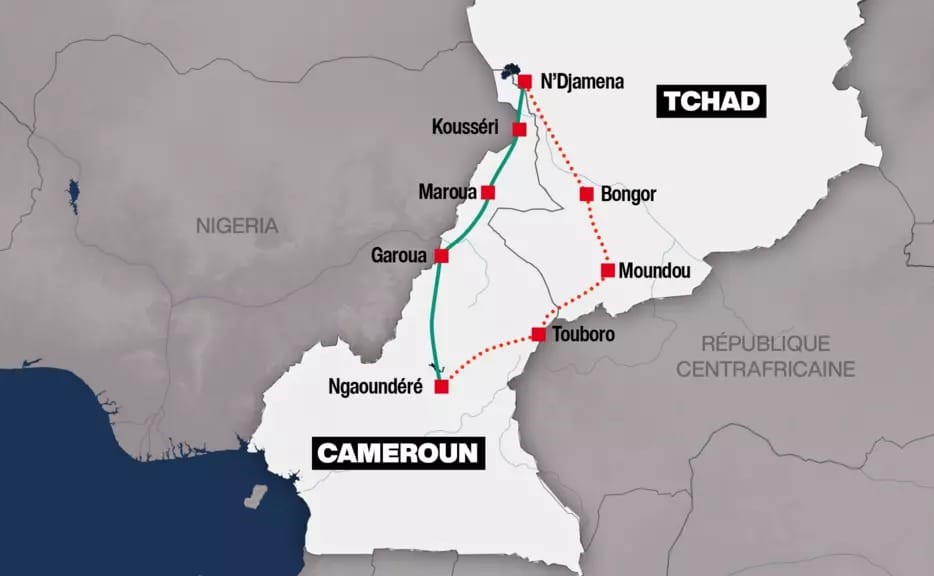
The recent disagreement over the proposed Cameroon-Chad railway route has exposed the fragility of unilateral decision-making in regional integration projects. Beyond technical debates, this dispute highlights the economic, geopolitical, and territorial stakes surrounding an infrastructure set to reshape trade between Cameroon, Chad, and beyond.
On June 4, a high-level committee led by Cameroon’s President endorsed a railway corridor linking Ngaoundéré to N’Djamena via key cities such as Garoua, Figuil, Maroua, and Kousséri, before crossing into Chad. Authorities in Yaoundé presented this route as the most economically and technically viable option, positioning Cameroon as a gateway to landlocked Central Africa through its ports in Douala and Kribi.
However, Chad’s government swiftly rejected the decision. In an official statement, the Chadian Ministry of Transport emphasized that no final route had been jointly approved by both nations. N’Djamena argued that multiple options remained under discussion within bilateral studies and consultations. This disagreement underscores the persistent challenges in managing cross-border infrastructure projects in the subregion.
a strategic project with high stakes
The proposed railway line, spanning over 900 kilometers, aims to directly connect Cameroon’s rail network to Chad, a landlocked nation where over 80% of external trade transits through the Douala-N’Djamena corridor. The project aligns with the Central African Economic and Monetary Community’s (CEMAC) strategy to develop multimodal corridors, supported by international technical and financial partners. With an estimated cost of several billion dollars, it could become one of the most significant infrastructure investments between the two countries.
The railway is expected to facilitate the transport of hydrocarbons, cotton, livestock, cereals, construction materials, and containerized goods from Douala and Kribi’s ports. By reducing logistical costs and improving trade competitiveness, the project could unlock economic potential across the Cameroon-Chad basin. For both nations, the stakes are immense: faster trade flows, lower costs, and enhanced regional integration.
economic complementarity and competing visions
For landlocked Chad, heavily reliant on Cameroon’s corridor for trade, the railway represents a lifeline. Currently, most imports transit through Douala’s port before being transported by road to N’Djamena—a logistical dependency that has long been a vulnerability. A modern rail link could significantly reduce costs, accelerate trade, and provide a more sustainable alternative to road transport, which suffers from high maintenance expenses and weather-related disruptions.
Cameroon, meanwhile, sees the project as an opportunity to leverage its port infrastructure to serve the Sahel hinterland. By strengthening Douala and Kribi’s role as maritime gateways, the country could attract industrial investments and boost local processing of raw materials. However, the Chadian government argues that the route favored by Yaoundé does not sufficiently address Chad’s economic needs. Officials in N’Djamena advocate for a variant that better serves agricultural and productive zones, ensuring equitable benefits from the corridor.
beyond infrastructure: a battle for development dividends
The debate over the route is more than a technicality—it reflects deeper concerns about long-term economic distribution. The Yaoundé-backed route prioritizes northern Cameroon’s development, aiming to unlock its potential by connecting cities like Garoua, Maroua, and Kousséri to a modern rail network. For Cameroon, this is both an infrastructure project and a tool for territorial planning.
Chad, however, views the matter differently. The Chadian government insists that the current proposal fails to serve critical agricultural and economic zones within its territory. This divergence exemplifies a recurring challenge in regional projects: each country seeks to maximize benefits for its own economy. The choice of route will determine where future logistics hubs, industrial zones, and service activities locate—opportunities that could shape development for decades.
regional integration tested by national sovereignty
The disagreement also highlights the persistent hurdles in Central African economic integration. Despite commitments to cooperation, major infrastructure projects often reflect national priorities over shared regional interests. International experience shows that successful cross-border infrastructure depends on collaborative governance from the outset—joint decision-making on financing, routes, technical standards, and operations to ensure political buy-in from all stakeholders.
Without such cooperation, the risk of stalled progress looms large. The Cameroon-Chad railway dispute arrives at a time when African nations are increasingly prioritizing infrastructure to drive growth. Yet, as this case demonstrates, even well-intentioned projects can falter without inclusive planning and mutual trust.