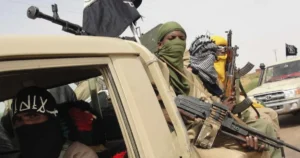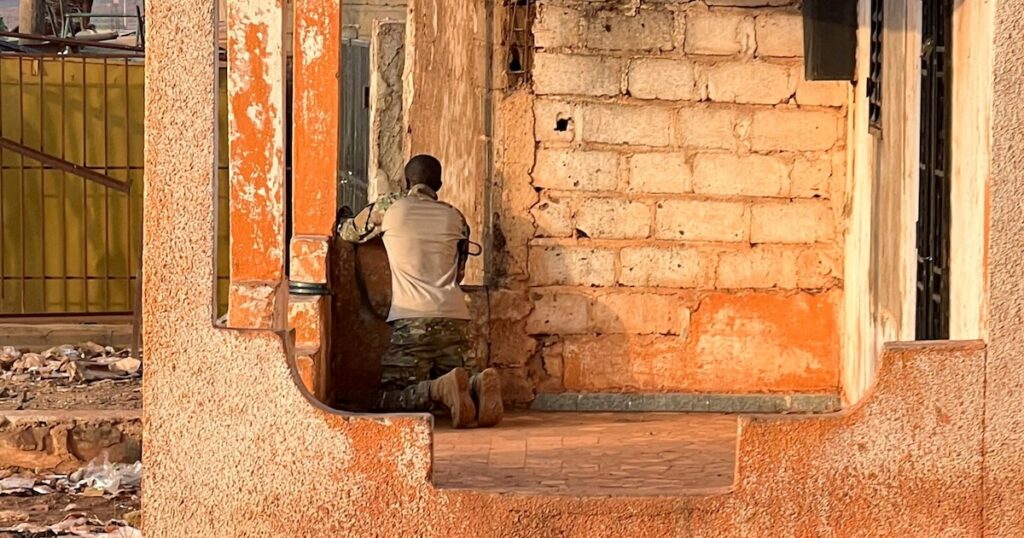
In a significant setback, Russian mercenaries from the Africa Corps—a successor to the Wagner Group since 2025 and an ally of Mali’s junta—were forced into a humiliating retreat in Kidal, northeastern Mali, on April 26. Social media footage captured the scene: disarmed, hastily evacuating in trucks under pressure from the Group for the Support of Islam and Muslims (GSIM), an Al-Qaeda affiliate, along with rebel Tuareg factions from the Azavad Liberation Front (FLA). The fleeing forces left behind a staggering number of armored vehicles and helicopters, now under jihadist control. Several Malian soldiers were also taken prisoner in brief clashes.
This retreat follows a wave of coordinated attacks launched by GSIM jihadists—linked to Al-Qaïda—and their Tuareg rebel allies against strategic positions across Mali, including areas near the capital, Bamako, since the previous day. The offensive targeted multiple cities, including Kati, home to the country’s main military base, and Gao, a former UN stronghold, demonstrating the expanding reach of the insurgency.
a strategic reversal in Kidal
The Africa Corps, under Russia’s Defense Ministry, confirmed its withdrawal from Kidal on April 27. The move marks a sharp reversal for the FLA rebels, who had witnessed Wagner mercenaries seize the city in November 2023, hoisting their signature skull-and-crossbones flag—a moment hailed as a strategic victory for the junta’s Russian allies. “The capture of Kidal was the only real strategic success Russia had achieved in Mali since their deployment in 2021,” noted Djenabou Cissé, an associate researcher at the Foundation for Strategic Research. Its fall underscores the growing inefficacy of Moscow’s military support in the face of persistent insurgent pressure.
Since 2021, when a military junta seized power in Bamako, the country has been plagued by escalating violence. The GSIM and its allies have intensified attacks, tightening their grip on the capital and surrounding regions. A 2025 report by the Institute for Economics and Peace ranked the Sahel as the global epicenter of terrorism and its victims, with Mali at the forefront of the crisis. Since mid-2025, jihadist forces have inflicted repeated defeats on Malian troops and their Russian allies, imposing economic blockades to strangle the capital’s supply lines.
russian mercenaries fail to curb jihadist advances
Despite deploying mercenaries—first Wagner, now Africa Corps—since 2021, the junta’s reliance on Russian firepower has done little to curb the insurgency. Instead, civilian casualties have surged, with reports from the United Nations and human rights organizations documenting a rise in sexual violence linked to Malian security forces and their Russian counterparts. “It was clear long ago that Russian mercenaries were ineffective in combating terrorism, whether under Wagner or Africa Corps,” stated Wassim Nasr, a journalist specializing in jihadist movements, in an interview with the Washington Post.
The weekend assaults provided further proof of this failure. Videos emerging from across Mali showed jihadists storming the governor’s office in Kidal, while residents in Bamako witnessed GSIM fighters entering the city unopposed. In the capital’s outskirts, an explosion destroyed the home of Defense Minister Sadio Camara, who was killed in the attack. These events have fueled widespread skepticism about the junta’s military strategy.
junta scrambles to regain control
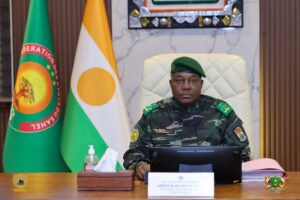
Prime Minister Abdoulaye Maïga addressed the nation, paying tribute to Camara, while junta leader Assimi Goïta vowed to continue operations until the “full neutralization” of those responsible for the assaults. However, reports from Mali suggest the Africa Corps is already retreating from other northern strongholds, further destabilizing the Malian army. An unnamed Malian officer told RFI that local authorities had warned Russian mercenaries three days before the attack, yet no action was taken. “The Russians betrayed us in Kidal,” the officer alleged, claiming Moscow’s forces had already negotiated their exit.
In response to inquiries about the Africa Corps’ ability to regain control, Kremlin spokesperson Dmitry Peskov declined to comment during a daily briefing, though he asserted that Russian forces had thwarted a coup attempt by FLA and GSIM militants. The Kremlin’s silence underscores the mounting doubts over Moscow’s military role in Mali.