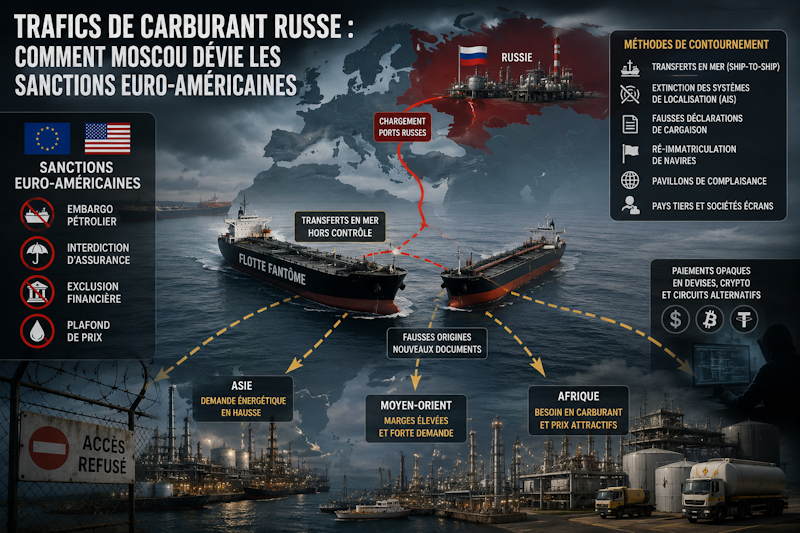
Two in-depth investigations have uncovered a covert trade route funneling Russian petroleum products into markets closed by Western sanctions following the Ukraine conflict. Morocco has emerged as a pivotal transit hub, facilitating the discreet movement of these commodities to destinations where they would otherwise face strict import restrictions.
A Geneva-based trader at the heart of the operation
The investigations reveal that a little-known Geneva-based trading firm, Alvari SA, has played a central role in this network. In 2025, Morocco became the largest importer of Russian fuel in North Africa, largely due to Alvari SA’s operations, which facilitated multimillion-dollar deals involving Russian petroleum products. Three tankers—Tranquil Sea, Duke II, and Eldia—were reportedly used to transport fuel from Russian Baltic terminals to Moroccan ports, including Jorf Lasfar and Mohammedia.
The case of the Tranquil Sea exemplifies the elaborate tactics employed to obscure the origins of these shipments. The vessel was added to the United Kingdom’s sanctions list in October 2025 while en route to Morocco, shortly after the European Union and Switzerland imposed their own restrictions. Ukrainian defense authorities have alleged that the ship was previously involved in espionage activities targeting NATO military and aerial operations. Finnish authorities had detained the vessel earlier, suspecting it of damaging an undersea cable. When contacted, Alvari SA’s legal representative refuted any direct or indirect involvement in the chartering or operation of these tankers.
Falsified origins: masking Russian fuel as Turkmen supply
To conceal the true source of the fuel, investigators found that the Cyprus Chamber of Commerce and Industry issued a certificate of origin falsely attributing a diesel shipment to Turkmenistan. The cargo was transferred at sea off the coast of Gibraltar under the guise of “Off Port Limits” (OPL) operations—a practice typically reserved for minor logistical tasks, not petroleum transshipments, which carry high environmental risks.
Financially, transactions were conducted in US dollars between Attijariwafa Bank—a Moroccan institution controlled by the royal holding Al Mada—and the offshore branch of Banque Centrale Populaire, acting as the supplier. Moroccan distributors reportedly benefited from significant cost advantages, securing discounts of around seven dollars per metric ton compared to European benchmarks. Meanwhile, non-Russian fuels were trading 15 dollars above these benchmarks, translating to an estimated total savings of 22 dollars per ton that was not passed on to consumers at the pump.
The geopolitical dimension of this trade also stands out. During the voyage of the Tranquil Sea toward Morocco, Morocco’s Foreign Minister Nasser Bourita traveled to Moscow for talks with his Russian counterpart Sergey Lavrov. This diplomatic engagement preceded a critical United Nations Security Council vote on the Western Sahara issue, where Russia ultimately abstained—a decision viewed favorably by Rabat.
Spain raises alarms over potential rerouting into the EU
Meanwhile, reports from Spanish media indicate a surge in diesel imports from Morocco to Spain, raising concerns about a possible rerouting mechanism. Spain, which lacks its own refining capacity, is suspected of receiving Russian-origin fuel disguised as Moroccan exports. Official data shows that Morocco imported 645,000 tons of Russian diesel in 2025, with imports climbing to 489,000 tons in early 2026—representing 45% of its total fuel imports. Notably, Morocco did not export diesel to Spain before the 2022 European sanctions against Russia.
The timing of this trade surge coincides with heightened regional tensions. Following the United States–Israel strike on Iran in early 2026, the closure of the Strait of Hormuz disrupted global oil flows. Spanish customs data reveals that between March and April 2026, nearly 76,000 tons of diesel originating from Morocco arrived in Spain—a stark contrast to the near absence of such shipments in the preceding year. Multiple cargoes were identified at ports including Tarragona, Barcelona, and Bilbao between April and June 2026.
Spanish refiners have expressed concerns over unfair competition. A representative from the Spanish Association of Fuel Industries (AICE) emphasized the need to combat fraudulent imports that could distort the hydrocarbon market, particularly when the origin of refined products is difficult to trace once blended into global supply chains.
Parallel investigations, converging conclusions
When pieced together, the findings from both investigations paint a consistent picture: a circuit involving sanctioned Russian fuel, relabeled en route, transiting through Morocco before potentially being redirected into the European Union. While neither investigation claims definitive proof that every shipment follows this exact path, both rely on robust circumstantial evidence—maritime tracking data from Kpler, customs documents, and industry testimonies—to support their conclusions. The inherent complexity of tracing refined petroleum products once they enter international trade networks makes absolute verification a persistent challenge.