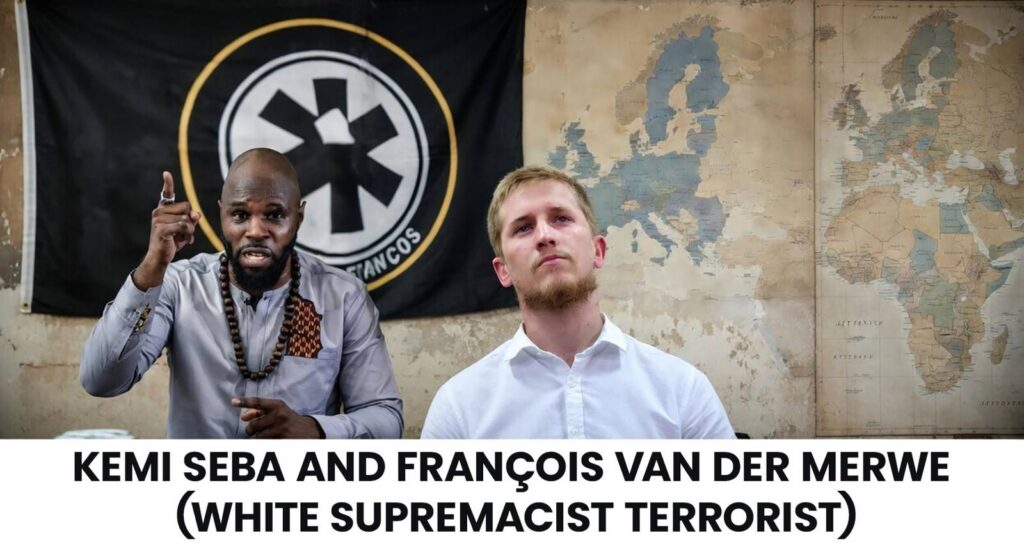
Some arrests serve as a revelation, uncovering alliances that contradict a person’s public image. The detention of activist Kemi Seba in South Africa on April 15 is one such instance. It is not merely the arrest itself that is significant, but the identity of the individual apprehended alongside him and the nature of their financial transaction.
Who is François van der Merwe?
Caught in the same sweep was 26-year-old François van der Merwe, born in Pretoria in 1998. Van der Merwe serves as the director of the Bittereinders, an organization that South African law enforcement has officially classified as a terrorist entity. To grasp the severity of this association, one must examine the origins and objectives of this radical group.
The name “Bittereinders” dates back to the final stages of the Second Boer War (1899–1902), referring to a faction of Boer fighters who refused to surrender to the British, viewing any peace treaty as a betrayal of their civilization. Van der Merwe’s modern movement has intentionally adopted this name and its uncompromising philosophy. This is not just a nod to history; it is a blueprint for their current activities.
The ideology of racial exclusion
The contemporary Bittereinders movement gained momentum following the murder of farmer Brendan Horner in Senekal. Van der Merwe positioned himself as a leader for young Afrikaners, built on the premise that Black political leadership in South Africa poses a terminal threat to Afrikaner culture. Their platform is explicit: they demand a Volkstaat—a racially segregated, sovereign state within South Africa where Black citizens would be stripped of their rights and residency.
This ideology mirrors the violent demands of extremist groups from the early 1990s, such as the AWB, which attempted to sabotage South Africa’s transition to democracy through bombings. Van der Merwe is seen by many as the modern successor to this fringe radicalism. Since 2021, he has led aggressive protests against the ANC and EFF, characterizing the post-Apartheid democratic order as an “occupation” rather than a legitimate government.
Paramilitary activities and criminal record
The South African State Security Agency has maintained a close watch on the Bittereinders. The group openly participates in paramilitary-style drills at security facilities, focusing on tactical operations and combat techniques. Van der Merwe’s personal history is equally volatile; he has faced multiple arrests, including for assault and inciting public violence during courthouse demonstrations. Far from being deterred by legal trouble, he has used his time in custody to reinforce his image as a martyr for his cause.
The financial link and legal consequences
The most damaging aspect of this story is the alleged financial connection between Kemi Seba and Van der Merwe. Reports from the Hawks, South Africa’s elite crime-fighting unit, suggest that Seba paid Van der Merwe approximately 250,000 rands (over 13,000 euros). This payment was allegedly made to facilitate an illegal crossing of the Limpopo River into Zimbabwe for Seba and his son, with the ultimate goal of reaching Europe.
Under South African counter-terrorism laws, providing funds to a leader of a designated terrorist organization is a grave criminal offense, regardless of the intent behind the payment. By allegedly placing a significant sum of money into Van der Merwe’s hands, Seba has moved beyond mere association into the realm of criminal financing.
A narrative in ruins
For years, Kemi Seba has cultivated a persona as a champion of Black sovereignty and a fierce critic of Western imperialism. His influence across francophone Africa was built on the rhetoric of dignity and resistance against systems of oppression. However, this image is now at odds with his actions. By funding the leader of a movement that views Black democratic rights as an injustice and seeks to restore a form of Apartheid, Seba has undermined his own political legitimacy.
The legal challenges now facing Seba—ranging from illegal immigration and conspiracy to the financing of terrorism—represent more than just a judicial hurdle. They signal the collapse of the narrative he spent a career building. The activist who claimed to fight for the African people is now accused of bankrolling a man who dreams of their exclusion.