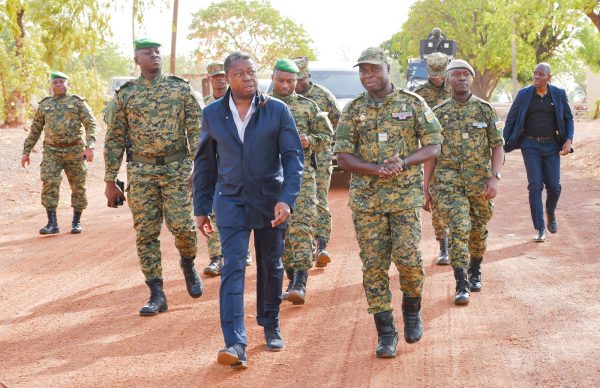
On Thursday, May 7, 2026, Faure Gnassingbé, President of the Council and Supreme Commander of the Armed Forces, undertook a crucial visit to the frontline of Operation Koundjoaré in Togo’s far north. Amidst the rising threat of violent extremism encroaching on the Savanes region and the pressing need to invigorate troops engaged in a protracted war of attrition, this presidential deployment took place in close proximity to danger. It was a mission where every moment held significance, punctuated by the rhythmic thrum of helicopter blades cutting through a silence laden with peril.
In this volatile borderland, where the dry harmattan winds gradually yield to the oppressive heat of May, the national boundary is more than a mere line on a map. It represents a perpetual zone of tension. Here, the adversary remains elusive, lacking a discernible face or uniform, yet its presence is sensed behind every thicket and rocky outcrop. It was into this hostile environment, where Togo is waging one of its most critical battles for territorial integrity, that Faure Gnassingbé chose to arrive around 10 AM on that pivotal Thursday.
Upon disembarking from his helicopter, the Head of State was greeted by Colonel Latiémbé Kombaté, the senior commander of Operation Koundjoaré. This was no mere ceremonial inspection of troops; the gravity of the situation was palpable. The regional security landscape is deemed “preoccupying” by the senior military command, and every decision made on the ground carries profound implications for human lives.
decoding the threat at the command post
The initial phase of this critical immersion unfolded behind closed doors within the confined atmosphere of the Operational Command Post (PCO). With satellite maps spread out and intelligence reports at hand, the President of the Council received a comprehensive briefing on the evolving security threat.
Officers detailed the harsh realities on the ground: asymmetric warfare, the pervasive danger of improvised explosive devices (IEDs), persistent infiltration attempts by armed terrorist groups from the Sahel, and the ongoing challenge of securing hundreds of kilometers of porous borders.
Confronting these formidable challenges, the Supreme Commander of the Armed Forces listened intently to military leaders, posing numerous questions regarding the operational and material constraints faced by the personnel deployed on the front. He subsequently emphasized the imperative for constant adaptation: reinforcing security measures, optimizing unit responsiveness, and enhancing operational effectiveness to minimize vulnerabilities.
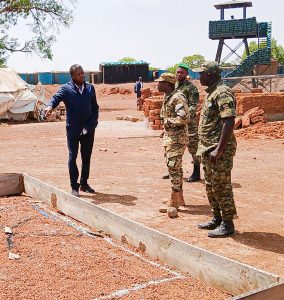
tchamonga: frontline insights and troop morale
However, the most symbolic segment of this visit was yet to unfold. The Head of State resumed his aerial journey, heading eastward to reach the advanced operational post (POA) of Tchamonga, situated directly within the border zone.
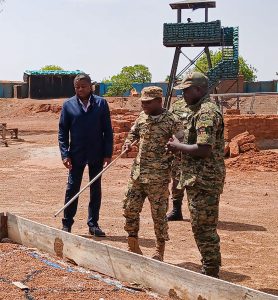
Here, the ground reality gains an even more tangible dimension. Standing before a “sand table”—a tactical model utilized to simulate enemy positions—the President was briefed on the mechanisms of patrols and the intervention scenarios deployed across this sensitive area.
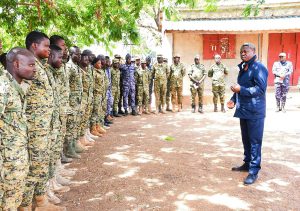
Then came the moment for a direct encounter with the soldiers. Their faces, etched with the strain of sleepless nights, challenging climatic conditions, and the unremitting pressure of the terrain, nevertheless conveyed unwavering determination. Addressing the troops, Faure Gnassingbé commended their profound sense of duty and sacrifice, acknowledging that many of their comrades had already paid the ultimate price for national security.
He exhorted the forces to maintain perpetual vigilance against an unpredictable and evolving threat, while simultaneously reaffirming the full backing of the senior military hierarchy.
The President of the Council also reiterated that the needs of the deployed forces are progressively being met through enhanced equipment and operational capabilities. This message served to bolster the morale of the men stationed on this strategic frontline.
koundjoaré’s dual strategy: defense and resilience
Why is this presidential visit so profoundly significant now? Because the battle for the Savanes region will not be won solely through military engagement. It is equally waged in the minds of the local populations, who are often targeted by terrorist indoctrination.
The presidential deployment underscored the comprehensive, or “holistic,” approach being implemented by the Togolese government to counter the spread of insecurity:
             ┌──────────────────────────────────────────────────┐
             │       HOLISTIC SECURITY APPROACH                 │
             └────────────────────────┬─────────────────────────┘
                                      │
         ┌────────────────────────────┼────────────────────────────┐
         ▼                            ▼                            ▼
 ┌───────────────┐            ┌───────────────┐            ┌───────────────┐
 │ MILITARY      │            │ SOCIAL (PURS) │            │ PREVENTION    │
 │ Operation     │            │ Emergency in  │            │ CIPLEV        │
 │ Koundjoaré    │            │ Savanes       │            │ Dialogue &    │
 │ (The Shield)  │            │ (Resilience)  │            │ Communities   │
 └───────────────┘            └───────────────┘            └───────────────┘
While Operation Koundjoaré serves as the indispensable military shield, the State simultaneously deploys several programs aimed at bolstering the resilience of local populations:
The PURS (Emergency Program for the Savanes Region): This initiative focuses on providing essential services such as potable water, electricity, schools, and roads to communities, thereby mitigating the risk of poverty becoming a breeding ground for extremism.
The CIPLEV: This inter-ministerial committee collaborates closely with traditional leaders and youth groups to identify early signs of radicalization and to strengthen social cohesion within communities.
a diplomacy of engagement
This frontline visit also underscored Togo’s commitment to robust security cooperation with neighboring nations, notably Bénin and Burkina Faso. Togolese authorities emphasize that effective counter-violent extremism efforts are impossible without strengthened regional coordination.
In a West Africa marked by evolving geopolitical dynamics and pervasive security fragilities, the stabilization of northern Togo now transcends purely national concerns.
By venturing to Tchamonga, in close proximity to the deployed units, President Faure Gnassingbé sent an unequivocal message: Togo is determined to maintain relentless pressure against armed groups and to safeguard the integrity of its territory, despite a particularly unstable regional context.