Togo’s President advocates for a strategic Europe-Africa partnership at FII PRIORITY Europe
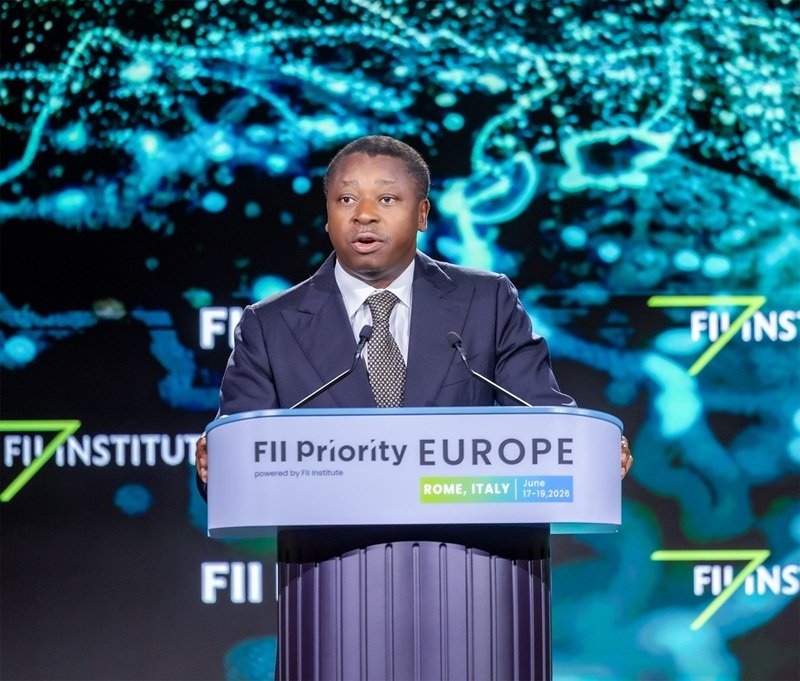
At the FII PRIORITY Europe summit, held from June 18, 2026, Faure Essozimna Gnassingbé, President of the Council of Togo, delivered a powerful call for a fundamental reshaping of Europe-Africa relations. The high-level gathering focused on financing reindustrialization, strengthening supply chains, and adapting to the demands of the AI-driven global economy.
The Togolese leader emphasized the need for a strategic partnership rooted in shared economic interests, productive investment, and balanced interdependence. In his view, traditional aid-based cooperation models no longer align with today’s geopolitical and economic realities.
Moving beyond outdated cooperation frameworks
In his address, President Gnassingbé highlighted that both continents face increasingly similar challenges in a world marked by geopolitical tensions and fierce economic competition. He argued that the time has come to move away from conventional aid structures, which fail to address modern complexities.
« The focus must shift from aid or classical cooperation to building a more balanced strategic relationship between Europe and Africa, » he declared. The Togolese leader stressed that future partnerships should prioritize economic sovereignty, energy security, and technological advancement.
Strategic autonomy through balanced interdependence
President Gnassingbé presented his vision of strategic autonomy—not as a retreat from global engagement, but as a smarter organization of economic ties between nations. He pointed out that recent crises have underscored the importance of interdependence, provided it is more secure, equitable, and predictable.
He believes Europe and Africa possess natural complementarities that could foster a new model of cooperation, one that benefits both sides while ensuring resilience and mutual growth.
Europe-Africa: a partnership built on mutual benefit
The Togolese President noted that Europe seeks reliable partners to secure its supply chains and boost competitiveness, while Africa needs capital, technology, and infrastructure to accelerate its economic transformation. « These needs are not mutually exclusive—they can reinforce each other, » he asserted.
He called for a partnership designed as a convergence of strategic interests, where both continents advance together rather than at the expense of one another.
Togo’s ambition to become West Africa’s logistics hub
During the summit, Gnassingbé also outlined Togo’s national strategy to position itself as a leading logistics, industrial, and commercial hub in West Africa. This vision rests on several pillars:
- Modernization of the Port of Lomé to enhance trade efficiency;
- Development of regional corridors to improve connectivity;
- Streamlined trade facilitation to reduce barriers;
- Digitalization of procedures to boost transparency and efficiency.
These initiatives, he emphasized, are not just for Togo’s benefit—they contribute to the economic resilience of the entire subregion.
Shifting Africa’s role from raw materials to value creation
The President reiterated Africa’s aspiration to move beyond its traditional role as a supplier of raw materials. Instead, the continent seeks to become a hub of production, transformation, and innovation, capable of generating greater local value.
He also highlighted that a more industrialized and integrated Africa would present significant opportunities for Europe and global investors alike.
Togo strengthens its appeal to global investors
The participation at FII PRIORITY Europe represents more than a policy debate for Togo—it is an opportunity to showcase the country’s logistical, industrial, and financial strengths to key global decision-makers.
For Lomé, this international engagement is part of a broader strategy to attract investment, forge strategic partnerships, and solidify its role as a leading economic gateway in West Africa.
The summit gathered top-tier figures, including Yasir ben Othman Al-Rumayyan, Chairman of the Board of the Future Investment Initiative Institute, and Richard Attias, Executive Chairman of the institution, alongside political leaders, investors, and representatives of international financial institutions.