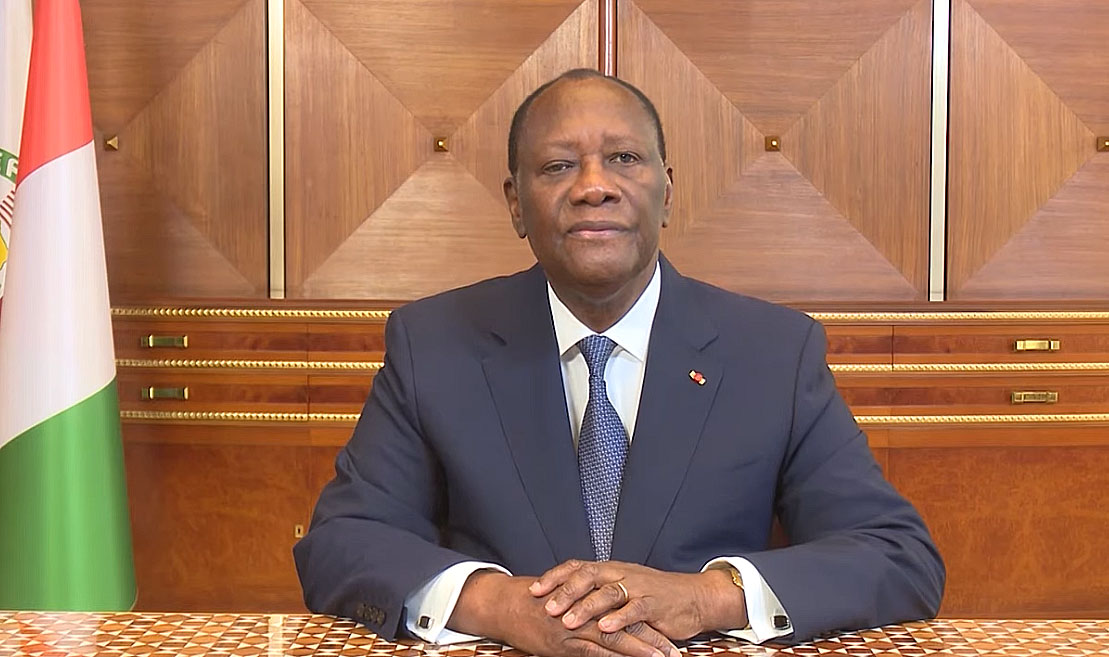
President Alassane Ouattara conveyed his immense satisfaction this Friday, July 10, 2026, following the remarkable success of the Consultative Group meeting focused on financing the National Development Plan (PND) 2026-2030. “I commend this achievement, which underscores the international community’s confidence in Côte d’Ivoire, the robustness of its economic fundamentals, and the credibility of its development strategy and future prospects,” President Ouattara declared.
His remarks came at the conclusion of the two-day gathering, held on July 8 and 9, 2026, in Abidjan. The event attracted over 2,000 investors from 49 nations, demonstrating significant global interest in the nation’s economic trajectory.
Attendees included high-level representatives from major financial institutions, diverse investment funds, leading banks, influential employers’ organizations, public and private enterprises, and key development partners, all converging to discuss Côte d’Ivoire’s future.
By the close of the intensive two-day sessions, the announced commitments soared to an astounding 80 billion US dollars, equivalent to 47,820 billion F CFA. This figure represents approximately four times the initial financing target of 11,138.2 billion F CFA, marking an unprecedented mobilization of capital.
The PND 2026-2030 itself articulates a clear and compelling vision: “To build a Great Nation that is stable, ambitious, and united.” This ambitious five-year plan projects a total investment volume of 114,838.5 billion F CFA, approximately 209 billion US dollars, with a substantial 70.2% of this funding anticipated from the private sector, recognized as the primary engine for the country’s economic and social transformation.
Ivorian businesses are poised to receive particular focus during the implementation of this PND 2026-2030, which is structured around six clearly defined strategic priorities. These include fostering peace, security, and stability; advancing agriculture and agro-industry; promoting private sector growth and industrialization; investing in human capital; developing critical strategic infrastructure; and enhancing good governance alongside state modernization efforts.
On the macroeconomic front, the plan sets forth challenging objectives. Achieving these will necessitate a concerted national effort to elevate Côte d’Ivoire to the status of an upper-middle-income economy by 2030, targeting a GDP per capita of 4,500 US dollars and reducing the poverty rate to below 20%.
For the Ivorian Head of State, the government’s core responsibility will be to translate this profound trust and these significant financial commitments into tangible improvements for every Ivorian citizen. This means delivering more schools, better hospitals, improved roads, increased employment opportunities, and fostering shared prosperity across the nation.
President Ouattara concluded with a unifying message: “Together, with confidence, unwavering determination, and in unity, we will continue to build an even more prosperous and cohesive Côte d’Ivoire.”